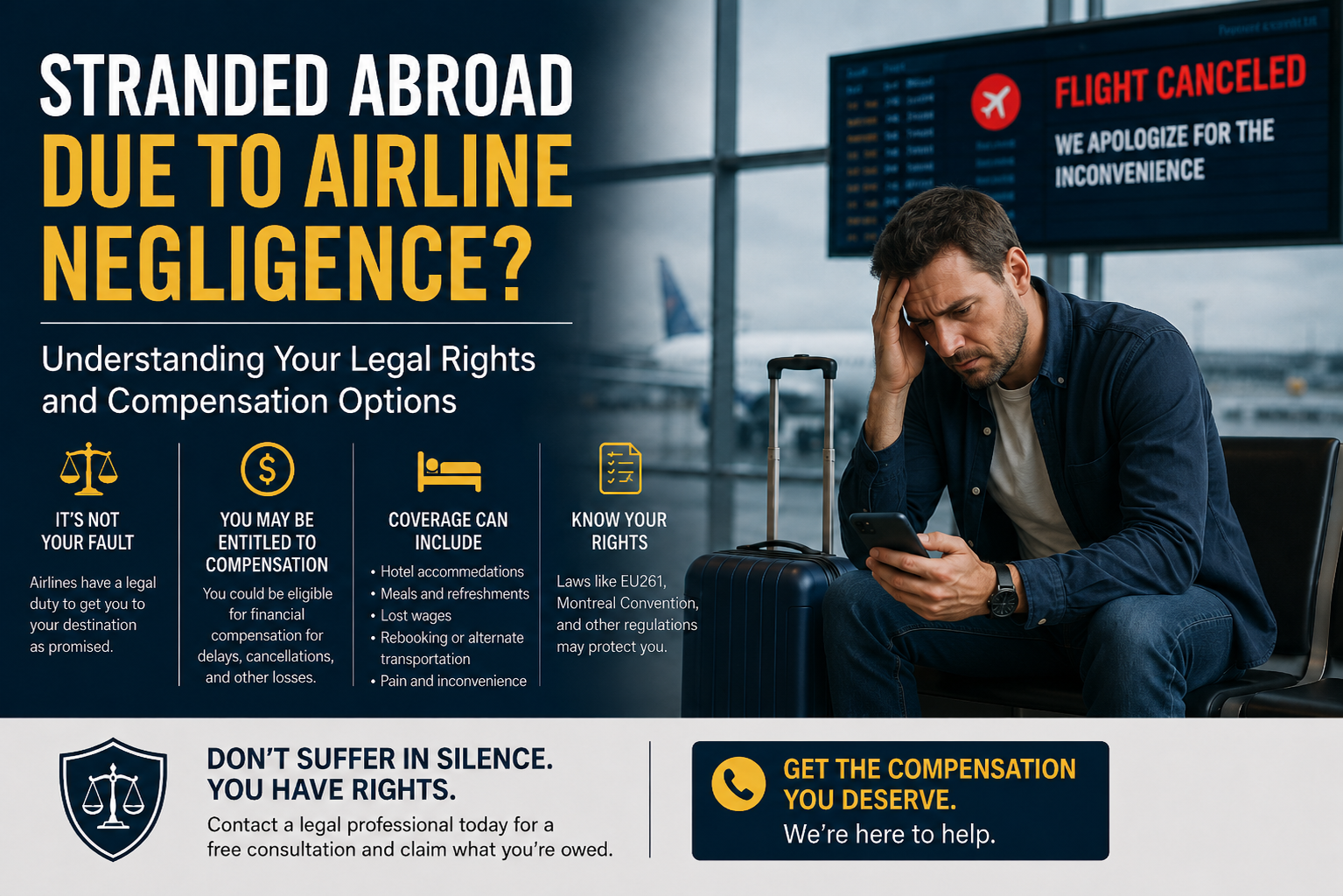
📖 Introduction: When a Dream Vacation Turns Into a Legal Battle
For many people, international travel is more than just boarding a flight—it is the culmination of months of planning, significant financial investment, and cherished dreams. Families save for years to enjoy a holiday abroad, students travel overseas to pursue education, professionals attend important business meetings, and couples plan memorable vacations. However, despite meticulous planning, everything can go wrong within a matter of hours if an airline fails to perform its responsibilities with due care.Imagine reaching an international airport only to discover that your connecting flight has been missed because your previous flight was delayed without adequate notice. Your checked baggage has not arrived. The airline staff are unable to provide clear information. You are forced to spend the night at the airport or pay for an expensive hotel from your own pocket. In some unfortunate situations, passengers may even be questioned by immigration authorities due to documentation or operational mistakes beyond their control. 😟
These situations are not merely travel inconveniences—they can cause substantial financial loss, emotional distress, and disruption of carefully planned itineraries.
This naturally raises an important legal question:
Can an airline be held legally responsible if its negligence leaves passengers stranded in a foreign country?
The answer is often yes, but the extent of liability depends upon the facts of the case, applicable domestic laws, international conventions, contractual obligations, and available evidence.
This comprehensive guide explores the legal rights of passengers, explains when airlines may be held accountable, discusses available compensation mechanisms, and provides practical guidance for individuals facing such unfortunate situations.
🌍 Understanding What It Means to Be “Stranded Abroad”
Being stranded abroad is not limited to being physically stuck at an airport.
In legal and practical terms, a passenger may be considered stranded whenever airline-related failures prevent them from completing their journey according to the confirmed itinerary and no reasonable alternative assistance is provided.
This may happen because of:
✈️ Significant flight delays
❌ Flight cancellations
🚫 Denied boarding despite confirmed reservations
🧳 Delayed or lost baggage
💻 Reservation system failures
🔄 Missed connecting flights
📄 Administrative errors in ticketing
⚠️ Failure to provide alternative arrangements
For many passengers, especially elderly individuals, children, or persons with medical conditions, being stranded in another country can become a genuine emergency rather than a mere inconvenience.
Language barriers, unfamiliar laws, unexpected expenses, and lack of local support often magnify the problem.
😔 The Real Impact of Airline Negligence
When discussing compensation claims, people often focus only on the price of airline tickets.
In reality, the consequences of airline negligence can extend far beyond the airfare itself.
💰 Financial Losses
Passengers may incur expenses including:
- Emergency hotel accommodation 🏨
- Meals and refreshments 🍽️
- Local transportation 🚖
- Replacement flight tickets ✈️
- Purchase of clothing 👕
- Medicines and medical treatment 💊
- Communication costs 📱
- Visa extension charges 📑
For families travelling together, these expenses can run into several lakhs of rupees within a short period.
😢 Emotional and Psychological Distress
Being stranded in a foreign country often creates:
- Anxiety
- Fear
- Public embarrassment
- Frustration
- Mental agony
- Emotional exhaustion
Parents travelling with young children or elderly family members may experience even greater stress.
Business travellers may lose important contracts, while tourists may lose once-in-a-lifetime experiences that cannot be recreated.
🏥 Health and Medical Risks
Travel disruptions may create medical emergencies.
For example:
- A diabetic passenger may lose access to insulin.
- A heart patient may be separated from essential medicines.
- Children may require urgent medical attention.
- Elderly passengers may suffer fatigue or dehydration.
If delayed baggage contains life-saving medication, the consequences can become extremely serious.
⚖️ What Is Airline Negligence?
Negligence simply means a failure to exercise reasonable care expected under particular circumstances.
Every airline owes certain obligations to its passengers after accepting payment and confirming reservations.
Negligence may arise when an airline:
❌ Fails to honour confirmed bookings.
❌ Mishandles passenger records.
❌ Loses baggage due to operational failures.
❌ Fails to communicate cancellations.
❌ Provides incorrect travel documentation.
❌ Ignores mandatory passenger assistance obligations.
❌ Leaves passengers without reasonable support after avoidable disruptions.
However, it is equally important to understand that not every delay automatically amounts to negligence.
For instance, delays caused by cyclones 🌪️, earthquakes 🌍, airport closures 🚧, security emergencies 🔒, or political unrest may not necessarily create liability if the airline acted reasonably under the circumstances.
Therefore, every dispute depends upon its own facts.
📜 The Contract Between You and the Airline
Many passengers think they only purchase a seat on an aircraft.
Legally speaking, however, purchasing a ticket creates a contractual relationship known as the Contract of Carriage.
This agreement imposes obligations on both parties.
✈️ Obligations of the Airline
Generally, the airline undertakes to:
- Transport passengers according to the booked itinerary.
- Exercise reasonable care in handling baggage.
- Provide accurate travel documentation.
- Follow safety regulations.
- Maintain operational standards.
- Offer assistance where legally required.
🙋 Obligations of the Passenger
Passengers must also:
- Carry valid passports and visas.
- Arrive before check-in deadlines.
- Follow baggage restrictions.
- Comply with immigration rules.
- Observe airline policies.
When either party breaches these obligations, legal consequences may arise depending upon applicable law.
🛫 Common Situations That Leave Passengers Stranded
⏳ 1. Long Flight Delays
A delay of several hours may appear manageable domestically but can become catastrophic during international travel.
Suppose a passenger flies from Delhi to Paris via Doha.
If the Delhi–Doha flight arrives six hours late, the connecting Paris flight may already have departed.
The passenger now faces:
- Missed connections
- Extra accommodation expenses
- Lost bookings
- Visa complications
- Rearranged itineraries
The financial consequences can be enormous.
❌ 2. Sudden Flight Cancellation
Airlines occasionally cancel flights because of operational or technical reasons.
If alternative arrangements are not promptly provided, passengers may need to purchase new tickets at much higher prices.
Holiday seasons often make replacement tickets extremely expensive.
A traveller who originally paid ₹45,000 for a round-trip ticket may suddenly spend over ₹1,50,000 simply to reach home.
🚫 3. Denied Boarding
Sometimes passengers possessing valid tickets and confirmed reservations are unexpectedly denied boarding.
Possible reasons include:
- Overbooking
- Documentation disputes
- Technical errors
- Operational issues
Whether compensation is payable depends upon the specific circumstances and applicable legal framework.
🧳 4. Lost or Delayed Baggage
Delayed baggage is among the most common aviation complaints worldwide.
While airlines often trace and deliver missing baggage later, passengers may suffer immediate hardship.
Imagine arriving in Europe during winter without winter clothing because your baggage is delayed.
Or discovering that prescription medicines necessary for daily survival are unavailable.
Emergency purchases become unavoidable.
Such expenses may become relevant in compensation proceedings.
💻 5. Reservation System Errors
Modern aviation depends heavily upon digital reservation systems.
A technical malfunction may result in:
- Booking disappearance
- Ticket cancellation
- Incorrect passenger status
- Duplicate reservations
Passengers often discover these issues only at the airport, creating panic and confusion.
🔄 6. Missed Connections Due to Airline Delay
International itineraries frequently involve multiple connecting flights.
Even a relatively short delay on the first segment may cause passengers to miss onward travel.
If replacement flights are unavailable until several days later, passengers may incur:
🏨 Hotel expenses
🍽️ Food costs
🚕 Local transportation expenses
📶 Communication charges
💼 Business losses
All of these may become relevant when assessing damages.
🇮🇳 Consumer Rights Under Indian Law
Indian passengers enjoy statutory protection under the Consumer Protection Act, 2019.
An airline that provides transportation services in exchange for payment may be liable for deficiency in service if it fails to meet legally expected standards.
Examples may include:
- Failure to honour confirmed reservations.
- Unreasonable operational failures.
- Mishandling baggage.
- Failure to provide promised assistance.
- Poor customer service during major disruptions.
If deficiency is established, the appropriate Consumer Commission may grant suitable relief based upon the facts of the case.
Possible remedies include:
💰 Refunds
💵 Compensation
🏨 Reimbursement of expenses
⚖️ Litigation costs
📑 Any other relief considered appropriate by the adjudicating authority.
Importantly, every claim depends upon evidence, documentation, and judicial appreciation of the facts rather than assumptions alone.
📚 Why Passengers Should Know Their Rights
Many travellers assume airlines have absolute authority and that nothing can be done if problems occur.
This misconception often prevents passengers from preserving evidence or asserting valid legal claims.
In reality, informed passengers are generally better positioned to negotiate settlements, seek reimbursements, or pursue legal remedies where justified.
Understanding your rights does not guarantee compensation in every case—but it significantly improves your ability to protect your interests when things go wrong.
International Aviation Law: What Happens When Your Flight Is International?
When a passenger travels within India, disputes are primarily governed by Indian laws and airline policies. However, international travel introduces another layer of legal protection through international conventions and treaties.
One of the most significant legal instruments governing international air travel is the Montreal Convention, 1999.
The Convention was adopted to create uniform rules regarding the liability of airlines operating international flights. Many countries, including India, recognize its framework for determining carrier liability in eligible cases.
The Convention deals with issues such as:
✈️ Passenger injury or death
🧳 Loss, delay, or damage to checked baggage
⏳ Flight delays
📦 Cargo-related claims
The purpose of these provisions is to ensure that passengers have a standardized legal framework instead of facing completely different rules in every country they travel to.
However, every claim under the Convention depends upon the specific facts, evidence available, and applicable legal limitations.
🧳 Delayed or Lost Baggage: More Than Just an Inconvenience
For many travellers, checked baggage contains far more than clothes.
It may include:
💊 Prescription medicines
💻 Business documents
👔 Professional attire
👶 Baby essentials
🎁 Gifts
📚 Educational materials
When baggage is delayed for several hours or even days, passengers may be forced to spend significant amounts on emergency purchases.
Imagine arriving in Switzerland during winter without jackets because your luggage has not arrived. Or reaching an international conference where all your presentation material is inside the missing baggage.
In such situations, the inconvenience is not merely emotional—it translates into measurable financial loss.
Where appropriate and legally permissible, passengers may seek reimbursement or compensation, provided they preserve supporting evidence.
🧾 Keep Every Receipt: Documentation Can Decide Your Case
One of the biggest mistakes passengers make is failing to maintain proper records.
After returning home, they often remember the inconvenience but cannot prove the expenses.
Documentation can make a substantial difference during settlement discussions or legal proceedings.
Always preserve:
✅ Airline tickets
✅ Boarding passes
✅ Passport stamps
✅ Baggage claim tags
✅ Property Irregularity Reports (PIR)
✅ Hotel invoices
✅ Taxi bills
✅ Food receipts
✅ Medical bills
✅ Purchase invoices for emergency clothing
✅ Screenshots of airline emails or messages
✅ Chat conversations with customer support
Even small receipts may become valuable evidence when establishing actual financial loss.
📑 What Is a Property Irregularity Report (PIR)?
Whenever checked baggage does not arrive at the destination airport, passengers should immediately approach the airline's baggage desk.
The airline generally records the complaint by preparing a Property Irregularity Report (PIR).
This report serves as an official acknowledgment that baggage has not been delivered as expected.
Many compensation claims become difficult because passengers leave the airport without filing this report.
Therefore, before exiting the airport:
✔️ Report missing baggage.
✔️ Obtain a copy or reference number.
✔️ Verify your contact details.
✔️ Preserve photographs of baggage tags.
The earlier the issue is reported, the easier it usually becomes to trace the luggage.
💊 Medical Emergencies Caused by Baggage Delays
Certain baggage delays can create serious health concerns.
Suppose a passenger packs medicines for diabetes, hypertension, epilepsy, or heart disease in checked baggage.
If that baggage remains missing for several days, the passenger may struggle to obtain replacement medication immediately in a foreign country due to prescription requirements or language barriers.
Similarly:
👶 Infant formula
🍼 Baby care products
🩺 Medical devices
💉 Prescription medicines
may become urgently necessary.
Passengers should therefore consider carrying essential medicines in cabin baggage wherever airline regulations permit.
At the same time, if an airline's operational failures create foreseeable medical hardship, the surrounding circumstances may become relevant while assessing legal responsibility.
💺 Flight Delays and Missed Connecting Flights
International itineraries frequently involve multiple connections.
For example:
Delhi ✈️ Dubai ✈️ Rome
or
Mumbai ✈️ Istanbul ✈️ Amsterdam
If the first flight is substantially delayed, the passenger may miss the second segment entirely.
The consequences can include:
🏨 Additional hotel bookings
🍽️ Extra meals
🚖 Airport transportation
✈️ New tickets
📅 Cancelled tours
💼 Missed business meetings
These secondary losses are often the most expensive part of the disruption.
Whether compensation is recoverable depends upon the facts of each case, contractual terms, governing law, and evidence available.
🛡️ Passenger Rights Under DGCA Guidelines
Within India, the Directorate General of Civil Aviation (DGCA) issues regulatory requirements relating to passenger facilitation and airline obligations.
Depending upon the circumstances and applicable provisions, airlines may be expected to provide assistance during situations involving significant delays, cancellations, or denied boarding.
Such assistance may include:
🍽️ Meals and refreshments
🏨 Hotel accommodation where appropriate
🚖 Transfers between airport and hotel
✈️ Alternative travel arrangements
💰 Refund options in eligible situations
The exact entitlement varies according to the facts and the applicable regulatory framework.
Passengers should therefore always request written clarification from airline representatives regarding available assistance.
🤔 Can an Airline Simply Say "It's Not Our Fault"?
Not always.
Airlines often defend claims by arguing that delays occurred because of:
🌩️ Bad weather
🛫 Air traffic congestion
🔒 Security alerts
🌋 Natural disasters
🚧 Airport restrictions
In many situations, these explanations may indeed constitute genuine operational challenges.
However, if evidence suggests that:
- Communication was inadequate,
- Operational planning was deficient,
- Internal administrative failures caused the disruption, or
- Avoidable mistakes created passenger hardship,
the airline's conduct may be examined more closely.
Each dispute ultimately depends upon its own evidence and legal context.
😔 Can You Claim Compensation for Mental Agony?
When people hear the word "compensation," they often think only of direct financial losses.
However, prolonged travel disruptions may also cause:
😢 Emotional suffering
😡 Mental stress
😰 Anxiety
👨👩👧 Family hardship
📉 Damage to professional reputation
🎓 Missed educational opportunities
Consumer adjudicatory bodies in India have, in appropriate circumstances, awarded compensation for harassment or mental agony where service providers were found deficient.
Nevertheless, such awards are highly fact-specific and depend on judicial assessment of the evidence presented.
Passengers should therefore avoid assuming that emotional distress automatically results in compensation, but should preserve evidence showing how the disruption affected them.
💸 What Types of Expenses May Be Recoverable?
Depending on the facts of the dispute and applicable law, passengers may seek reimbursement or compensation for losses such as:
✈️ Cost of replacement flights
🏨 Emergency accommodation
🍽️ Food and refreshments
🚕 Local transportation
👕 Essential clothing purchases
💊 Emergency medicines
📞 Communication expenses
📑 Certain documented out-of-pocket costs
Recovery depends on proving that:
✔️ The expense actually occurred.
✔️ It resulted from the disruption.
✔️ It was reasonably necessary.
✔️ Supporting evidence exists.
This is why maintaining invoices and receipts is so important.
📋 The Importance of Written Communication
Whenever possible, passengers should insist on written responses from airlines.
Instead of relying solely on verbal assurances, request:
📧 Email confirmations
📝 Complaint acknowledgments
📄 Delay certificates
📲 Chat transcripts
📨 Booking status updates
Written communication creates an evidentiary trail that may prove invaluable if litigation or settlement discussions arise later.
⚖️ What Should You Do If You Are Stranded Abroad Due to Airline Negligence?
The first few hours after discovering that you are stranded can significantly influence both your travel experience and any future legal claim. Panic and frustration are natural reactions, but acting methodically can help protect your rights.
🛑 Step 1: Stay Calm and Contact the Airline Immediately
Visit the airline's customer service desk or transit assistance counter as soon as possible.
Ask the airline representative:
- Why has the disruption occurred?
- Will an alternative flight be provided?
- Is hotel accommodation available?
- Will meals or refreshments be arranged?
- What is the estimated waiting time?
- Can the airline issue a written confirmation of the delay or cancellation?
Always request written communication rather than relying solely on verbal assurances.
📄 Step 2: Obtain Written Confirmation
If your flight has been delayed or cancelled, ask the airline to issue:
✅ Delay certificate
✅ Cancellation confirmation
✅ Rebooking confirmation
✅ Baggage delay acknowledgment
✅ Written explanation (where available)
These documents can later become valuable evidence before insurance companies, consumer forums, or courts.
🧳 Step 3: Report Missing Baggage Without Delay
If your checked baggage has not arrived:
- Visit the baggage services counter immediately.
- File a Property Irregularity Report (PIR).
- Obtain the reference number.
- Photograph your baggage tags.
- Keep copies of all paperwork.
Many passengers unknowingly weaken their claims by leaving the airport without officially reporting missing baggage.
💰 Preserve Every Expense You Incur
One of the strongest pieces of evidence in any compensation claim is documentary proof of expenses.
Keep receipts for:
🏨 Hotels
🍽️ Restaurants
🚖 Taxi fares
🚇 Public transport
👕 Emergency clothing
💊 Medicines
📱 SIM cards or communication expenses
✈️ Replacement airline tickets
Even if the amount appears small, preserve the invoice. Multiple small expenses can collectively represent a substantial financial burden.
🛡️ Does Travel Insurance Cover Such Situations?
Many travellers purchase travel insurance but never read the policy document.
Depending on the terms of the policy, travel insurance may provide benefits for:
✔️ Flight delays
✔️ Trip interruptions
✔️ Lost baggage
✔️ Delayed baggage
✔️ Emergency accommodation
✔️ Medical emergencies
✔️ Missed connections
However, every insurance policy contains exclusions and conditions.
Passengers should notify the insurer as soon as possible and preserve all supporting documents required for reimbursement.
Travel insurance does not eliminate airline liability, but it may provide quicker financial relief while disputes with the carrier are resolved.
📬 Should You Send a Legal Notice Before Filing a Case?
In many situations, issuing a formal legal notice is a practical first step before initiating litigation.
A well-drafted notice may:
📢 Explain the facts clearly.
⚖️ Specify the legal violations alleged.
💰 Quantify financial losses.
📑 Attach supporting documents.
⏳ Give the airline an opportunity to resolve the matter voluntarily.
Although every case is different, early communication sometimes results in negotiated settlements and avoids prolonged legal proceedings.
Passengers should consider obtaining professional legal advice before sending such notices.
🏛️ Can You File a Consumer Complaint in India?
Where jurisdiction exists and the facts justify legal action, passengers may approach the appropriate Consumer Commission under the Consumer Protection Act, 2019.
The Commission may examine questions such as:
- Was there a deficiency in service?
- Did the airline fail to fulfil contractual obligations?
- Was the passenger financially harmed?
- Were the claimed expenses reasonable?
- Has sufficient evidence been produced?
Each matter is decided on its own merits after considering the facts and applicable law.
📚 What Evidence Strengthens Your Case?
A successful claim often depends more on evidence than emotion.
Useful documents include:
📄 E-ticket and booking confirmation
🎫 Boarding passes
🛂 Passport entries
📧 Airline emails
📱 SMS alerts
💬 Chat records
🧾 Expense receipts
🧳 Baggage claim tags
📑 Property Irregularity Report
📸 Photographs
🎥 Videos
🏨 Hotel invoices
✈️ Replacement ticket invoices
The stronger your documentation, the easier it becomes to establish the extent of your losses.
⚠️ Common Mistakes Passengers Should Avoid
Many otherwise valid claims fail because passengers make avoidable mistakes.
❌ Throwing Away Boarding Passes
Always retain physical or digital copies.
❌ Failing to File a Baggage Complaint
Without an official report, proving baggage delay later may become difficult.
❌ Ignoring Emails
Save every communication from the airline.
❌ Paying in Cash Without Receipts
Whenever possible, make traceable payments and collect invoices.
❌ Waiting Too Long to Raise Complaints
Prompt reporting often strengthens credibility and facilitates quicker resolution.
🌍 Practical Tips Before Every International Journey
Preparation can reduce both inconvenience and legal complications.
🎒 Carry Essentials in Cabin Baggage
Keep with you:
💊 Medicines
📄 Important documents
💻 Laptop
🔌 Chargers
👕 One change of clothes
💳 Payment cards
🪪 Identity documents
Never place irreplaceable essentials entirely in checked baggage.
📲 Save Digital Copies
Store scanned copies of:
- Passport
- Visa
- Tickets
- Travel insurance
- Hotel bookings
- Emergency contacts
Cloud storage or secure email backups can prove invaluable if documents are lost.
🛡️ Purchase Comprehensive Travel Insurance
Many travellers consider insurance an unnecessary expense until an emergency occurs.
A carefully selected policy may substantially reduce financial hardship arising from unforeseen disruptions.
❓ Frequently Asked Questions (FAQs)
Q1. Can I claim compensation simply because my flight was delayed?
Not necessarily.
The availability of compensation depends upon the cause of delay, applicable law, contractual terms, and surrounding circumstances.
Q2. What if the airline says bad weather caused the delay?
Weather-related disruptions may affect liability, but each case depends upon its facts and evidence.
Passengers should still request written explanations and preserve documentation.
Q3. Can I recover the cost of emergency hotel bookings?
In some situations, passengers may seek reimbursement where expenses resulted directly from airline-related disruptions and are properly documented.
The outcome depends upon the applicable legal framework and evidence.
Q4. What should I do if my baggage is delayed?
Immediately report the issue, obtain a Property Irregularity Report, preserve baggage tags, and keep receipts for essential purchases.
Q5. Can I claim compensation for mental agony?
Consumer forums have awarded compensation in appropriate cases involving deficiency in service, but entitlement depends on the facts and evidence presented.
Q6. Is travel insurance enough?
Travel insurance and airline liability are separate issues.
Insurance may provide contractual benefits under the policy, while airline liability depends upon applicable law and circumstances.
🏁 Conclusion
Being stranded abroad due to airline negligence can cause significant financial and emotional hardship. Understanding your rights, preserving evidence, and taking timely action can help you seek appropriate remedies and protect your interests under applicable laws.
📢 Disclaimer
This article is intended solely for educational and informational purposes. It does not constitute legal advice or create a lawyer-client relationship.

Leave a Comment
Your email address and mobile number will not be published. Required fields are marked *