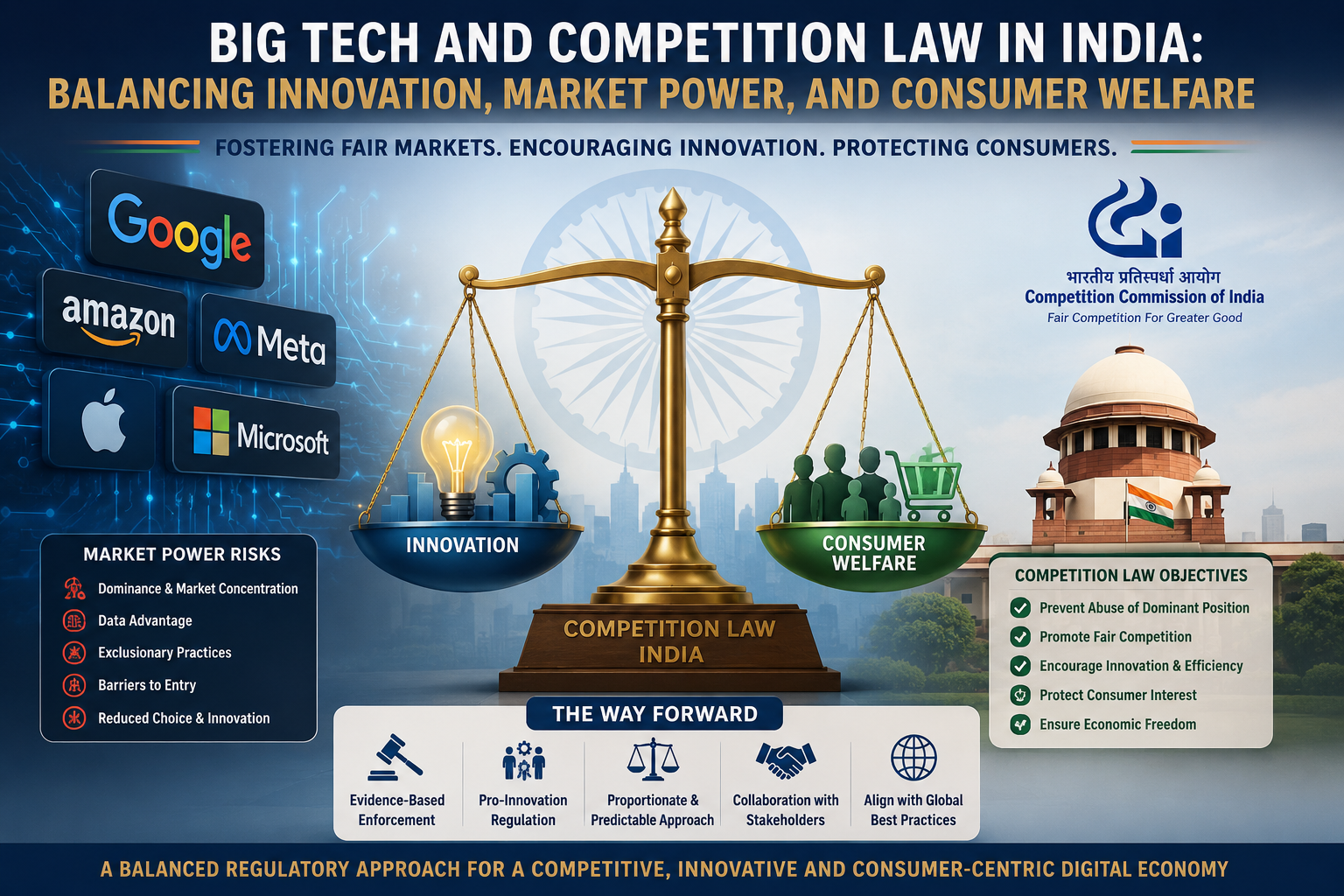
▪️Introduction
The digital economy has fundamentally transformed the way businesses operate, consumers interact, and markets function. In recent years, technology companies have emerged as some of the most influential economic actors in the world. Digital platforms have revolutionized commerce, communication, transportation, entertainment, and financial services. Companies such as Google, Amazon, Apple, Meta, and Microsoft have established dominant positions across multiple sectors, shaping the global digital landscape.
India, with its rapidly expanding internet penetration, digital infrastructure, and technology-driven economy, has become one of the most important markets for digital platforms. The growth of e-commerce, online advertising, digital payments, social media, cloud computing, and app-based services has generated significant economic opportunities while simultaneously raising concerns regarding market concentration and competition.
The rise of Big Tech has presented a complex challenge for competition regulators worldwide. On one hand, digital platforms contribute substantially to innovation, economic growth, consumer convenience, and technological advancement. On the other hand, their increasing market power has prompted concerns about anti-competitive conduct, barriers to entry, exploitation of consumer data, and the potential suppression of emerging competitors.
In India, the legal framework governing competition is primarily contained in the Competition Act, 2002, which seeks to prevent practices having an adverse effect on competition, promote consumer welfare, and ensure freedom of trade. However, the unique characteristics of digital markets have raised questions regarding the adequacy of traditional competition law tools in addressing modern technological realities.
This article examines the relationship between Big Tech and competition law in India, explores the challenges posed by digital markets, analyzes recent regulatory developments, and evaluates how India can balance innovation, market power, and consumer welfare in the digital economy.
▪️Understanding Big Tech and Digital Markets
The term "Big Tech" generally refers to large technology companies that operate digital platforms with extensive market reach and significant economic influence. These firms often serve as intermediaries connecting millions of users, advertisers, developers, merchants, and service providers.
Digital markets differ significantly from traditional markets due to several characteristics:
1. Network Effects
Network effects occur when the value of a platform increases as more users join it. Social media platforms provide a classic example. A platform becomes more valuable when a larger number of users participate, making it difficult for competitors to attract users.
2. Data-Driven Advantages
Data has become a critical economic resource in the digital age. Big Tech firms collect vast quantities of user information, enabling them to improve services, target advertisements, and develop new products.
3. Economies of Scale
Digital platforms often experience low marginal costs. Once a platform is established, serving additional users may require relatively little additional expenditure.
4. Ecosystem Integration
Many technology firms operate integrated ecosystems consisting of operating systems, app stores, cloud services, advertising networks, and digital marketplaces. Such integration can strengthen market positions and increase barriers to entry.
5. Multi-Sided Markets
Digital platforms frequently serve multiple groups simultaneously. For example, an online marketplace connects buyers and sellers, while a search engine connects users and advertisers.
These features make digital markets highly dynamic yet potentially susceptible to market concentration.
▪️Competition Law Framework in India
The Competition Act, 2002 was enacted to ensure fair competition and protect consumer interests.
The primary objectives of the Act include:
Preventing anti-competitive agreements.
Preventing abuse of dominant position.
Regulating combinations and mergers.
Promoting competition in markets.
Protecting consumer welfare.
The principal regulatory authority under the Act is the Competition Commission of India.
The CCI is empowered to investigate anti-competitive conduct, impose penalties, and issue directions to restore market competition.
The Act addresses three principal areas:
Anti-Competitive Agreements
Section 3 prohibits agreements that cause appreciable adverse effects on competition.
Examples include:
Cartels
Price-fixing arrangements
Market allocation agreements
Bid-rigging practices
Abuse of Dominance
Section 4 prohibits dominant enterprises from abusing their market position.
Examples include:
Predatory pricing
Unfair conditions
Limiting production
Denial of market access
Combinations
Sections 5 and 6 regulate mergers, acquisitions, and combinations that may substantially lessen competition.
▪️The Rise of Digital Competition Concerns
The emergence of digital platforms has challenged traditional assumptions regarding market competition.
Historically, competition law focused on factors such as price increases and output restrictions. However, many digital services are offered free of monetary cost.
Consumers may not pay directly for:
Search engines
Social networking platforms
Email services
Mapping applications
Instead, platforms monetize user attention and personal data.
As a result, regulators increasingly consider factors such as:
Data control
Privacy implications
Algorithmic influence
Platform neutrality
Innovation suppression
These concerns have transformed competition law discourse globally.
▪️Big Tech and Market Power
Market power refers to the ability of a firm to act independently of competitive pressures.
In digital markets, market power may arise through:
Control of Data
Large platforms possess vast data repositories unavailable to smaller competitors.
User Lock-In
Consumers often face switching costs when moving between platforms.
Self-Preferencing
Platform operators may favor their own products or services over competing offerings.
Gatekeeper Functions
Some platforms serve as essential gateways between businesses and consumers.
Such positions enable firms to influence market access and competitive outcomes.
▪️Major Competition Concerns in India's Digital Economy
Self-Preferencing
A significant concern involves platforms promoting their own products or services ahead of competitors.
For example:
Marketplace operators promoting private labels.
Search engines prioritizing proprietary services.
App stores favoring platform-owned applications.
Self-preferencing may reduce visibility for competitors and distort market competition.
Predatory Pricing
Digital firms often possess substantial financial resources.
By offering services below cost for extended periods, dominant firms may eliminate competitors before raising prices or strengthening market control.
Data Concentration
Data accumulation can create substantial entry barriers.
New entrants may struggle to compete against firms possessing years of consumer behavioral data.
Platform Dependency
Many businesses rely heavily on digital platforms for visibility and customer access.
Excessive dependence may create power imbalances between platforms and business users.
Killer Acquisitions
Large technology firms may acquire emerging competitors before they become significant threats.
Such acquisitions may reduce future competition and innovation.
▪️Competition Commission of India and Big Tech Investigations
The Competition Commission of India has increasingly focused on digital markets.
Several investigations have examined allegations involving:
Search bias
App store practices
Digital advertising
Online marketplaces
Mobile operating systems
These investigations demonstrate the regulator's growing attention to platform-based competition issues.
The CCI has emphasized that digital markets require careful analysis because conventional market definitions may not adequately capture competitive realities.
▪️Data as a Source of Market Power
Data is frequently described as the "new oil" of the digital economy.
However, unlike traditional resources, data possesses unique characteristics:
It can be replicated.
It can be analyzed repeatedly.
Its value increases when combined with other datasets.
Large technology firms derive substantial competitive advantages from:
Consumer preferences
Search histories
Location information
Transaction records
Behavioral patterns
The ability to leverage such data enables firms to improve algorithms, personalize services, and strengthen market positions.
Competition regulators increasingly view data concentration as an important factor in assessing market dominance.
▪️Consumer Welfare in Digital Markets
Consumer welfare remains a central objective of competition law.
However, digital markets require a broader understanding of consumer welfare beyond price effects.
Important considerations include:
Privacy
Consumers may exchange personal information for access to services.
Competition authorities increasingly recognize privacy as a competition-related concern.
Quality of Service
Market concentration may reduce incentives to improve services.
Innovation
Consumers benefit when firms compete through technological advancement.
Reduced competition may diminish innovation incentives.
Choice
Competition encourages diversity of products and services.
Dominant platforms may reduce consumer choice by restricting market access for competitors.
▪️Innovation versus Regulation
One of the most difficult challenges in digital competition policy is balancing innovation with regulation.
Excessive regulation may:
Discourage investment.
Increase compliance costs.
Slow technological development.
Insufficient regulation may:
Encourage monopolistic behavior.
Reduce consumer welfare.
Limit market entry.
Policymakers must therefore strike a careful balance.
Innovation thrives when firms can earn rewards for success, but markets must remain open to new entrants and competitors.
▪️International Approaches to Big Tech Regulation
Several jurisdictions have adopted new approaches toward digital competition.
European Union
The Digital Markets Act introduces obligations for designated gatekeepers.
The legislation seeks to:
Prevent self-preferencing.
Promote interoperability.
Ensure fair access.
United States
American authorities have intensified scrutiny of digital platforms through antitrust litigation and investigations.
United Kingdom
The UK has developed specialized frameworks targeting digital market dominance.
These international developments provide valuable lessons for India.
▪️Need for Competition Law Reforms in India
Traditional competition law was designed primarily for industrial-era markets.
Digital markets require additional analytical tools.
Potential reform areas include:
Updated Market Definition
Digital ecosystems often operate across interconnected markets.
Regulators may require more flexible methods for defining relevant markets.
Data-Centric Analysis
Competition assessments should consider data access and data concentration.
Ex-Ante Regulation
Certain obligations may apply before anti-competitive conduct occurs.
Enhanced Merger Review
Authorities should closely examine acquisitions involving innovative startups.
Algorithmic Transparency
Regulators may require greater transparency regarding platform decision-making processes.
▪️Digital Competition Bill and Emerging Policy Discussions
India has witnessed growing discussions regarding specialized digital competition regulation.
Policy experts have proposed frameworks addressing:
Gatekeeper platforms
Self-preferencing
Data portability
Fair ranking practices
Anti-steering restrictions
Such proposals seek to complement rather than replace the Competition Act.
The objective is to ensure contestable and competitive digital markets while preserving innovation incentives.
▪️Challenges in Regulating Big Tech
Despite the need for oversight, regulation presents several challenges.
Rapid Technological Change
Technology evolves faster than legislation.
Global Operations
Digital firms operate across multiple jurisdictions.
Defining Dominance
Market power may be difficult to measure in rapidly evolving markets.
Balancing Privacy and Competition
Data-sharing obligations may conflict with privacy protections.
Enforcement Complexity
Digital platforms often employ sophisticated algorithms and business models that require specialized expertise.
▪️The Way Forward
India's approach to digital competition should focus on balanced regulation.
Key priorities include:
Strengthening Institutional Capacity
Regulators should invest in technological expertise, data science capabilities, and digital market analysis.
Promoting Startup Ecosystems
Competition policy should encourage innovation and entrepreneurship.
Enhancing Consumer Awareness
Consumers should understand how platforms collect and utilize data.
Improving Coordination
Competition authorities, data protection regulators, and sector-specific regulators should collaborate effectively.
Encouraging Market Contestability
Regulatory measures should facilitate entry by innovative firms and reduce artificial barriers.
Evidence-Based Enforcement
Competition interventions should be grounded in rigorous economic analysis.
▪️Conclusion
Big Tech has significantly contributed to India's digital growth, innovation, and consumer convenience. At the same time, concerns regarding market dominance and fair competition require careful regulatory attention.
A balanced competition law framework is essential to promote innovation, protect consumer welfare, and ensure that digital markets remain open, fair, and competitive for all participants.
🔸Disclaimer
The views expressed in this article are solely for educational and scholarly discussion.

Leave a Comment
Your email address and mobile number will not be published. Required fields are marked *