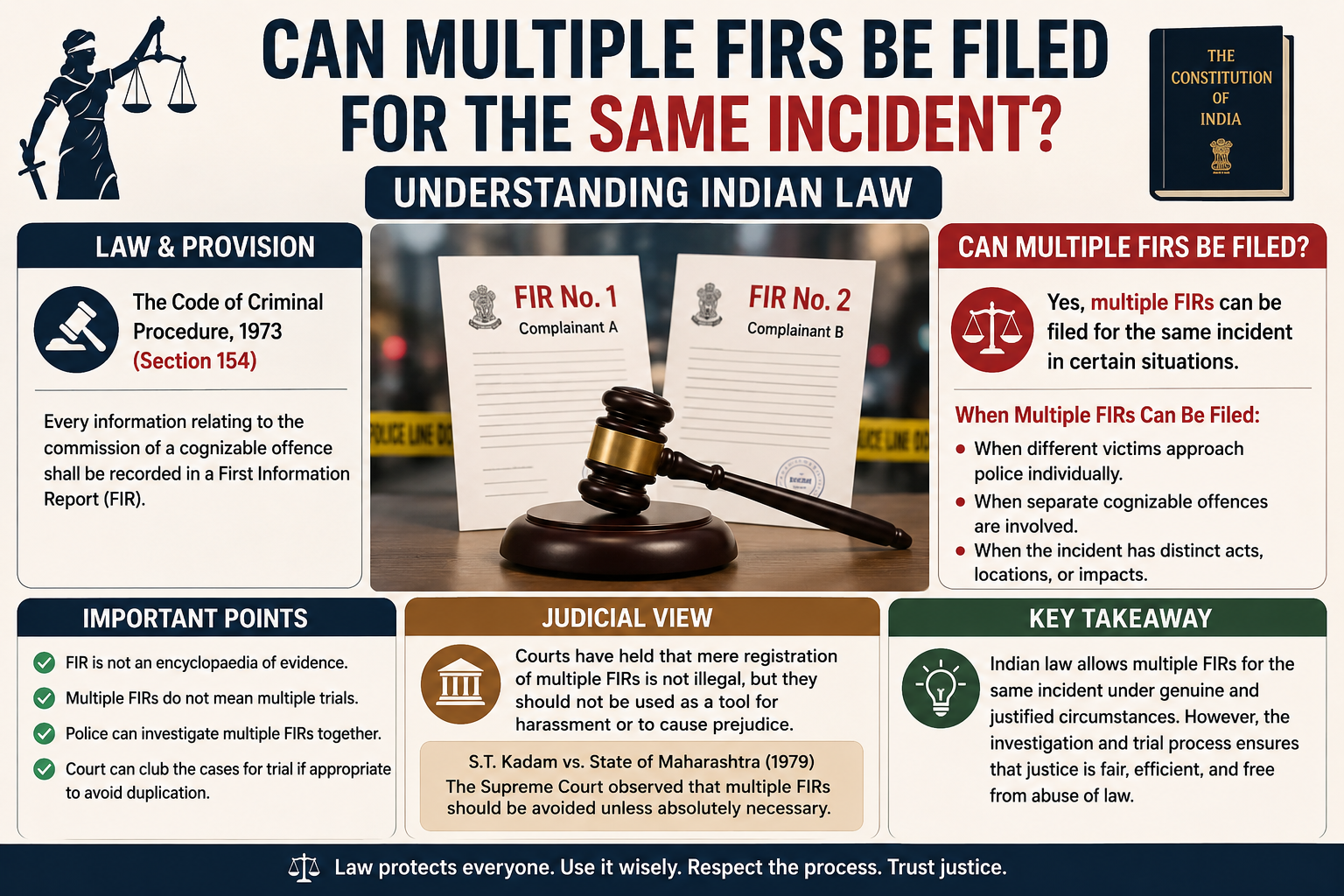
Introduction:
In recent years, India has witnessed increasing public debate over the misuse of criminal law through repeated FIRs, parallel investigations, and multiple criminal complaints arising from the same incident. Whether involving political leaders, journalists, social media influencers, businesspersons, protestors, or ordinary citizens, the issue of multiple FIRs has become one of the most significant procedural concerns in Indian criminal jurisprudence.
A common question often raised by citizens is:
“Can the police register more than one FIR for the same incident?”
The answer, according to Indian law, is generally no. The Supreme Court of India has consistently held that multiple FIRs concerning the same incident or transaction are ordinarily impermissible because they violate principles of fairness, due process, and constitutional protection.
At the same time, Indian law also recognizes situations where separate FIRs may be legally valid—such as counter-complaints, distinct offences, or separate transactions arising from connected events. Therefore, the law does not impose an absolute prohibition but instead applies judicial tests to determine whether repeated FIRs amount to abuse of criminal process.
The issue is deeply connected with constitutional values under:
Article 14 (equality before law),
Article 20(2) (protection against double jeopardy),
and Article 21 (right to life and personal liberty).
The judiciary has repeatedly emphasized that criminal investigation should serve justice—not become a tool of harassment or intimidation.
This article examines:
what FIRs are,
when multiple FIRs are allowed,
when they become illegal,
important Supreme Court judgments,
constitutional safeguards,
recent legal developments,
and practical rights available to citizens.
What Is an FIR?
An FIR (First Information Report) is the earliest information given to police authorities regarding the commission of a cognizable offence.
Under Section 173 of the Bharatiya Nagarik Suraksha Sanhita (BNSS), previously Section 154 of the Code of Criminal Procedure (CrPC), police officers must register an FIR when information discloses a cognizable offence.
A cognizable offence refers to a serious offence where police may:
investigate without prior court permission,
and arrest without a warrant.
Examples include:
murder,
kidnapping,
rape,
cheating,
robbery,
and serious cyber offences.
The FIR marks the formal beginning of criminal investigation.
Why Is FIR Important?
The FIR serves several critical functions:
1. It Sets Criminal Law Into Motion
Without an FIR, police generally cannot begin a formal investigation into cognizable offences.
2. It Records the Earliest Version of Events
The FIR preserves the complainant’s initial allegations before evidence is altered or influenced.
3. It Prevents Fabrication
Recording facts immediately reduces chances of manipulation later.
4. It Ensures Accountability
Police action becomes subject to judicial scrutiny once the FIR is registered.
What Does “Multiple FIRs” Mean?
Multiple FIRs refer to situations where:
more than one FIR,
concerning the same incident,
same occurrence,
or same transaction, is registered.
For example:
several FIRs filed in different states over one speech,
repeated complaints regarding the same financial dispute,
or multiple police stations investigating identical allegations.
Such situations create serious legal concerns.
Why Are Multiple FIRs Problematic?
Parallel FIRs can cause:
repeated arrests,
multiple interrogations,
mental harassment,
financial burden,
media trials,
conflicting investigations,
and abuse of police powers.
Imagine an ordinary citizen facing:
one FIR in Delhi,
another in Mumbai,
and a third in Lucknow, for the same social media post.
Such repeated prosecution can itself become punishment.
Therefore, courts have evolved legal safeguards.
Constitutional Protection Against Multiple FIRs:
Article 21: Right to Fair Procedure
Article 21 guarantees:
“No person shall be deprived of life or personal liberty except according to procedure established by law.”
The Supreme Court has interpreted Article 21 broadly to include:
fair investigation,
protection against arbitrary prosecution,
procedural due process,
and freedom from harassment.
Repeated FIRs violate fairness because they expose individuals to:
endless investigations,
uncertainty,
and repeated coercive action.
The Court therefore treats multiplicity of FIRs as a constitutional issue.
Article 14: Equality Before Law
Article 14 prohibits arbitrary state action.
When authorities repeatedly register FIRs on the same facts, it may amount to:
selective targeting,
vindictive prosecution,
or abuse of process.
The rule against parallel FIRs ensures fairness and consistency in investigation.
Article 20(2): Protection Against Double Jeopardy
Article 20(2) provides:
“No person shall be prosecuted and punished for the same offence more than once.”
Though technically applicable after conviction or acquittal, the constitutional philosophy discourages repetitive criminal proceedings arising from identical allegations.
Landmark Judgment: T.T. Antony v. State of Kerala
The most important case on this issue is:
T.T. Antony v. State of Kerala
The Supreme Court held:
there cannot ordinarily be a second FIR regarding the same incident,
fresh investigations on identical facts are impermissible,
and subsequent information should become part of the original investigation.
The Court observed that allowing repeated FIRs would:
create confusion,
encourage abuse,
and undermine fairness.
This judgment became the foundation of Indian law on multiplicity of FIRs.
What Is the “Sameness Test”?
Courts apply the “sameness test” to determine whether two FIRs concern:
the same transaction,
or distinct incidents.
The court examines:
similarity of allegations,
common evidence,
continuity of action,
proximity in time,
and unity of purpose.
If both FIRs substantially overlap, the second FIR is usually quashed.
When Multiple FIRs Are NOT Allowed:
1. Same Incident, Same Allegations
If two FIRs arise from the same occurrence and contain identical allegations, the second FIR is generally illegal.
Example:
One financial fraud complaint cannot be repeatedly registered in different police stations merely to pressure the accused.
2. Repeated FIRs by Same Complainant
A complainant cannot repeatedly file fresh FIRs simply by changing wording slightly.
Courts examine the substance—not drafting style.
3. Political or Malicious Harassment
Courts frequently intervene where repeated FIRs appear intended to:
harass,
intimidate,
or silence individuals.
When Multiple FIRs MAY Be Allowed:
Indian law does recognize exceptions.
1. Counter FIRs
Suppose two groups clash violently.
Both sides may file separate FIRs giving rival versions.
This is legally permissible.
The Supreme Court clarified this in:
Upkar Singh v. Ved Prakash
The Court held that counter complaints are valid because they present:
different narratives,
and separate accusations.
2. Distinct Transactions
If incidents are genuinely different, separate FIRs may be registered.
Example:
A person commits fraud in Delhi and a separate fraud in Mumbai involving different victims and facts.
3. Separate Statutory Offences
Different agencies may investigate distinct legal violations.
For example:
state police,
Enforcement Directorate,
or CBI, may investigate separate offences under different laws.
However, courts ensure that investigations do not become repetitive harassment.
Babubhai v. State of Gujarat
In:
Babubhai v. State of Gujarat
the Supreme Court elaborated the “sameness test.”
The Court emphasized:
substance over form,
factual overlap,
and continuity of transaction.
The judgment strengthened safeguards against repetitive prosecution.
Arnab Ranjan Goswami v. Union of India
The issue gained national attention in:
Arnab Ranjan Goswami v. Union of India
Several FIRs were registered across states over the same television broadcast.
The Supreme Court observed:
multiple FIRs create chilling effects on speech,
repetitive prosecution threatens liberty,
and criminal law cannot become a tool of intimidation.
The Court consolidated proceedings and protected the accused from repeated investigation.
This judgment significantly influenced modern jurisprudence on parallel FIRs.
Recent Case: Amit Katyal & Anr. v. State of Haryana
A recent reaffirmation came in:
Amit Katyal & Anr. v. State of Haryana
The Supreme Court reiterated:
parallel FIRs concerning identical allegations are impermissible,
criminal procedure must remain fair,
and investigative powers cannot be misused.
The Court emphasized constitutional fairness and procedural discipline.
Multiple FIRs in Social Media Cases:
The digital era has made this issue more complex.
Today:
one tweet,
one Instagram post,
or one YouTube video, may trigger complaints across several states.
This creates risks of:
forum shopping,
political misuse,
and intimidation.
Courts increasingly support:
centralized investigation,
transfer of proceedings,
and consolidation of FIRs.
Political Cases and Media Trials
Repeated FIRs often arise in:
political controversies,
election speeches,
protests,
and media debates.
Sometimes criminal complaints are strategically used to:
pressure opponents,
create public spectacle,
or exhaust financial resources.
The judiciary has repeatedly warned against:
abuse of criminal law,
and weaponization of investigation.
Economic Offences and Multiple Investigations
Financial crimes often involve:
several complainants,
multiple jurisdictions,
and different agencies.
This creates legal complexity.
Courts distinguish between:
legitimate separate investigations, and
repetitive proceedings based on identical allegations.
The key question remains:
Is the second FIR genuinely distinct?
Rights of Citizens Facing Multiple FIRs
If a person faces repeated FIRs concerning the same incident, they may approach:
the High Court,
or the Supreme Court.
Possible remedies include:
quashing of FIRs,
consolidation of proceedings,
transfer petitions,
and interim protection against arrest.
Role of High Courts
High Courts possess extraordinary powers under:
Article 226 of the Constitution,
and inherent criminal jurisdiction.
Courts may quash proceedings where:
allegations are repetitive,
investigations overlap,
or prosecution is malicious.
Judicial intervention prevents abuse of process.
Can Police Continue Investigation After One FIR?
Yes.
Police may conduct:
further investigation,
supplementary investigation,
and additional evidence collection.
What is prohibited is:
fresh FIRs on identical allegations.
This distinction is very important.
Why This Issue Matters to Ordinary Citizens:
Many people assume that:
“If one FIR exists, no further trouble is possible.”
However, in practice:
multiple complaints,
repeated notices,
and inter-state investigations, can create enormous pressure.
Understanding legal protections is therefore essential.
The rule against multiplicity of FIRs protects not only famous individuals but also:
students,
journalists,
activists,
businesspersons,
and ordinary citizens.
Constitutional Morality and Criminal Justice
The doctrine reflects broader constitutional values:
fairness,
accountability,
restraint,
and dignity.
Criminal investigation should not become punishment.
The Supreme Court repeatedly emphasizes that:
liberty cannot be sacrificed at the altar of procedural abuse.
Conclusion:
The law on multiple FIRs in India seeks to protect individuals from repeated prosecution and procedural harassment. Courts have consistently held that parallel FIRs on the same incident are generally not permissible, as they may violate fairness and constitutional rights. Through various landmark judgments, the judiciary has emphasized that criminal law must ensure justice without becoming a tool of abuse or intimidation.
Disclaimer:
This article is intended solely for academic, educational, and informational purposes.

Leave a Comment
Your email address and mobile number will not be published. Required fields are marked *