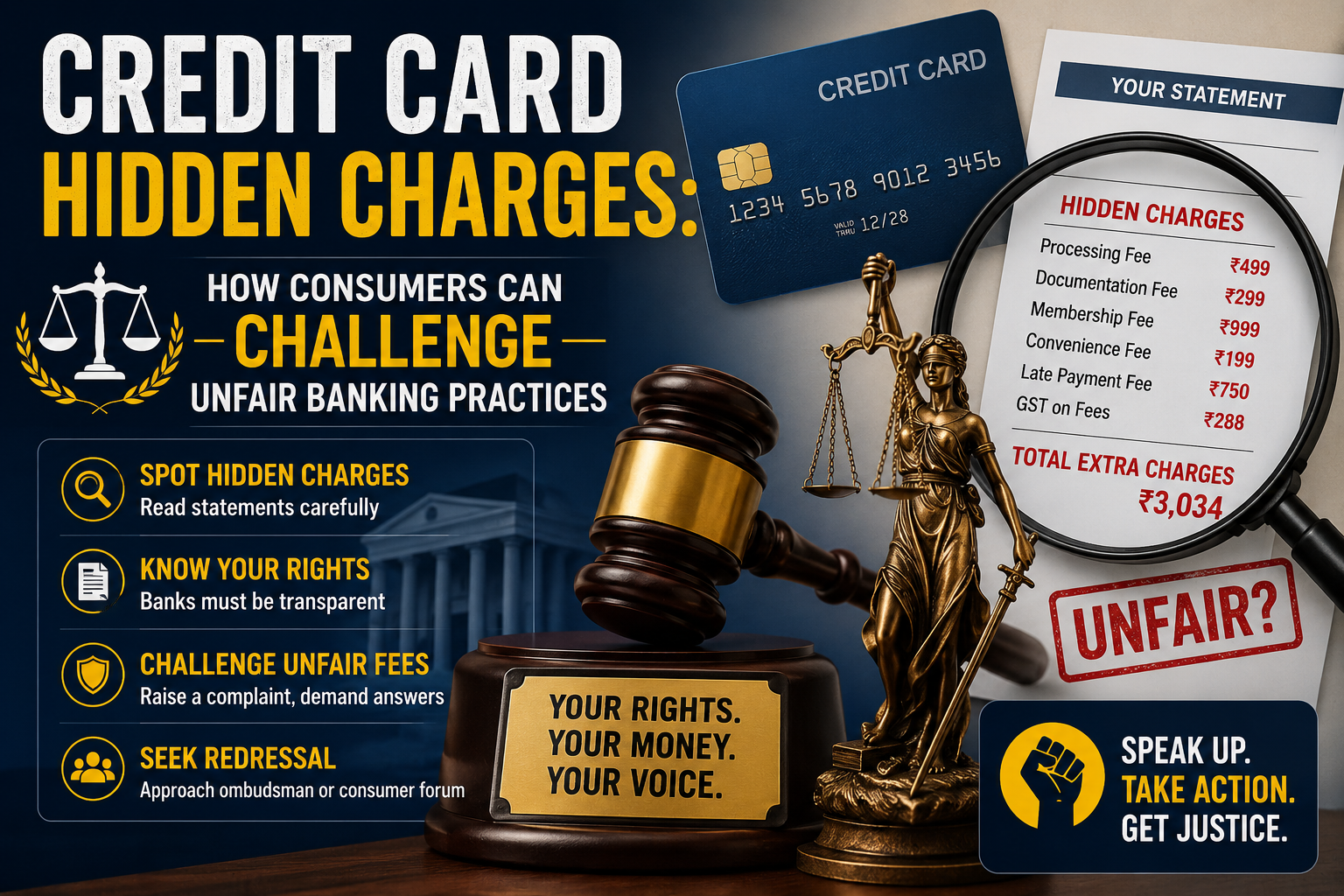
🌟Introduction :
Credit cards have become an essential part of modern financial life. Whether it is online shopping, travel bookings, emergency expenses, utility bill payments, or everyday purchases, credit cards provide convenience, flexibility, and access to short-term credit. Banks and financial institutions aggressively promote credit cards by highlighting attractive benefits such as cashback, reward points, airport lounge access, EMI facilities, and interest-free periods.
However, behind these attractive features lies a common source of consumer complaints—hidden charges and undisclosed fees.
Many consumers discover unexpected charges only after receiving their monthly statement. These may include annual fees, finance charges, late payment penalties, over-limit charges, dynamic currency conversion fees, processing fees, GST on charges, card replacement fees, and various other costs that were not adequately explained at the time of issuance.
The problem becomes more serious when banks fail to provide transparent disclosures or impose charges that consumers neither expected nor understood. Such practices can result in financial loss, disputes, damaged credit scores, and significant consumer frustration.
The issue is not merely a matter of customer dissatisfaction. It raises important legal questions concerning transparency, informed consent, fair banking practices, consumer protection, contractual obligations, and regulatory compliance.
This comprehensive guide examines hidden credit card charges, the legal rights of consumers, the responsibilities of banks, available remedies, and practical strategies for challenging unfair banking practices in India.
💳Understanding the Nature of Credit Cards :
A credit card is essentially a revolving credit facility provided by a bank or financial institution.
When a consumer uses a credit card:
The bank pays the merchant.
The consumer repays the bank later.
Interest may apply if the outstanding amount is not paid within the specified period.
Unlike debit cards, credit cards involve a lending relationship between the bank and the customer.
Because the relationship involves lending, various fees and charges may arise during the life cycle of the credit card.
The key legal question is not whether banks can charge fees.
The real issue is:
Were those charges properly disclosed, transparently communicated, and lawfully imposed?
🔍What Are Hidden Charges?
A hidden charge is generally a fee, penalty, or financial burden that was:
Not adequately disclosed.
Not clearly explained.
Difficult for consumers to understand.
Unexpected from the consumer's perspective.
In many cases, banks disclose charges in lengthy terms and conditions that customers rarely read or fully understand.
While legal disclosure may technically exist, questions often arise regarding whether the disclosure was sufficiently clear and transparent.
💰Common Hidden Credit Card Charges Faced by Consumers :
1. Annual Membership Fees
Many consumers are told that a credit card is “free.”
Later they discover:
Annual charges.
Renewal fees.
Membership fees.
The dispute often arises when consumers were not clearly informed at the time of issuance.
2. Late Payment Charges
Missing the due date can result in:
Late payment fees.
Interest charges.
GST on penalties.
Even a small delay may trigger substantial costs.
3. Finance Charges and Interest Costs
Many consumers mistakenly believe that paying the minimum amount due prevents interest.
In reality:
Interest may continue on the remaining balance.
New purchases may also attract interest.
This often surprises cardholders.
4. Over-Limit Charges
When spending exceeds the approved credit limit:
Additional fees may be imposed.
Consumers sometimes discover these charges only after receiving statements.
5. Cash Withdrawal Charges
Using a credit card to withdraw cash may attract:
Transaction fees.
Immediate interest charges.
Unlike regular purchases, the interest-free period may not apply.
6. EMI Conversion Charges
Banks frequently advertise EMI conversion facilities.
However, hidden costs may include:
Processing fees.
Interest costs.
Foreclosure charges.
7. Dynamic Currency Conversion Charges
When making international transactions:
Currency conversion fees may apply.
Exchange rate markups may be charged.
Consumers often remain unaware of these costs.
8. Card Replacement Charges
Lost or damaged cards may result in replacement fees.
9. Statement Charges
Some banks charge fees for:
Duplicate statements.
Historical account records.
10. Reward Program Charges
Consumers may discover:
Reward redemption fees.
Program maintenance charges.
These reduce the actual value of rewards.
11. GST on Charges
Even legitimate charges often attract GST.
This increases the overall financial burden.
12. Inactivity Charges
Certain products may impose fees for prolonged inactivity.
⚠️Why Hidden Charges Create Consumer Concerns :
The problem is not merely financial.
It also concerns:
Transparency
Consumers should understand the true cost of the product.
Informed Consent
Customers should know what they are agreeing to.
Fairness
Banks possess greater bargaining power and information.
Consumer Trust
Unexpected charges damage confidence in the banking system.
😟How Hidden Charges Affect Consumers
Financial Loss
Unexpected fees accumulate quickly.
A small charge can become significant when interest and taxes are added.
Credit Score Damage
Disputed charges may remain unpaid.
This can affect:
Credit reports.
Future borrowing capacity.
Mental Stress
Consumers often spend considerable time:
Contacting customer care.
Filing complaints.
Seeking explanations.
Reduced Financial Planning
Unexpected charges disrupt budgets and financial goals.
⚖️Legal Relationship Between Bank and Consumer :
A credit card agreement creates contractual obligations.
The bank must:
Provide agreed services.
Maintain transparency.
Follow regulatory requirements.
The consumer must:
Use the card responsibly.
Make payments on time.
Comply with contractual terms.
The validity of a charge often depends upon whether the bank fulfilled its disclosure obligations.
🛡️Consumer Rights in Credit Card Transactions :
Consumers possess several important rights.
Right to Information
Customers have the right to receive clear information about:
Fees
Interest rates
Charges
Penalties
Right to Transparency
Important charges should not be hidden within complicated documentation.
Right to Fair Treatment
Banks must treat customers fairly and reasonably.
Right to Accurate Statements
Consumers are entitled to correct billing information.
Right to Dispute Unauthorized Charges
Cardholders may challenge incorrect entries.
Right to Grievance Redressal
Consumers may seek resolution through established complaint mechanisms.
🏦The Duty of Banks to Maintain Transparency
Banks are expected to communicate:
Annual Fees
Clearly and prominently.
Interest Rates
Including applicable calculations.
Penalties
Including circumstances triggering charges.
Reward Program Conditions
Including restrictions and fees.
Foreign Transaction Costs
Including conversion-related expenses.
Transparency is central to fair banking practices.
📢Misleading Marketing and Credit Cards
Many disputes begin with marketing representations.
Examples include:
“Lifetime free card.”
“Zero charges.”
“No annual fee.”
Consumers may later discover limitations and conditions.
This creates questions regarding:
Fair disclosure.
Consumer expectations.
Accuracy of representations.
🚨Unauthorized Credit Card Charges
Hidden charges differ from unauthorized charges.
Unauthorized charges occur when:
The consumer did not initiate the transaction.
The transaction was fraudulent.
The bank incorrectly debited the account.
Such cases require immediate action.
📋Common Consumer Complaints Against Credit Card Issuers
Wrong Billing
Incorrect transaction entries.
Duplicate Charges
Same transaction charged twice.
Incorrect Interest Calculation
Interest applied incorrectly.
Undisclosed Fees
Unexpected charges appearing on statements.
Failure to Reverse Charges
Banks refusing legitimate dispute requests.
Delayed Complaint Resolution
Slow response to customer grievances.
🔎How to Identify Hidden Charges in Your Statement
Consumers should regularly review:
Transaction Details
Check every purchase.
Interest Charges
Verify calculations.
Service Fees
Review descriptions carefully.
Taxes
Ensure GST calculations are accurate.
Penalties
Confirm legitimacy.
Membership Charges
Check annual fee entries.
Regular review helps identify issues early.
📑Steps Consumers Should Take When Hidden Charges Appear
Step 1: Review Terms and Conditions
Determine whether the charge was disclosed.
Step 2: Obtain Clarification
Contact customer support.
Request:
Detailed explanation.
Calculation basis.
Relevant policy.
Step 3: Preserve Evidence
Maintain:
Statements
Emails
Screenshots
Chat transcripts
Step 4: Submit a Written Complaint
Written complaints create valuable records.
Step 5: Request Reversal
Where appropriate, formally seek reversal.
Step 6: Escalate the Complaint
If unresolved, use higher-level grievance mechanisms.
✉️The Importance of Written Communication
Consumers frequently make the mistake of relying on phone calls.
Written communication provides:
Evidence.
Clarity.
Accountability.
Always preserve complaint reference numbers.
⚖️Credit Card Charges and Consumer Protection Principles
Banking services are subject to consumer protection principles.
Issues may arise when:
Charges are unfair.
Disclosures are inadequate.
Service quality is deficient.
Consumers may challenge such conduct through appropriate legal channels.
🏛️Hidden Charges and Deficiency in Service
A dispute may potentially involve deficiency in service where:
Charges are wrongly imposed.
Complaints are ignored.
Errors remain uncorrected.
Transparency obligations are neglected.
Each case depends upon its facts and supporting evidence.
Impact on Credit Scores 📊
Disputed charges can affect:
Payment History
Missed payments may be recorded.
Credit Utilization
Outstanding balances increase.
Future Borrowing
Loan approvals may become difficult.
Interest Rates
Consumers may receive less favorable lending terms.
👴👵Special Concerns for Senior Citizens
Senior citizens may face additional difficulties.
These include:
Complex documentation.
Digital banking challenges.
Understanding fee structures.
Banks should ensure proper communication and transparency.
🌐Online Credit Card Applications and Disclosure Issues
Digital applications often involve:
Multiple hyperlinks.
Extensive terms.
Automated approvals.
Consumers may unknowingly accept conditions.
This increases the importance of clear disclosure practices.
Preventive Measures for Consumers ✅
Read the Key Fact Sheet
Focus on major charges.
Monitor Statements Monthly
Early detection prevents escalation.
Set Payment Reminders
Avoid penalties.
Maintain Email Records
Useful during disputes.
Understand Reward Programs
Know applicable fees and limitations.
Track International Transactions
Review exchange-related charges.
Check Renewal Conditions
Confirm annual fee requirements.
⚖️🏛️Legal Redressal Mechanisms Available to Consumers
If a bank fails to address complaints regarding hidden credit card charges or unfair billing practices, consumers may seek redress through the following mechanisms:
1. Internal Grievance Redressal Mechanism of the Bank
The consumer should first file a written complaint with the bank's customer service department, branch manager, or grievance redressal officer and seek a formal response.
2. Reserve Bank of India (RBI) Integrated Ombudsman Scheme
If the bank does not resolve the complaint satisfactorily within the prescribed time, the consumer may approach the grievance mechanism established by the Reserve Bank of India for banking service-related disputes.
3. Consumer Commissions
Under the Consumer Protection Act, 2019, consumers may file complaints before the appropriate Consumer Commission for:
Deficiency in service
Unfair trade practices
Compensation for financial loss or mental harassment
4. Civil Courts
In appropriate cases involving contractual disputes, recovery of money, or other civil claims, consumers may seek remedies before competent civil courts.
5. Credit Information Dispute Mechanisms
Where hidden charges have resulted in incorrect reporting affecting the consumer's credit history, the consumer may seek correction through the concerned bank and the relevant credit information company.
6. Legal Notice Through an Advocate
Before initiating formal proceedings, consumers may issue a legal notice demanding:
Reversal of wrongful charges
Correction of records
Compensation, where applicable
Frequently Asked Questions (FAQs) ❓
Can banks charge annual fees?
Yes, provided such fees are properly disclosed and applicable under the card terms.
Can I dispute a charge that was not explained to me?
Yes. Consumers may seek clarification and challenge charges they believe are improper or inadequately disclosed.
What if customer care refuses to help?
The complaint may be escalated through the bank's grievance process.
Can hidden charges affect my credit score?
Yes. Unpaid disputed amounts may impact credit reporting.
Should I immediately stop paying the entire statement?
Consumers should carefully evaluate the situation and seek professional advice where necessary before taking decisions that may affect credit records.
Case Study: The Cost of Ignoring Small Charges 📖
Consider a hypothetical situation.
A consumer notices a ₹500 annual fee that was not expected.
Believing it to be insignificant, the consumer ignores it.
Over time:
Interest accumulates.
GST applies.
Late payment penalties arise.
Within months, the liability becomes several times larger.
The lesson is simple:
Challenge questionable charges immediately.
⚔️Building a Strong Consumer Dispute Case
Successful challenges often depend on evidence.
Important documents include:
Credit card agreement.
Monthly statements.
Promotional materials.
Emails.
SMS notifications.
Complaint records.
Call recordings (where legally maintained).
Documentation significantly strengthens a consumer's position.
The Future of Consumer Protection in Banking
As banking becomes increasingly digital, transparency becomes even more important.
Consumers expect:
Simple disclosures.
Clear pricing.
Fair treatment.
Effective grievance systems.
Banks that prioritize transparency are more likely to maintain customer trust and avoid disputes.
🎯Conclusion
Credit cards are useful financial tools, but consumers deserve clear and transparent information about all applicable charges. By staying informed, reviewing statements regularly, and challenging unfair or undisclosed fees, consumers can protect their financial interests and effectively enforce their legal rights when necessary.
Disclaimer ⚠️
This article is intended solely for educational and informational purposes and does not constitute legal advice.

Leave a Comment
Your email address and mobile number will not be published. Required fields are marked *