📖 Introduction
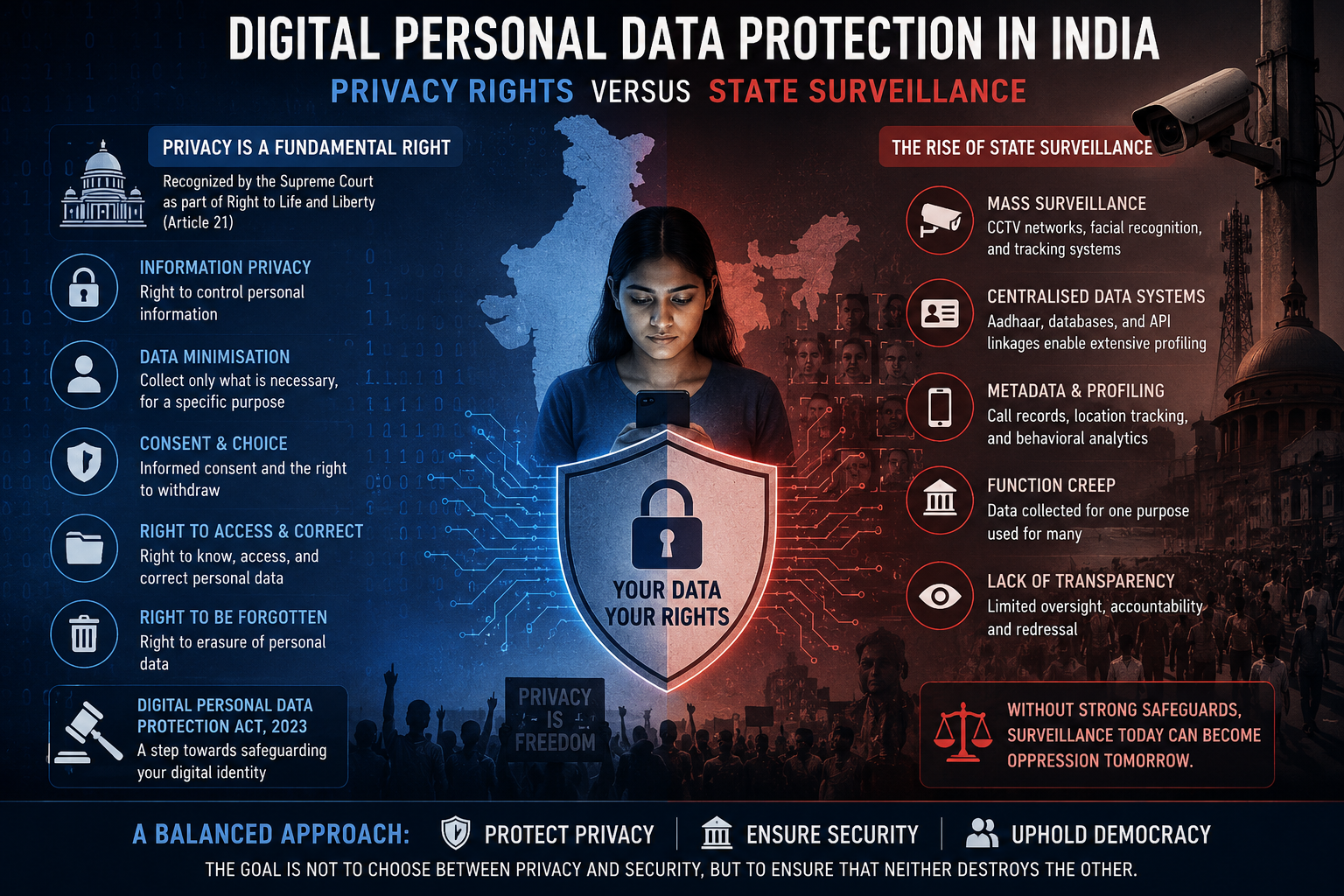
The digital age has transformed the way individuals communicate, conduct business, and interact with governments. Smartphones, online banking, social media platforms, e-commerce websites, and artificial intelligence have made personal data one of the most valuable resources in the modern world. Every digital activity generates information that can reveal an individual’s identity, preferences, financial status, health records, and even behavioral patterns. While the collection and use of such data contribute to innovation and efficient governance, they also raise serious concerns regarding privacy and misuse.
In India, the expansion of digital infrastructure through initiatives such as Digital India, Aadhaar, and online public services has accelerated the demand for a robust legal framework to protect personal data. At the same time, the State increasingly relies on digital surveillance tools to combat terrorism, cybercrime, financial fraud, and threats to national security. This has created an important constitutional debate: should the protection of individual privacy prevail over the State’s surveillance powers, or should national security justify greater governmental access to personal data?
The issue lies at the intersection of constitutional law, technology, governance, and human rights. Achieving a balance between personal liberty and public security has become one of the most significant legal challenges of contemporary India.
⚖️ The Concept of Digital Personal Data Protection
Personal data refers to any information capable of identifying an individual either directly or indirectly. It includes names, addresses, contact details, biometric information, financial records, health information, and digital identifiers.
Data protection laws aim to regulate how such information is collected, processed, stored, shared, and deleted. They seek to ensure that organizations handle personal data responsibly while respecting the rights and autonomy of individuals. In a digital economy where data drives innovation and economic growth, protecting personal information has become an essential aspect of democratic governance.
🏛️ Privacy as a Constitutional Right
Although the Constitution of India does not expressly mention the right to privacy, judicial interpretation has expanded the scope of Article 21 to include privacy as an essential element of life and personal liberty.
Privacy is closely connected with human dignity, personal autonomy, and freedom of choice. It protects individuals from arbitrary interference by both public authorities and private entities. Constitutional recognition of privacy reflects the principle that citizens should have control over their personal information and should not be subjected to unnecessary surveillance without lawful justification.
The constitutional protection of privacy therefore serves as a safeguard against excessive governmental intrusion while reinforcing democratic accountability.
📜 Need for a Comprehensive Data Protection Law
The rapid digitization of public and private services exposed significant gaps in India's earlier legal framework governing personal data. Existing provisions under information technology laws offered limited protection and were inadequate to address emerging technological challenges.
Growing dependence on cloud computing, artificial intelligence, online transactions, and cross-border data flows highlighted the need for legislation capable of regulating modern digital ecosystems. A dedicated legal framework became necessary to establish rights for individuals, obligations for data processors, and accountability mechanisms for violations.
The Digital Personal Data Protection framework emerged as a response to these evolving realities.
🔐 Key Features of India's Data Protection Framework
India's data protection regime seeks to create a structured system for responsible data processing while promoting innovation and economic development.
The framework emphasizes informed consent, lawful processing of personal information, protection against unauthorized use, and mechanisms for grievance redressal. It also imposes obligations on entities handling personal data to ensure security safeguards and prevent data breaches.
At the same time, it recognizes that governments may require access to data in specific situations involving public interest, legal compliance, or national security. This balance between individual rights and governmental functions remains one of the most debated aspects of the law.
👁️ Understanding State Surveillance
State surveillance refers to the monitoring or collection of information by public authorities for purposes such as law enforcement, intelligence gathering, national security, and public order.
Modern surveillance extends beyond physical observation and increasingly relies on digital technologies, including electronic communications monitoring, metadata analysis, facial recognition systems, biometric databases, and artificial intelligence.
Governments argue that these tools enable quicker detection of criminal activities and improve responses to security threats. However, widespread surveillance also creates risks of excessive governmental control and misuse of personal information.
⚔️ Privacy Rights versus State Surveillance
The debate between privacy rights and State surveillance represents one of the defining constitutional questions of the digital era.
Supporters of stronger privacy protections argue that unrestricted surveillance undermines civil liberties and democratic values. They contend that individuals should not live under constant observation and that personal autonomy requires meaningful control over one's information.
Conversely, advocates of enhanced surveillance emphasize that governments have a constitutional obligation to protect citizens from terrorism, organized crime, cyberattacks, and financial offences. Effective policing often requires timely access to digital information and technological monitoring.
Neither perspective can be ignored. Absolute privacy may hinder legitimate investigations, while unrestricted surveillance risks creating an environment inconsistent with constitutional democracy. The challenge lies in ensuring that surveillance measures remain lawful, proportionate, and subject to independent oversight.
🤖 Technology and the Expansion of Surveillance
Technological innovation has significantly increased surveillance capabilities.
Artificial intelligence can analyze vast quantities of data within seconds. Facial recognition software enables automated identification of individuals in public spaces. Predictive algorithms assist law enforcement agencies in identifying suspicious patterns and potential threats.
While these technologies improve efficiency, they also raise concerns regarding algorithmic bias, mass profiling, and lack of transparency. Errors in automated systems may disproportionately affect innocent individuals, making judicial and administrative safeguards essential.
The integration of technology into governance therefore requires careful regulation to preserve constitutional values.
🌍 International Approaches
Many democratic jurisdictions have adopted comprehensive data protection regimes that recognize privacy while permitting limited governmental access under strict legal conditions.
The European Union emphasizes individual consent, transparency, accountability, and independent regulatory oversight. The United Kingdom and several other countries similarly require surveillance activities to comply with statutory safeguards and proportionality principles.
These comparative experiences demonstrate that privacy protection and national security need not be mutually exclusive. Effective legal frameworks can accommodate both objectives through balanced regulation.
🇮🇳 Challenges Before India
Despite significant progress, India continues to face multiple challenges in implementing an effective data protection regime.
Digital literacy remains uneven across different regions and social groups. Many users are unaware of how their personal information is collected or processed. Cybersecurity threats continue to evolve rapidly, increasing the risk of data breaches and identity theft.
At the same time, expanding government databases and surveillance technologies require transparent accountability mechanisms to maintain public trust. Questions regarding judicial oversight, independent regulation, and procedural safeguards remain central to ongoing policy discussions.
Balancing innovation with constitutional protections will determine the long-term success of India's digital governance model.
💡 The Way Forward
India's future data governance framework should strengthen privacy without undermining legitimate security interests.
Clear statutory safeguards governing surveillance activities should be accompanied by transparency and accountability measures. Independent oversight institutions can ensure that governmental powers are exercised within constitutional limits. Strong cybersecurity standards and public awareness initiatives should complement legal reforms.
Investment in digital literacy, responsible artificial intelligence, and privacy-by-design principles will further promote trust in digital ecosystems. Legislative flexibility will also be necessary to address emerging technologies that evolve faster than traditional legal systems.
Ultimately, effective data protection requires cooperation among governments, businesses, civil society, and citizens.
📚 Conclusion
Digital personal data protection is essential in safeguarding individual privacy in an increasingly connected world. At the same time, the State has a legitimate responsibility to ensure national security and public safety. The real challenge lies in maintaining a balance where surveillance powers are exercised lawfully and privacy rights are protected through transparency, accountability, and constitutional safeguards. A balanced legal framework can help India build a secure digital ecosystem while preserving the fundamental rights of its citizens.
⚠️ Disclaimer
The views expressed in this article are for informational purposes only .

Leave a Comment
Your email address and mobile number will not be published. Required fields are marked *