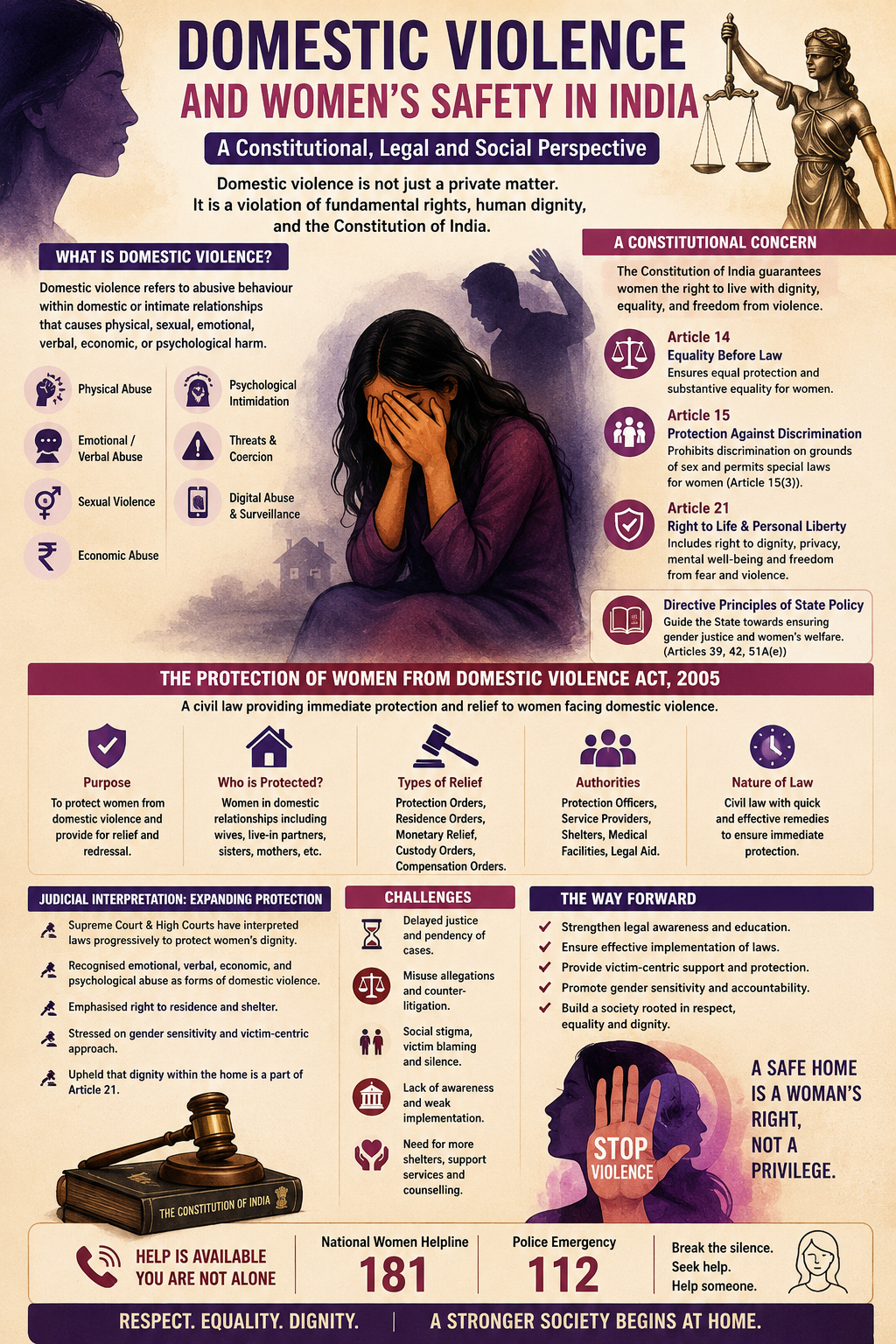
Introduction:
Domestic violence remains one of the most persistent and complex social and legal challenges in India. Despite constitutional guarantees of equality, dignity, and personal liberty, countless women continue to experience violence and coercion within their homes. The home, traditionally imagined as a space of care and emotional security, often becomes a site of physical abuse, emotional trauma, economic control, and psychological intimidation.
The issue has acquired renewed urgency in recent years due to increasing public awareness, judicial interventions, media reporting, and conversations around women’s rights. Contemporary cases involving dowry deaths, emotional abuse, marital cruelty, digital harassment, and suspicious deaths of married women have highlighted the continuing vulnerability of women within domestic relationships. These incidents have also exposed the limitations of legal enforcement, institutional mechanisms, and social support systems.
Domestic violence is no longer understood merely as physical assault. Modern legal and constitutional discourse recognises that violence may also take the form of:
Emotional abuse
Verbal humiliation
Sexual coercion
Economic deprivation
Social isolation
Digital surveillance
Psychological intimidation
Women’s safety in India therefore cannot be discussed only in the context of public spaces, workplace harassment, or street violence. Safety within homes and intimate relationships is equally important for ensuring constitutional dignity and equality.
The challenge before Indian society and the legal system is multifaceted. On one hand, there is an urgent need to protect victims of abuse through effective laws, accessible remedies, and institutional support. On the other hand, concerns regarding procedural fairness, misuse allegations, delayed justice, and social stigma complicate the implementation of domestic violence laws.
This blog exlain domestic violence and women’s safety in India through constitutional principles, statutory frameworks, judicial interpretation, contemporary legal debates, and ongoing socio-cultural challenges.
▪️Understanding Domestic Violence:
Domestic violence refers to abusive behaviour within domestic or intimate relationships aimed at controlling, intimidating, humiliating, or harming another individual.
Domestic violence may occur between:
Spouses
Live-in partners
Family members
Elderly dependents
Relatives within shared households
Although women are disproportionately affected, domestic violence impacts entire family structures, including children and elderly persons.
Modern legal understanding recognises domestic violence as extending beyond physical assault.
It includes:
Physical abuse
Emotional and verbal abuse
Sexual violence
Economic abuse
Psychological intimidation
Threats and coercive conduct
Digital abuse and surveillance
Domestic violence frequently involves patterns of control rather than isolated incidents of aggression.
▪️Domestic Violence as a Constitutional Concern:
Domestic violence is not merely a private family dispute. It is fundamentally connected to constitutional rights and human dignity.
The Indian Constitution provides a broad framework for protecting women against violence and discrimination.
Article 14: Equality Before Law
Article 14 guarantees equality before law and equal protection of laws.
Domestic violence undermines substantive equality because abuse within intimate relationships creates conditions of fear, dependency, and inequality.
Women experiencing violence are often denied:
Freedom of movement
Decision-making autonomy
Economic independence
Equal participation within family structures
The constitutional promise of equality therefore requires active legal protection against gender-based violence.
Article 15: Protection Against Gender Discrimination
Article 15 prohibits discrimination on grounds of sex while permitting the State to enact special protective laws for women under Article 15(3).
This constitutional provision forms the basis for:
Domestic violence legislation
Dowry laws
Sexual harassment protections
Maternity benefits
Gender-sensitive legal safeguards
The constitutional legitimacy of women-centric protective legislation emerges from the recognition that historical and structural inequalities require corrective legal intervention.
Article 21: Right to Life and Personal Liberty
Article 21 has become the most important constitutional provision in the context of women’s safety.
The Supreme Court has interpreted the right to life expansively to include:
Right to dignity
Bodily integrity
Mental well-being
Privacy
Freedom from fear
Autonomy and personal liberty
Domestic violence directly violates these constitutional guarantees.
A woman cannot meaningfully enjoy constitutional liberty while living under constant fear, humiliation, or coercion within her own home.
The evolution of Article 21 jurisprudence demonstrates the judiciary’s increasing recognition that dignity within private spaces is equally essential to constitutional democracy.
Directive Principles and Gender Justice
The Directive Principles of State Policy further reinforce constitutional commitment toward women’s welfare.
Relevant provisions include:
Article 39(a): Equal right to livelihood
Article 39(d): Equal pay for equal work
Article 42: Humane conditions of work and maternity relief
Although non-justiciable, these principles guide legislative and judicial interpretation concerning gender justice.
▪️The Protection of Women from Domestic Violence Act, 2005:
The enactment of the Protection of Women from Domestic Violence Act, 2005 represented a transformative moment in Indian family law jurisprudence.
Before this legislation, legal responses largely focused on criminal punishment after violence had already occurred.
The Domestic Violence Act shifted focus toward:
Immediate protection
Civil remedies
Residence rights
Economic support
Preventive relief
Key Features of the Domestic Violence Act
Broad Definition of Domestic Violence
The Act recognises:
Physical abuse
Emotional abuse
Sexual abuse
Verbal abuse
Economic abuse
This broader understanding was significant because many victims experience severe harm without visible physical injuries.
Right to Shared Household
A woman has the right to reside in the shared household regardless of ownership or title.
This provision prevents arbitrary eviction from matrimonial homes.
Protection Orders
Courts may prohibit:
Further acts of violence
Communication threats
Harassment
Contact or intimidation
Monetary Relief
Victims may receive:
Maintenance
Medical expenses
Compensation
Financial assistance
Custody Orders
Courts may issue temporary custody arrangements prioritising child welfare.
Protection Officers
Protection officers assist victims in:
Filing complaints
Obtaining shelter
Accessing medical care
Seeking legal remedies
▪️Criminal Law and Matrimonial Cruelty:
Domestic violence intersects significantly with criminal law.
Cruelty Provisions
Cruelty by a husband or his relatives related to harassment or abuse constitutes a criminal offence.
Cruelty includes:
Physical violence
Mental harassment
Dowry-related abuse
Conduct likely to cause grave injury or suicide
These provisions emerged due to increasing reports of severe matrimonial abuse and suspicious deaths of married women.
Dowry Harassment and Women’s Safety
Despite statutory prohibition under the Dowry Prohibition Act, dowry-related harassment remains deeply entrenched in Indian society.
Dowry demands frequently involve:
Cash payments
Vehicles
Property
Luxury goods
Financial assistance
Failure to satisfy demands may result in:
Emotional abuse
Isolation
Violence
Threats
Matrimonial abandonment
Dowry harassment reveals how patriarchal structures continue to commodify marriage and women’s roles within families.
Domestic Violence Beyond Physical Abuse
Modern understanding of domestic violence increasingly focuses on non-physical forms of abuse.
Emotional and Psychological Abuse
Psychological violence may involve:
Constant criticism
Humiliation
Threats
Manipulation
Isolation from family and friends
Character assassination
Mental cruelty can deeply affect emotional stability and self-worth.
Indian courts increasingly recognise that psychological abuse may be equally destructive as physical assault.
Economic Abuse
Economic dependency often traps women in abusive relationships.
Economic abuse may include:
Restricting access to money
Preventing employment
Confiscating earnings
Denying financial support
Controlling property and assets
Economic control operates as a powerful mechanism of domination.
Digital Abuse and Surveillance
Technology has created new dimensions of domestic abuse.
Examples include:
Monitoring phones
Tracking locations
Reading private messages
Online humiliation
Threats involving personal photographs
Cyberstalking
Domestic violence law increasingly intersects with privacy rights and cyber law concerns.
Domestic Violence and Mental Health
One of the most neglected aspects of domestic violence is its psychological impact.
Victims may experience:
Anxiety
Depression
Trauma
Fear
Social withdrawal
Emotional instability
Long-term abuse frequently damages confidence, independence, and mental well-being.
Children exposed to domestic violence may also suffer lasting emotional and behavioural consequences.
Thus, domestic violence constitutes both a legal and public health concern.
Domestic Violence in Urban and Educated Families
A widespread misconception suggests that domestic violence primarily affects economically weaker or uneducated communities.
However, abuse occurs across:
Urban households
Professional families
Educated communities
Economically privileged sections
Social prestige often conceals violence rather than preventing it.
Victims from affluent backgrounds may face additional pressure to preserve family reputation and avoid public scrutiny.
Live-In Relationships and Expanding Protection
Indian courts increasingly recognise protections for women in relationships “in the nature of marriage.”
This reflects:
Constitutional morality
Recognition of changing social realities
Protection of vulnerable partners
Courts have acknowledged that abuse may occur irrespective of formal marital status.
However, defining legally protected domestic relationships continues to generate litigation.
Judicial Trends in Contemporary India
Indian courts increasingly adopt a rights-based approach toward women’s safety.
▪️Judicial trends include:
Recognition of mental cruelty
Expansion of dignity jurisprudence
Protection of live-in partners
Caution against arbitrary arrests
Emphasis on fair investigation
Promotion of mediation where appropriate
Courts increasingly recognise that violence within the home affects constitutional freedoms.
▪️Misuse Debate and Procedural Fairness:
One of the most debated issues surrounding domestic violence law concerns allegations of misuse.
Critics argue that:
False complaints may occur during matrimonial disputes.
Criminal provisions are sometimes strategically invoked.
Women’s rights advocates respond that:
Misuse narratives are frequently exaggerated.
Genuine domestic violence remains severely underreported.
Fear of disbelief discourages victims from reporting abuse.
The legal system therefore faces a difficult balancing exercise:
Protecting victims
Ensuring fair investigation
Preventing arbitrary arrests
Preserving due process rights
The Supreme Court has repeatedly emphasised careful investigation and procedural fairness in matrimonial cases.
▪️Challenges in Implementation:
Despite progressive legal frameworks, implementation remains inadequate.
Social Stigma
Victims often fear:
Public shame
Family rejection
Social judgment
Economic insecurity
Women are frequently encouraged to tolerate abuse for the sake of preserving marriage.
Financial Dependency
Economic dependence remains a major obstacle to leaving abusive relationships.
Many women lack:
Independent income
Property awareness
Financial security
Access to support systems
Judicial Delays
Long litigation processes discourage victims from pursuing legal remedies.
Delays may involve:
Emotional exhaustion
Repeated hearings
Financial burden
Pressure for compromise
Justice delayed often weakens effective protection.
Institutional Weaknesses
Challenges include:
Shortage of protection officers
Inadequate shelter homes
Limited counselling services
Gender-insensitive policing
Lack of awareness in rural areas
Legal rights become ineffective without institutional support.
Domestic Violence as a Human Rights Issue
Domestic violence is internationally recognised as a human rights violation.
India’s obligations under international frameworks reinforce commitments toward gender equality and protection against violence.
Relevant international instruments include:
United Nations initiatives concerning women’s rights
Convention on the Elimination of All Forms of Discrimination Against Women
These frameworks emphasise:
Human dignity
Equality
Freedom from violence
State responsibility to protect vulnerable persons
▪️Role of Education and Social Reform:
Legal reform alone cannot eliminate domestic violence.
Long-term transformation requires:
Gender-sensitive education
Awareness campaigns
Economic empowerment of women
Community support systems
Cultural change challenging patriarchal attitudes
Violence cannot be addressed merely through punishment without broader social reform.
▪️Need for Institutional Reforms:
India requires stronger implementation mechanisms to improve women’s safety.
Necessary reforms include:
Fast-track domestic violence courts
Better victim counselling services
Expanded shelter infrastructure
Legal aid accessibility
Gender-sensitive police training
Mental health support systems
Technology may also improve:
Online complaint systems
Emergency response mechanisms
Evidence preservation
▪️Constitutional Morality and Women’s Dignity:
The concept of constitutional morality increasingly influences judicial interpretation concerning women’s rights.
Constitutional morality requires:
Respect for dignity
Equality within intimate relationships
Individual autonomy
Freedom from coercive social norms
Courts increasingly recognise that social customs cannot override constitutional protections.
Women’s safety must therefore be viewed not merely as welfare policy but as a constitutional imperative.
▪️Contemporary Relevance:
Domestic violence remains deeply relevant in contemporary India because it reveals the gap between constitutional ideals and lived realities.
India simultaneously witnesses:
Expanding constitutional jurisprudence
Increasing female education
Greater economic participation of women
Rising awareness of rights
Yet domestic abuse persists across social classes.
This contradiction demonstrates that genuine progress requires transformation within private spaces as much as public institutions.
▪️Conclusion:
Domestic violence remains a serious challenge to women’s dignity, equality, and safety in India. Despite strong constitutional protections and legal safeguards, many women continue to face physical, emotional, and economic abuse within their homes. Effective implementation of laws, institutional support, and social awareness are essential to ensure justice and meaningful protection for victims. Ultimately, safeguarding women from domestic violence is vital to upholding constitutional values and human dignity.
▪️Disclaimer
This blog is intended solely for educational, informational, and academic purposes.

Leave a Comment
Your email address and mobile number will not be published. Required fields are marked *