📑 Introduction
For most Indians, buying a house is not just a financial investment—it is an emotional milestone and often the result of years of hard work, savings, and sacrifices. Whether purchased through personal savings or financed through a home loan, a property represents security, stability, and long-term wealth. Along with the property itself, the original title documents serve as the most important proof of ownership and legal rights.
When an individual avails a home loan or a loan against property, banks and housing finance companies usually retain the original property documents as security until the borrower repays the loan. Customers hand over these valuable papers with complete confidence that a regulated financial institution will preserve them safely and return them immediately after the loan is closed.
But what happens if the bank itself loses those original documents? 🤔
Although such incidents are relatively uncommon, they do occur due to negligence, poor record management, accidental destruction, theft, fire, or administrative lapses. The consequences can be severe. A borrower may struggle to sell the property, obtain another loan, establish ownership during legal disputes, or complete succession proceedings. The emotional distress and financial burden caused by the disappearance of irreplaceable documents can be immense.
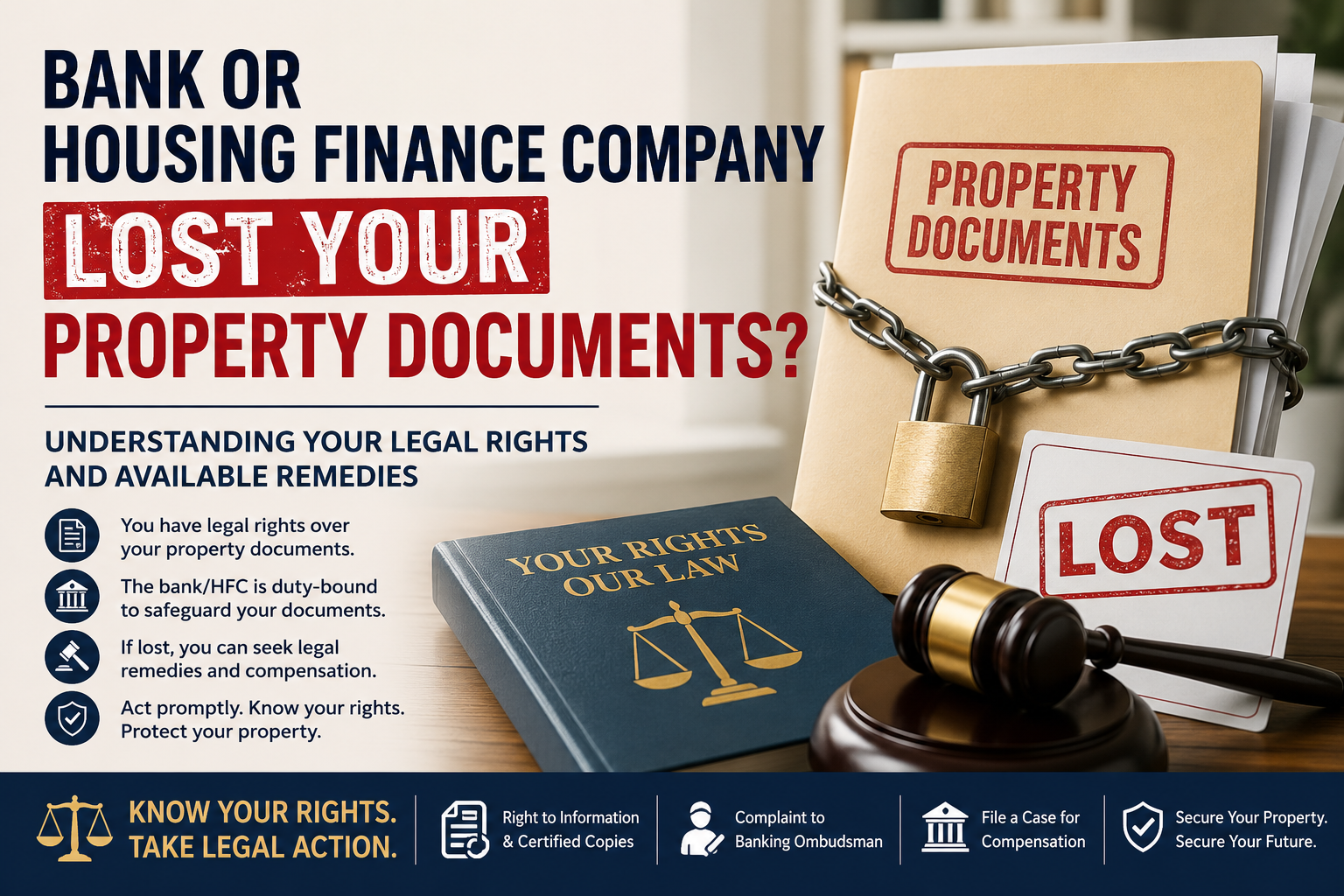
Fortunately, Indian law does not leave consumers without protection. ⚖️ A borrower whose original property documents are lost while in the custody of a bank or housing finance company has several legal rights and remedies. Courts and consumer commissions have repeatedly emphasized that financial institutions owe a duty of care towards documents entrusted to them and may be liable to compensate customers if they fail to discharge that responsibility.
This article explores the legal framework governing such situations, the responsibilities of lenders, the remedies available to consumers, judicial developments, compensation mechanisms, and practical steps that borrowers should take when faced with such an unfortunate situation.
🏦 Why Do Banks Keep Original Property Documents?
When a bank sanctions a housing loan or a loan against property, it creates a security interest over the immovable property to ensure repayment of the loan amount. One of the most common methods adopted in India is the deposit of original title deeds, often referred to as an equitable mortgage.
By depositing these documents, the borrower provides security to the lender, enabling the bank to enforce its rights in case of default. Until the loan is fully repaid, the original documents remain in the custody of the financial institution.
These documents may include:
📄 Original Sale Deed
📜 Conveyance Deed
🏡 Gift or Partition Deed
📑 Chain of Title Documents
🏗️ Approved Building Plan
✅ Occupancy or Completion Certificate
📋 Mutation Records
📝 Possession Letter
📂 Encumbrance Certificates
📌 Other supporting ownership records
Because these papers establish legal ownership and are often unique, they require careful preservation.
🔍 Why Are Original Property Documents So Important?
Many people assume that certified copies obtained from the Sub-Registrar's Office can always replace originals. While certified copies are legally recognized for many purposes, they cannot fully substitute the value of original documents.
Original title deeds serve as:
Evidence of lawful ownership.
Proof of an unbroken chain of title.
Essential documents for future mortgage transactions.
Important records during litigation.
Critical papers during resale or transfer of ownership.
Prospective buyers frequently insist on inspecting originals before purchasing property. Similarly, banks sanctioning future loans often conduct extensive title verification and may become cautious if originals are unavailable.
Consequently, the loss of original documents can reduce the commercial value and marketability of a property even when ownership itself remains legally intact.
⚖️ The Legal Duty of Banks and Housing Finance Companies
When customers hand over their original documents, a relationship of trust is created between the borrower and the lender.
The financial institution assumes responsibility for preserving those documents with reasonable care until they are returned.
The obligation extends beyond ordinary contractual duties. Under established legal principles governing custody of another person's property, the institution must exercise due care comparable to that expected from a prudent custodian handling valuable legal records.
This responsibility includes:
🔒 Secure storage systems.
📚 Proper indexing and inventory management.
🖥️ Document tracking mechanisms.
🚪 Restricted access to record rooms.
🔥 Fire protection measures.
💾 Digital backups wherever feasible.
📦 Safe return of every original document after loan closure.
If these precautions are ignored and documents are lost because of negligence, the institution may be held legally accountable.
💼 Fiduciary Responsibility of Financial Institutions
Banks occupy a position of confidence and trust in society.
Customers choose regulated financial institutions because they expect professional standards of record keeping and security. Unlike private individuals, banks possess dedicated infrastructure, trained personnel, internal compliance mechanisms, and standardized procedures.
Accordingly, courts often impose a higher duty of care upon banks.
If documents disappear due to poor management or administrative lapses, merely stating that the papers "could not be traced" is generally insufficient to absolve the institution of responsibility.
The burden often shifts to the bank to explain how such an important lapse occurred and what remedial measures have been undertaken.
🚨 Does Losing Original Documents Amount to Deficiency in Service?
In many situations, yes.
Consumer protection law recognizes banking services as services rendered for consideration. Borrowers pay processing charges, interest, documentation fees, and other financial costs in exchange for professional services.
When original documents entrusted to a bank are lost because of negligence or failure to maintain adequate safeguards, such conduct may amount to deficiency in service.
Consumer forums have repeatedly observed that borrowers suffer not only financial losses but also mental agony, inconvenience, delays, and uncertainty because of such negligence.
Simply expressing regret or providing photocopies rarely eliminates the hardship caused to the customer.
📉 Practical Problems Caused by Missing Original Documents
The loss of original property documents creates several real-world challenges.
🏠 Difficulty in Selling the Property
Potential buyers often become hesitant if original title deeds are unavailable. They may fear hidden disputes or defective ownership.
💳 Problems in Obtaining Future Loans
Banks generally insist upon inspection of original documents before approving fresh mortgages.
Missing originals may delay approval or lead to rejection.
⚖️ Litigation Challenges
Ownership disputes become more complicated when primary evidence is unavailable.
Courts may require additional proof, increasing legal costs and delays.
💰 Additional Expenses
Borrowers frequently incur costs for:
Police complaints.
Newspaper publications.
Certified copies.
Indemnity bonds.
Legal opinions.
Advocate fees.
Administrative charges.
😟 Mental Stress
For many families, their house represents their lifetime savings.
Discovering that essential ownership documents have disappeared often causes considerable anxiety and emotional distress.
📑 Can Certified Copies Solve the Entire Problem?
Certified copies issued by registration authorities certainly help establish ownership and may legally replace originals for several official purposes.
However, they cannot entirely eliminate practical concerns.
Future purchasers may demand detailed explanations.
Banks may require additional verification.
Lawyers conducting title due diligence may insist upon indemnities.
Insurance companies or investors may raise further queries.
Therefore, while certified copies reduce the impact of the loss, they rarely restore the borrower to exactly the same position enjoyed before the bank's negligence.
🛡️ Rights of Consumers Under Indian Law
Consumers are not expected to silently accept the negligence of financial institutions.
If a bank or housing finance company loses original property documents, borrowers possess several important rights.
These include:
✅ The right to receive a complete explanation regarding the loss.
✅ The right to demand written confirmation from the institution.
✅ The right to obtain assistance in reconstructing documents.
✅ The right to seek reimbursement of expenses incurred.
✅ The right to claim compensation for financial loss.
✅ The right to seek damages for mental harassment and inconvenience.
✅ The right to pursue legal proceedings before appropriate forums if satisfactory relief is not provided voluntarily.
🏛️ Judicial Approach in India
Indian courts and consumer commissions have consistently emphasized that banks owe a high duty of care regarding customers' original property documents.
Where negligence is established, courts have awarded compensation considering factors such as:
💰 Financial loss suffered.
😟 Mental harassment.
⏳ Delay caused to the borrower.
📉 Reduction in property value.
📝 Expenses incurred for reconstruction of documents.
Every case depends on its own facts, but institutions cannot ordinarily escape liability merely by stating that documents are untraceable.
📋 RBI and Regulatory Expectations
Although banks maintain their own internal procedures for document custody, they are generally expected to:
🔒 Maintain secure storage facilities.
📚 Keep proper inventory records.
🖥️ Adopt document tracking systems.
📦 Return documents promptly after loan closure.
🛡️ Protect customer assets through effective internal controls.
Failure to maintain adequate safeguards may expose the institution to legal consequences.
📝 What Should You Do If Your Documents Are Lost?
If you discover that your bank has lost your original property documents, act promptly.
Step 1️⃣: Obtain Written Confirmation
Ask the bank to provide written acknowledgment that the documents are missing.
Step 2️⃣: Submit a Formal Complaint
File a written complaint requesting immediate action and compensation.
Step 3️⃣: Request Reconstruction Assistance
Ask the bank to bear expenses for obtaining certified copies and other replacement documents.
Step 4️⃣: Lodge a Police Complaint (if necessary)
If advised, ensure that an FIR or general diary entry regarding the missing documents is recorded.
Step 5️⃣: Publish Public Notice
A newspaper notice may help inform the public and reduce future disputes regarding the missing originals.
Step 6️⃣: Consult a Lawyer
Professional legal advice can help determine the best course of action based on your specific circumstances.
💰 Can You Claim Compensation?
Yes. ✅
If negligence by the bank causes loss or inconvenience, borrowers may claim compensation.
The amount depends on factors such as:
Financial loss suffered.
Cost of obtaining replacement documents.
Litigation expenses.
Delay in transactions.
Mental agony and inconvenience.
Consumer commissions have awarded compensation in appropriate cases where negligence was clearly established.
🏛️ Where Can You File a Complaint?
Depending on the facts of the case, a borrower may consider approaching:
⚖️ Consumer Commission.
🏦 Banking grievance mechanisms.
📑 Banking Ombudsman framework (where applicable under the prevailing RBI grievance system).
🏛️ Civil Court for appropriate relief.
📝 Other competent legal forums available under law.
The appropriate remedy depends upon the nature of the dispute and the relief sought.
📂 Can Certified Copies Be Used Instead?
Yes, certified copies obtained from the registration authority are legally recognized for many purposes.
However:
They may not satisfy every buyer.
Additional verification may be required.
Banks may insist on further documentation.
Property transactions may become more time-consuming.
Therefore, certified copies reduce the problem but may not completely eliminate it.
❓Frequently Asked Questions
Q1. Can a bank legally lose my original documents?
No. Banks are expected to preserve documents with reasonable care and may be held liable if negligence is established.
Q2. Can I sell my property without original documents?
It may still be possible using certified copies and supporting evidence, but practical difficulties and delays are common.
Q3. Is the bank required to help obtain duplicate documents?
In many situations, yes. Courts have recognized that negligent institutions should assist borrowers and bear reasonable expenses arising from the loss.
Q4. Can I seek compensation for mental harassment?
Yes. Consumer forums have awarded compensation where borrowers suffered unnecessary stress and inconvenience due to negligence.
Q5. Does loan repayment end the bank's responsibility?
No. After repayment, the bank must promptly return all original documents in its custody.
✅ Conclusion
Original property documents are valuable legal assets, and banks or housing finance companies have a duty to protect them. If these documents are lost due to negligence, borrowers have the right to seek explanations, recover losses, and pursue appropriate legal remedies. ⚖️ Acting promptly and being aware of your rights can help ensure accountability and protect your property interests. 🏠📑
⚠️ Disclaimer
This article is intended for general informational and educational purposes only and should not be construed as legal advice or a substitute for professional legal consultation.

Leave a Comment
Your email address and mobile number will not be published. Required fields are marked *