🔹Introduction
India’s constitutional jurisprudence has consistently evolved to expand the meaning of the Right to Life and Personal Liberty under Article 21 of the Constitution. What began as a guarantee against arbitrary deprivation of life has gradually transformed into a comprehensive source of rights encompassing dignity, livelihood, health, education, privacy, clean environment, and safe living conditions.
In a significant development, the Supreme Court, while deciding Maniyar Iliyaz @ Shaik Riyaz & Anr. v. P. Ayyappan & Ors., recognized that the right to walk safely on footpaths forms an integral part of the constitutional guarantee under Article 21. The Court did not merely adjudicate a compensation dispute arising out of a road accident; it highlighted a structural problem affecting millions of pedestrians across India—unsafe, encroached, damaged, or non-existent footpaths.
The judgment has profound implications for constitutional law, urban governance, municipal administration, transport policy, and public safety. It reinforces the principle that constitutional rights are meaningful only when supported by adequate public infrastructure.
This article analyses the legal significance of the decision, traces the evolution of Article 21 jurisprudence, examines the duties imposed upon public authorities, compares international approaches to pedestrian rights, and explores the future of constitutional urbanism in India.
I. The Growing Constitutional Meaning of Article 21
Article 21 provides:
“No person shall be deprived of his life or personal liberty except according to procedure established by law.”
Although the language appears concise, judicial interpretation has dramatically expanded its scope.
Initially, in A.K. Gopalan v. State of Madras (1950), the Supreme Court adopted a narrow interpretation. However, constitutional philosophy changed after Maneka Gandhi v. Union of India (1978), where the Court held that any procedure affecting personal liberty must be “just, fair and reasonable.”
Since then, Article 21 has become the constitutional foundation for numerous implied rights, including:
- Right to live with dignity;
- Right to livelihood;
- Right to health;
- Right to pollution-free environment;
- Right to shelter;
- Right to education (before Article 21A);
- Right to privacy;
- Right to legal aid; and
- Right to speedy justice.
The recognition of safe pedestrian movement represents another logical extension of this evolving doctrine.
II. The Facts Behind Maniyar Iliyaz @ Shaik Riyaz & Anr. v. P. Ayyappan & Ors.
The dispute arose from a tragic road accident involving a young child. During the proceedings, the Supreme Court examined broader questions relating to road infrastructure and pedestrian safety rather than confining itself solely to compensation.
The Bench observed that public roads are designed not merely for motor vehicles but also for pedestrians, who constitute one of the most vulnerable classes of road users.
Recognising increasing fatalities caused by encroachments, broken pavements, poor urban planning, and inadequate pedestrian facilities, the Court stated that every citizen possesses a constitutional entitlement to move safely on public footpaths.
The Court also emphasised the need for legislative and executive measures to ensure effective pedestrian protection and directed attention to the absence of a comprehensive statutory framework governing safe footpath access.
By doing so, the judgment transformed what was traditionally viewed as a municipal responsibility into an issue involving constitutional rights.
III. Why Footpaths Matter in a Constitutional Democracy
Footpaths are often treated as minor components of transport infrastructure. In reality, they are indispensable to constitutional freedoms.
Every citizen begins and ends most journeys on foot.
Students walking to schools.
Senior citizens accessing hospitals.
Persons with disabilities navigating public spaces.
Street vendors carrying goods.
Workers commuting to employment.
Women travelling after sunset.
Children crossing neighbourhood roads.
Without safe pedestrian infrastructure, the practical enjoyment of multiple constitutional rights becomes impossible.
The absence of usable footpaths increases the risk of road accidents, discourages mobility, restricts access to education and employment, and disproportionately affects economically weaker sections who rely heavily on walking.
Accordingly, the constitutional guarantee of life with dignity cannot remain indifferent to pedestrian safety.
IV. Linking Footpath Safety with Human Dignity
The Supreme Court has repeatedly held that Article 21 protects not merely biological existence but dignified living.
Dignity includes the ability to move safely in public spaces without unreasonable exposure to preventable hazards.
When pedestrians are forced onto busy roads because sidewalks are occupied by debris, illegal parking, open drains, or permanent encroachments, the State effectively compels them to choose between mobility and safety.
Such conditions undermine equality and disproportionately affect vulnerable groups.
For elderly citizens and persons with disabilities, inaccessible footpaths can amount to exclusion from public life itself.
The constitutional obligation of the State therefore extends beyond constructing roads for vehicles—it includes ensuring that pedestrians can use those roads safely and with dignity.
V. Municipal Authorities and Constitutional Accountability
Municipal corporations and local bodies are entrusted with maintaining roads, drainage systems, pavements, and public spaces.
Historically, failures in infrastructure maintenance were viewed primarily as administrative lapses.
However, the Supreme Court’s evolving jurisprudence suggests that persistent neglect causing foreseeable injury may implicate constitutional obligations.
Authorities cannot justify dangerous conditions by citing budgetary limitations where continued inaction threatens life and safety.
The doctrine of constitutional governance increasingly demands proactive planning, regular maintenance, prompt removal of encroachments, proper illumination, and universal accessibility standards.
As Indian cities expand rapidly, municipal accountability must evolve from reactive repair to preventive governance.
Part II – Constitutional Framework:
VI. Article 14 and the Principle of Equal Access to Public Spaces
Although the Supreme Court’s observations primarily stem from Article 21, the right to safe pedestrian infrastructure also finds support in Article 14, which guarantees equality before law and equal protection of laws.
Equality is not merely formal; it requires the State to ensure that public infrastructure is accessible to all sections of society.
A city that is designed exclusively for motor vehicles but neglects pedestrians creates an indirect form of discrimination against:
- Children;
- Senior citizens;
- Persons with disabilities;
- Low-income workers;
- Daily wage labourers;
- Cyclists; and
- Individuals who cannot afford private transportation.
The constitutional vision of equality requires roads to serve every citizen, not merely those driving cars or motorcycles.
Where municipalities systematically fail to maintain footpaths while prioritising vehicular infrastructure, questions of constitutional equality may arise.
VII. Article 19 and the Freedom of Movement
Article 19(1)(d) guarantees every citizen the right to move freely throughout the territory of India.
The freedom to move is meaningful only when physical infrastructure enables safe movement.
If pedestrians cannot walk because:
- sidewalks are permanently occupied,
- open drains remain uncovered,
- construction debris blocks pathways,
- illegal parking occupies public spaces, or
- damaged pavements create serious hazards,
the practical exercise of constitutional freedom becomes severely restricted.
Thus, the recognition of pedestrian safety complements—not replaces—the broader constitutional protection of free movement.
VIII. Article 21 and the Evolution of “Right to Live with Dignity”
The Supreme Court has consistently interpreted Article 21 expansively.
Important milestones include:
1. Maneka Gandhi v. Union of India (1978)
The Court held that any law affecting life or liberty must satisfy standards of fairness, justice, and reasonableness.
This decision transformed Article 21 into a dynamic source of substantive rights.
2. Francis Coralie Mullin v. Administrator, Union Territory of Delhi (1981)
The Court recognised that life means more than mere animal existence.
It includes living with dignity, basic necessities, and meaningful human existence.
3. Olga Tellis v. Bombay Municipal Corporation (1985)
The Court declared that the right to livelihood forms part of Article 21.
Millions of workers depend upon safe public mobility to access employment.
Unsafe roads directly affect their livelihood.
4. Consumer Education and Research Centre v. Union of India (1995)
Health and workplace safety were recognised as constitutional concerns.
Similarly, pedestrian safety concerns protection against preventable injuries arising from public negligence.
5. Justice K.S. Puttaswamy v. Union of India (2017)
Privacy was recognised as a fundamental right flowing from dignity and liberty.
The judgment reaffirmed that Article 21 evolves with changing societal needs.
Recognition of safe walking infrastructure represents another example of this evolving constitutional philosophy.
IX. The Supreme Court’s Approach in Maniyar Iliyaz @ Shaik Riyaz Case
The Supreme Court observed that public roads are shared civic spaces intended for safe use by all categories of users.
The Court recognised that:
- pedestrians are among the most vulnerable road users;
- lack of proper footpaths contributes significantly to accidents;
- governments must prioritise pedestrian safety; and
- the right to walk safely is inseparable from constitutional protection under Article 21.
Rather than viewing road accidents solely through the lens of negligence, the judgment encourages authorities to address structural deficiencies in urban planning.
The ruling reflects an important shift from compensating victims after accidents to preventing accidents through constitutional governance.
X. Duties of Municipal Corporations and Local Authorities
Municipal authorities derive powers and responsibilities from various statutes enacted by State Legislatures.
Their responsibilities generally include:
- maintenance of roads;
- upkeep of pavements;
- removal of encroachments;
- drainage management;
- street lighting;
- public sanitation; and
- traffic coordination.
Failure to discharge these obligations can expose authorities to legal proceedings under:
- writ jurisdiction;
- public interest litigation;
- tort principles;
- compensation jurisprudence; and
- constitutional remedies.
The Supreme Court’s observations strengthen the expectation that local governments must proactively protect pedestrians rather than merely respond after accidents occur.
XI. Pedestrian Safety and the Directive Principles
Although not directly enforceable, several Directive Principles support safer public infrastructure.
Article 38
The State must promote social order based on justice.
Safe mobility is an essential component of social justice.
Article 39(e)
The State should protect health and strength of citizens against abuse.
Dangerous pedestrian conditions expose vulnerable populations to avoidable harm.
Article 41
Public assistance and welfare require infrastructure enabling citizens to participate in social and economic life.
Article 47
Improvement of public health is a primary duty of the State.
Reducing preventable road injuries contributes directly to this constitutional objective.
XII. Persons with Disabilities and Accessible Footpaths
India's obligations under disability rights legislation require barrier-free public infrastructure.
Footpaths lacking ramps, tactile paving, or safe crossings create systemic exclusion.
Accessible pedestrian infrastructure is therefore not merely an urban planning preference but a legal obligation linked with equality and dignity.
The Supreme Court’s broader reasoning aligns closely with inclusive governance principles.
XIII. International Perspective
United Nations Sustainable Development Goals
Goal 11 seeks sustainable, inclusive, and safe cities.
Pedestrian infrastructure forms an important component of urban sustainability.
World Health Organization
The WHO repeatedly identifies pedestrians as vulnerable road users requiring dedicated safety measures.
Countries investing in sidewalks, pedestrian crossings, and traffic calming report substantial reductions in fatalities.
European Cities
Several European jurisdictions adopt “pedestrian-first” planning where:
- continuous sidewalks;
- barrier-free crossings;
- universal accessibility;
- traffic calming; and
- integrated urban design
form mandatory planning principles.
United States
The concept of “Complete Streets” promotes roads designed for motorists, cyclists, pedestrians, and persons with disabilities simultaneously.
The Indian constitutional approach increasingly moves toward similar inclusive planning ideals.
XIV. Public Interest Litigation and Judicial Oversight
Unsafe roads frequently become subjects of Public Interest Litigation.
Courts have intervened regarding:
- potholes;
- illegal encroachments;
- absence of pedestrian crossings;
- school zone safety;
- traffic management failures; and
- municipal negligence.
The recognition of safe walking as a constitutional concern provides stronger legal foundations for future PILs seeking infrastructural reforms.
XV. Compensation and State Liability
Traditionally, accident victims pursued compensation under motor vehicle laws.
However, where accidents arise partly because authorities failed to maintain public infrastructure, constitutional courts have occasionally awarded compensation for violation of fundamental rights.
The jurisprudence demonstrates that public authorities cannot avoid accountability merely because negligence originates from institutional inaction.
When foreseeable dangers persist despite knowledge, constitutional remedies may become available alongside statutory claims.
XVI. Towards a Pedestrian-Centric Constitutional Order
The Supreme Court’s observations mark an important philosophical transition.
Roads should no longer be viewed as infrastructure serving vehicles alone.
Instead, constitutional governance requires roads to serve people.
Urban development should therefore prioritise:
- uninterrupted footpaths;
- universal accessibility;
- proper maintenance;
- removal of encroachments;
- safe crossings;
- adequate lighting; and
- integrated mobility planning.
Such measures are not merely administrative improvements but manifestations of constitutional values rooted in dignity, equality, and life itself.
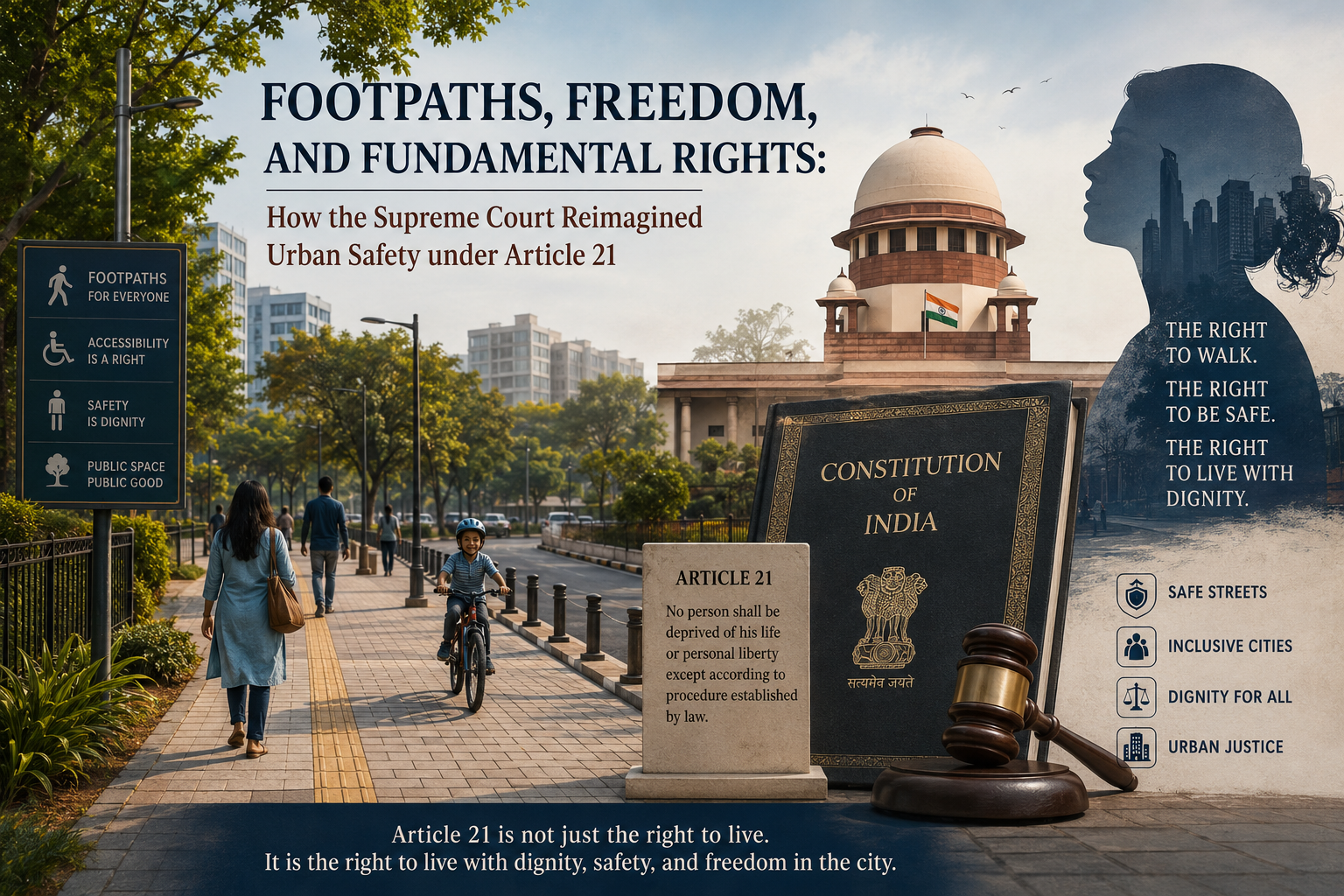
Footpaths, Freedom, and Fundamental Rights: How the Supreme Court Reimagined Urban Safety under Article 21
Part III – Policy Reforms
XVII. The Need for a Pedestrian-Centric Urban Policy
The Supreme Court’s recognition of the right to walk safely on footpaths is more than a judicial observation—it is a call for a paradigm shift in urban governance. For decades, Indian cities have largely been planned around motor vehicles, often treating pedestrians as an afterthought. This approach has resulted in broken sidewalks, illegal encroachments, poorly designed crossings, and inadequate accessibility for vulnerable groups.
A pedestrian-centric policy would require every urban development authority and municipal corporation to integrate walking infrastructure into the planning process from the very beginning. Such a policy should include:
- Continuous and obstruction-free footpaths;
- Universal accessibility for persons with disabilities;
- Proper lighting and surveillance;
- Safe pedestrian crossings at regular intervals;
- Tactile paving for visually impaired persons;
- Adequate drainage and maintenance systems; and
- Strict action against unauthorized encroachments.
Recognising these facilities as constitutional necessities rather than optional civic amenities would fundamentally transform urban planning in India.
XVIII. The Role of the Smart Cities Mission and Urban Development Authorities
The Government of India has invested heavily in smart city projects aimed at improving urban infrastructure and governance. However, technological advancement alone cannot create truly “smart” cities if pedestrians remain unsafe.
Urban development projects should therefore prioritize:
- Walkability indices;
- Public transport integration with footpaths;
- Last-mile connectivity;
- Barrier-free access for elderly citizens;
- Climate-resilient pedestrian infrastructure; and
- Digitally monitored maintenance systems.
Every redevelopment project should be evaluated not merely by the number of flyovers or expressways constructed but also by the quality and safety of pedestrian infrastructure provided.
XIX. Constitutional Torts and Government Accountability
Indian constitutional jurisprudence has gradually recognized that violations of fundamental rights may justify compensation under public law remedies.
Where governmental negligence directly contributes to loss of life or serious injury due to dangerous public infrastructure, courts may examine whether constitutional compensation is warranted in addition to statutory remedies.
Examples may include:
- Failure to repair hazardous sidewalks despite repeated complaints;
- Open drains adjacent to public pathways;
- Missing protective barriers near schools or hospitals;
- Dangerous construction debris left on footpaths; and
- Persistent encroachments ignored by authorities.
Although every accident does not automatically establish constitutional liability, systematic administrative failure may invite judicial scrutiny.
XX. Balancing Pedestrian Rights and Street Livelihoods
Indian footpaths often serve multiple social and economic functions. Street vendors provide affordable goods and contribute significantly to local economies.
The challenge lies in balancing:
- The constitutional right of pedestrians to safe movement; and
- The legal rights of licensed street vendors to carry on their occupation.
The solution is not indiscriminate eviction but scientific urban planning that allocates designated vending zones while preserving adequate walking space.
A rights-based approach should protect both livelihood and pedestrian safety without sacrificing either constitutional value.
XXI. Road Safety as a Public Health Issue
Road traffic accidents impose enormous social and economic costs.
Unsafe pedestrian infrastructure contributes to:
- Fatal injuries;
- Permanent disabilities;
- Increased healthcare expenditure;
- Productivity losses;
- Psychological trauma; and
- Financial hardship for families.
Viewing pedestrian safety as a public health priority aligns with constitutional commitments to protect life and improve the well-being of citizens.
Investment in sidewalks and crossings is therefore not merely an infrastructure expense but a long-term public welfare measure.
XXII. What This Judgment Means for Citizens
The Supreme Court’s recognition of safe walking as part of Article 21 empowers citizens in several ways.
Residents may increasingly demand:
- Removal of illegal encroachments;
- Repair of damaged pavements;
- Installation of pedestrian crossings;
- Better street lighting;
- Accessible infrastructure for disabled persons; and
- Improved municipal maintenance.
Public Interest Litigations seeking safer urban infrastructure are also likely to receive stronger constitutional support in the future.
XXIII. What This Means for Municipal Authorities
Municipal bodies can no longer regard pedestrian infrastructure as a secondary concern.
Good governance now requires:
- Periodic safety audits;
- Maintenance schedules;
- Public complaint mechanisms;
- Coordination with traffic police;
- Accessibility compliance reviews;
- Emergency repair protocols; and
- Transparent accountability systems.
Failure to adopt preventive measures may expose authorities to legal challenges and reputational consequences.
XXIV. Frequently Asked Questions (FAQs)
1. Has the Supreme Court declared the right to walk safely a fundamental right?
The Supreme Court has observed that the ability to walk safely on footpaths is an integral component of the protection guaranteed under Article 21 of the Constitution, linking pedestrian safety with the right to life and dignity.
2. Does this create new legal duties for governments?
While municipalities already have statutory obligations regarding public infrastructure, the constitutional recognition strengthens expectations that authorities must proactively ensure pedestrian safety.
3. Can citizens approach courts regarding unsafe footpaths?
Yes. Depending on the facts, citizens may seek remedies through writ petitions, public interest litigation, or other legal proceedings where governmental inaction results in significant public safety concerns.
4. Does the judgment affect urban planning?
Yes. The decision encourages authorities to adopt a more inclusive approach that places pedestrians at the centre of infrastructure planning rather than treating them as secondary road users.
5. Are street vendors automatically illegal because footpaths belong to pedestrians?
No. Street vending is regulated by law and protected in appropriate circumstances. The challenge lies in ensuring that vending activities do not completely obstruct public movement while simultaneously respecting lawful livelihoods.
XXV. Key Takeaways
- Article 21 continues to evolve through purposive constitutional interpretation.
- Safe pedestrian movement is increasingly recognised as an essential component of life with dignity.
- Municipal governance and constitutional rights are closely interconnected.
- Urban planning must balance mobility, accessibility, livelihood, and public safety.
- The judiciary is encouraging preventive governance rather than merely post-accident compensation.
Conclusion
The Supreme Court’s recognition of the right to walk safely on footpaths under Article 21 reinforces that safe and accessible public spaces are essential to the right to life and dignity. The decision places greater responsibility on governments and municipal authorities to ensure pedestrian-friendly infrastructure and highlights that urban development must protect the rights of every citizen, not just motorists.
Disclaimer:
This article is intended solely for informational and educational purposes.

Leave a Comment
Your email address and mobile number will not be published. Required fields are marked *