🖋️Introduction:
The Indian Constitution is not merely a legal document; it is a living instrument designed to protect human dignity, liberty, and justice. Among all constitutional provisions, Article 21 has emerged as one of the most dynamic and transformative guarantees in Indian constitutional law. It states:
“No person shall be deprived of his life or personal liberty except according to procedure established by law.”
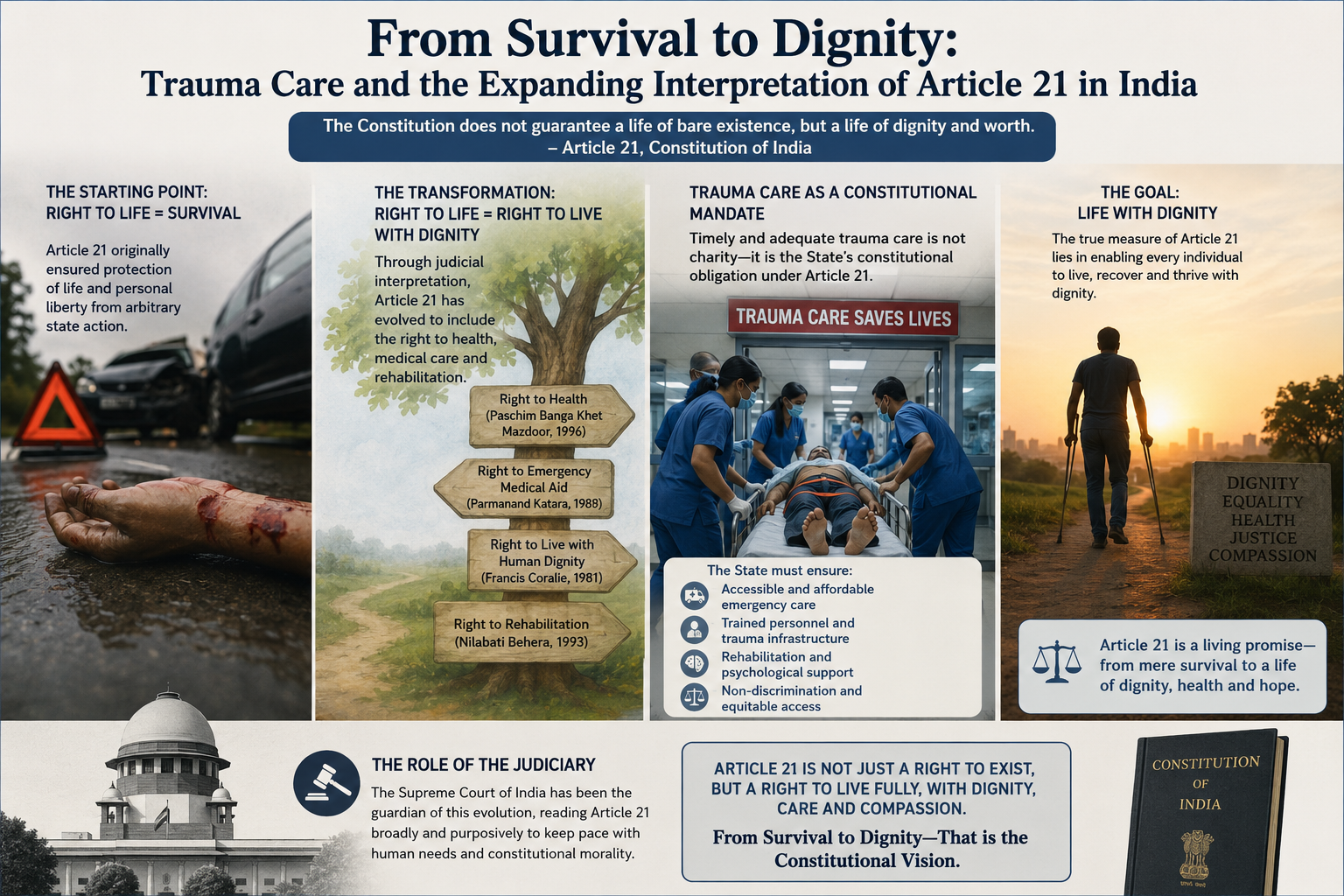
At first glance, the provision appears simple and restrictive. However, over decades of judicial interpretation, the Supreme Court of India has transformed Article 21 into a vast source of fundamental human rights. The concept of “life” under Article 21 no longer means mere animal existence or physical survival. Instead, it encompasses dignity, health, livelihood, education, privacy, clean environment, legal aid, and access to medical care.
One of the most significant modern developments in this constitutional evolution is the recognition of trauma care and emergency medical treatment as an essential part of the right to life. In a country where thousands die annually due to delayed medical assistance, inadequate emergency infrastructure, and refusal of treatment by hospitals, the constitutional importance of trauma care has become increasingly relevant.
Road accidents, industrial disasters, medical emergencies, natural calamities, and violent incidents often demand immediate medical intervention. In such situations, even a delay of a few minutes can determine whether a person survives, suffers permanent disability, or loses life altogether. The constitutional question therefore arises:
Can the State permit a situation where emergency medical care is inaccessible, delayed, or denied?
Indian courts have increasingly answered this question in the negative. Through progressive judicial interpretation, the right to trauma care has gradually evolved into a constitutional obligation flowing directly from Article 21.
This article explain the constitutional foundations, judicial developments, policy concerns, and future challenges surrounding trauma care in India. It explores how Indian constitutional jurisprudence has shifted from protecting mere survival to ensuring dignified existence through accessible emergency healthcare.
⚖️ Understanding Article 21: From Narrow Interpretation to Human Dignity:
Initially, Article 21 received a narrow interpretation in A.K. Gopalan v. State of Madras (1950), where the Supreme Court adopted a restrictive reading of personal liberty. However, constitutional jurisprudence changed dramatically after Maneka Gandhi v. Union of India (1978).
In Maneka Gandhi, the Court held that the “procedure established by law” must be just, fair, and reasonable. This judgment expanded the scope of Article 21 and transformed it into the heart of fundamental rights jurisprudence.
The Court gradually recognized several derivative rights under Article 21, including:
- Right to live with dignity
- Right to livelihood
- Right to health
- Right to clean environment
- Right to legal aid
- Right to shelter
- Right to privacy
- Right to emergency medical treatment
This expansion reflected the judiciary’s understanding that constitutional rights must adapt to evolving social realities.
The interpretation of Article 21 shifted from:
«“Protection against unlawful deprivation of life”»to
“Protection of conditions necessary for a dignified human existence.”
Healthcare, particularly emergency healthcare, naturally became part of this constitutional vision.
🚑 Trauma Care and Emergency Medical Treatment: Why It Matters:
Trauma care refers to immediate medical treatment provided to individuals suffering from severe physical injuries or medical emergencies. Such care includes:
- Emergency accident treatment
- Ambulance services
- Critical surgical intervention
- Intensive care support
- Stabilization treatment
- Disaster response mechanisms
- Emergency cardiac and neurological treatment
India witnesses an alarming number of preventable deaths caused by delayed trauma response. According to road safety data, a significant percentage of accident victims die during the “golden hour” — the critical period immediately following severe injury when prompt medical attention can save lives.
Unfortunately, several systemic problems continue to affect emergency care in India:
- Refusal of treatment due to police formalities
- Lack of trauma centers in rural areas
- Financial barriers
- Inadequate ambulance infrastructure
- Delayed referrals between hospitals
- Shortage of trained emergency specialists
- Overcrowded public hospitals
These failures raise serious constitutional concerns because the right to life loses meaning if emergency medical assistance is unavailable when needed most.
⚖️ Judicial Recognition of Medical Care as a Fundamental Right
1. Parmanand Katara v. Union of India (1989)
One of the most important judgments concerning emergency medical treatment was Parmanand Katara v. Union of India.
In this case, the Supreme Court held that every doctor, whether in a government or private hospital, has a professional obligation to provide immediate medical aid to injured persons without waiting for legal or procedural formalities.
The Court observed:
“Preservation of human life is of paramount importance.”
The judgment emphasized that procedural requirements such as police reporting cannot override the duty to save human life.
This case laid the constitutional foundation for emergency trauma care rights in India.
Significance:
- Immediate treatment became a legal obligation.
- Hospitals could not refuse emergency patients.
- Human life received constitutional priority over administrative procedures.
2. Paschim Banga Khet Mazdoor Samity v. State of West Bengal (1996)
This landmark case significantly expanded the constitutional right to healthcare.
A patient suffering from severe head injuries was denied treatment by multiple government hospitals due to lack of facilities. The Supreme Court held that failure of government hospitals to provide timely medical treatment violated Article 21.
The Court declared:
“Providing adequate medical facilities is an essential obligation of the State.”
The judgment recognized that the State cannot avoid constitutional responsibility merely due to financial or infrastructural limitations.
Important Principles Established:
- Right to emergency medical treatment is part of Article 21.
- The government has a constitutional duty to strengthen healthcare systems.
- Inability to provide medical facilities may amount to violation of fundamental rights.
This judgment directly linked trauma care to constitutional governance.
3. Consumer Education and Research Centre v. Union of India (1995)
The Court recognized health and medical care as integral to a dignified life under Article 21.
It held that:
- Protection of worker health is a constitutional obligation.
- Medical facilities are essential for preserving human dignity.
This judgment strengthened the constitutional basis of healthcare rights.
🏥 Trauma Care and the Concept of Human Dignity:
The evolution of Article 21 reflects a broader constitutional philosophy:
«Human life must not merely exist; it must exist with dignity.»
Trauma care is closely connected to dignity because emergency medical response determines:
- Whether a person survives,
- Whether permanent disability is prevented,
- Whether pain and suffering are minimized,
- Whether equal access to healthcare exists.
The denial of emergency care often disproportionately affects:
- Poor citizens
- Rural populations
- Accident victims
- Migrant workers
- Marginalized communities
Therefore, trauma care is not only a healthcare issue but also a social justice issue.
The constitutional principle of dignity requires:
- Immediate treatment regardless of financial condition,
- Non-discriminatory access to healthcare,
- Emergency response systems accessible to all citizens.
🚨 The Golden Hour and Constitutional Responsibility
Medical science recognizes the “golden hour” as the crucial period after traumatic injury during which immediate medical care significantly improves survival chances.
Failure during this period can result in:
- Brain damage,
- Permanent disability,
- Organ failure,
- Preventable death.
If the State fails to ensure emergency response infrastructure during this critical period, questions of constitutional accountability arise.
The judiciary increasingly views emergency healthcare infrastructure as part of the State’s constitutional obligations under:
- Article 21 (Right to Life),
- Directive Principles of State Policy,
- Public welfare responsibilities.
📜 Constitutional Framework Supporting Trauma Care:
Although the Constitution does not explicitly mention “trauma care,” several constitutional provisions collectively support it.
Article 21
Protects life and dignity.
Article 38
Directs the State to promote social welfare.
Article 39(e)
Protects health and strength of workers.
Article 41
Provides public assistance in sickness and disablement.
Article 47
Makes improvement of public health a primary duty of the State.
The Supreme Court has repeatedly used Directive Principles to strengthen the interpretation of Article 21.
🏛️ Government Initiatives and Trauma Care Infrastructure
India has introduced several policies aimed at improving emergency healthcare:
🚑 National Ambulance Services (108 Emergency Service)
The 108 emergency response system provides:
- Ambulance services,
- Accident response,
- Medical transport.
However, accessibility remains uneven across states.
🏥 AIIMS Trauma Centres and Emergency Networks
Specialized trauma centers have been established in metropolitan regions, though rural India still lacks adequate facilities.
🚦 Good Samaritan Guidelines
Fear of police harassment often prevented bystanders from helping accident victims. To address this issue, the Supreme Court approved Good Samaritan Guidelines protecting individuals who assist injured persons.
These guidelines:
- Prevent unnecessary questioning,
- Protect anonymity,
- Encourage public assistance during emergencies.
This was a major step toward strengthening trauma response culture in India.
⚖️ Private Hospitals and Constitutional Obligations
An important legal question concerns whether private hospitals also have constitutional responsibilities.
Indian courts have increasingly emphasized that:
- Emergency care cannot be denied merely because a patient cannot pay immediately.
- Private hospitals performing public functions may bear public law obligations.
Healthcare cannot be treated purely as a commercial activity when human life is at stake.
However, balancing:
- private healthcare economics,
- medical ethics,
- constitutional duties,
remains a continuing challenge.
⚠️ Challenges Facing Trauma Care in India
Despite judicial recognition, several practical problems continue to exist.
1. Rural Healthcare Deficiency
Most advanced trauma facilities remain concentrated in urban areas.
2. Shortage of Medical Professionals
Emergency medicine specialists are insufficient in number.
3. Poor Road and Ambulance Connectivity
Delayed transport remains a major cause of preventable deaths.
4. Financial Inequality
Many citizens cannot afford emergency private care.
5. Lack of Awareness
Citizens often remain unaware of their rights regarding emergency treatment.
6. Administrative Negligence
Coordination failures between hospitals and emergency services continue to affect patient survival.
🧑⚖️ Expanding Judicial Activism in Healthcare Rights
Indian courts increasingly intervene in healthcare-related matters:
- oxygen shortages,
- hospital negligence,
- medicine availability,
- pandemic management,
- emergency treatment access.
This reflects judicial recognition that:
Constitutional rights become meaningless without healthcare access.
However, critics argue excessive judicial intervention may blur the separation of powers.
Supporters respond that judicial activism becomes necessary when executive failures threaten human life.
🦠 Lessons from the COVID-19 Pandemic
The COVID-19 pandemic exposed severe weaknesses in India’s healthcare system:
- oxygen shortages,
- ambulance delays,
- hospital bed scarcity,
- medicine black marketing.
Courts across India repeatedly invoked Article 21 to direct governments to ensure:
- oxygen supply,
- treatment access,
- affordable medical services.
The pandemic reinforced the constitutional importance of healthcare infrastructure and emergency preparedness.
It demonstrated that:
«Healthcare is not charity; it is a constitutional necessity.»
⚖️ Trauma Care as a Human Rights Issue
International human rights law increasingly recognizes healthcare access as a basic human right.
Relevant international instruments include:
- Universal Declaration of Human Rights (UDHR),
- International Covenant on Economic, Social and Cultural Rights (ICESCR).
India’s constitutional interpretation often incorporates international human rights principles.
Thus, trauma care is not merely a welfare policy issue but part of broader human rights protection.
📌 Conclusion
The journey of Article 21 reflects one of the greatest constitutional transformations in Indian legal history. What began as a narrow protection against unlawful deprivation of life has evolved into a powerful guarantee of dignified existence.The recognition of trauma care as part of Article 21 signifies an important constitutional shift.
📌 Important Note
This article is intended solely for educational and informational purposes.

Leave a Comment
Your email address and mobile number will not be published. Required fields are marked *