🔹Introduction
Imagine driving on a busy road and noticing a vehicle with its number plate partially covered by tape, mud, a cloth, or even a tinted sheet. Such incidents have become increasingly common, especially with the widespread use of CCTV cameras, speed cameras, and automated challan systems.
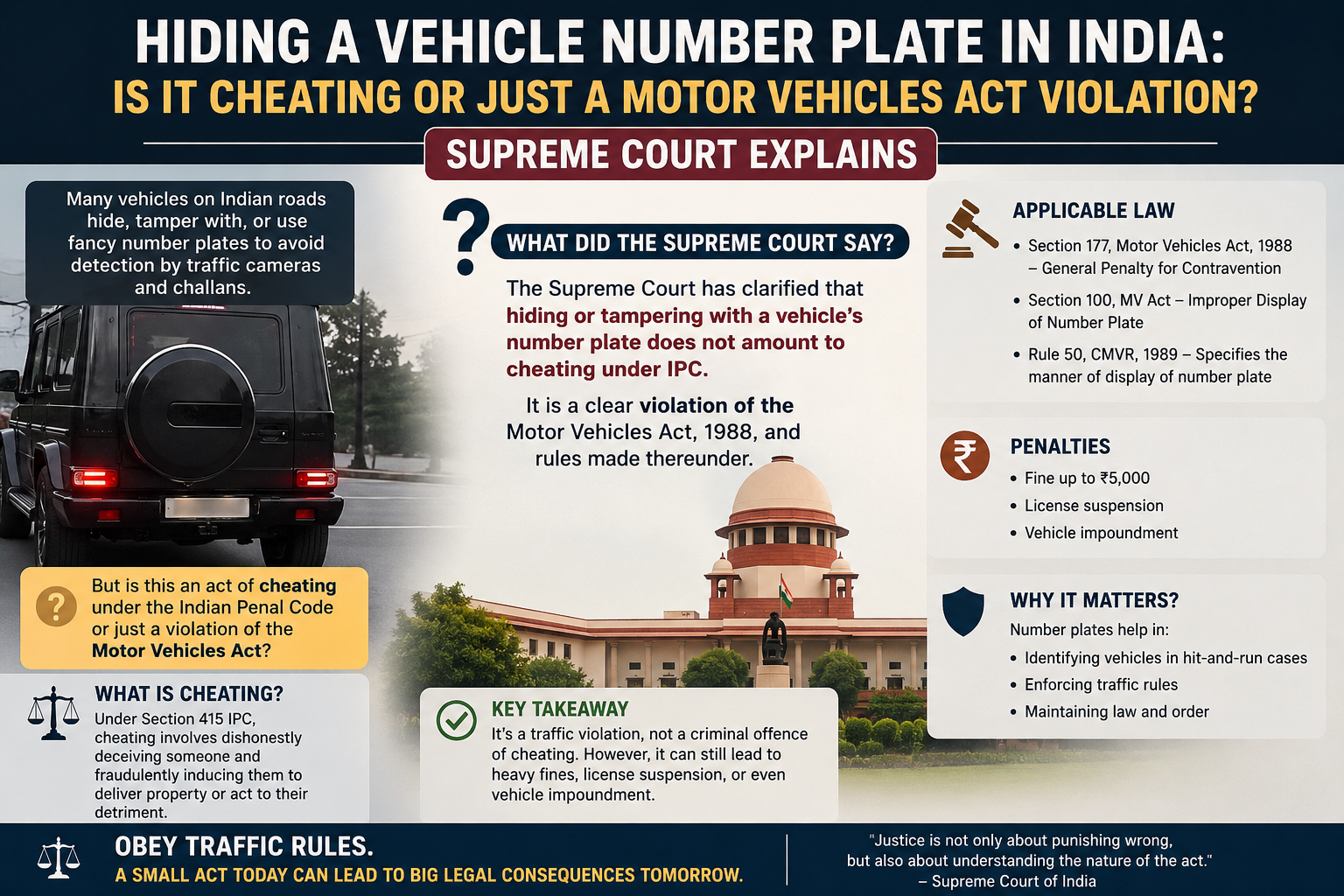
Many people assume that hiding a vehicle's registration number automatically amounts to the criminal offence of cheating. Others believe it is merely a traffic violation. This legal confusion was recently addressed by the Supreme Court of India, which clarified an important distinction:
Concealing or hiding a vehicle's number plate may violate the Motor Vehicles Act, but it does not automatically constitute the offence of cheating unless the legal ingredients of cheating are independently established.
The judgment highlights a broader principle of criminal law: every unlawful act is not necessarily a criminal offence under the Indian Penal Code or the Bharatiya Nyaya Sanhita (BNS). Some acts attract only regulatory penalties unless accompanied by additional criminal intent or statutory requirements.
This distinction is significant because it protects individuals from being prosecuted under serious criminal provisions where the facts disclose only a traffic offence.
Why Do People Hide Vehicle Number Plates?
Across India, vehicle owners conceal registration numbers for various reasons. While many of these reasons involve an intention to evade enforcement, the legal consequences differ depending on the circumstances.
Common methods include:
Covering one or more digits with tape.
Using reflective sprays to confuse cameras.
Installing fancy fonts or decorative plates.
Folding or bending the number plate.
Allowing excessive mud or dust to obscure the registration number.
Using tinted covers over the registration plate.
Temporarily removing the plate.
Such practices generally aim to avoid:
Speed camera detection.
Automatic traffic challans.
Toll collection.
Parking penalties.
Identification after traffic violations.
Although these actions may breach the Motor Vehicles Act and related rules, they do not automatically satisfy the ingredients of offences like cheating, forgery, or impersonation.
Why Was the Supreme Court Required to Clarify the Law?
Over time, police authorities in certain cases invoked not only provisions of the Motor Vehicles Act but also criminal offences such as cheating.
The issue before the Supreme Court was whether:
Merely hiding a vehicle's registration number, without more, is sufficient to constitute the offence of cheating.
The Court answered this question in the negative.
The Court emphasized that criminal offences cannot be presumed merely because an act appears suspicious or dishonest. Every criminal charge has specific legal ingredients that must be proved independently.
The Fundamental Principle of Criminal Law
Indian criminal jurisprudence follows an important doctrine:
No person can be punished unless every essential ingredient of the offence is established.
Courts do not examine merely whether an act appears morally wrong.
Instead, they ask:
What statute has been violated?
What are the legal ingredients?
Is criminal intention present?
Has wrongful loss or deception occurred?
Does the evidence satisfy every statutory requirement?
This principle prevents unnecessary criminalisation of regulatory violations.
Difference Between Regulatory Offences and Criminal Offences
Many people believe that every violation of law is automatically a crime.
This is incorrect.
Indian law broadly recognizes two categories:
1. Regulatory Violations
These regulate public administration and safety.
Examples include:
Traffic violations.
Parking violations.
Pollution certificate violations.
Driving without documents.
Helmet violations.
These usually attract:
Fines
Penalties
Suspension
Administrative action
2. Criminal Offences
These involve conduct specifically prohibited under criminal law.
Examples include:
Murder
Theft
Robbery
Forgery
Criminal breach of trust
Cheating
These may lead to:
Arrest
Criminal trial
Conviction
Imprisonment
The Supreme Court clarified that concealing a number plate ordinarily belongs to the first category unless additional facts justify criminal prosecution.
Understanding the Purpose of Vehicle Registration Numbers
A registration number serves several legal functions.
It enables authorities to identify:
The registered owner.
Insurance details.
Tax compliance.
Criminal investigations.
Accident liability.
Traffic enforcement.
Stolen vehicles.
Because of these purposes, Indian law requires registration numbers to remain clearly visible at all times.
What Does the Motor Vehicles Law Require?
Vehicle owners are legally required to display registration marks in the prescribed manner.
The law and the relevant rules require that registration plates:
remain clearly visible;
follow prescribed dimensions;
use approved fonts;
not be tampered with;
not be covered or obscured.
Failure to comply can attract penalties under the Motor Vehicles Act and related rules.
Does Hiding a Number Plate Show Dishonest Intention?
Perhaps.
But criminal law requires more than suspicion.
The Supreme Court noted that:
Dishonest conduct alone does not automatically amount to cheating.
For cheating to exist, every statutory ingredient must be satisfied.
Therefore, investigators cannot simply presume cheating because someone attempted to avoid a traffic camera.
Understanding the Offence of Cheating
One of the most misunderstood offences in Indian criminal law is cheating.
Many people use the term casually.
Legally, however, cheating has a precise meaning.
Generally, cheating requires:
deception of a person;
fraudulent or dishonest intention;
inducement because of that deception;
delivery of property or alteration of a valuable legal position, or causing legally recognized harm.
If these elements are absent, the offence of cheating may not be established.
Illustration
Suppose a driver covers the last digit of the registration plate to avoid receiving an automated speeding challan.
The driver has certainly violated traffic regulations.
However, unless the prosecution proves the legal ingredients required for cheating, merely hiding the plate does not automatically transform the conduct into that criminal offence.
Why This Judgment Matters
The Supreme Court's clarification is important because it reinforces several constitutional and criminal law principles:
1. Criminal law must be interpreted strictly.
Courts cannot enlarge criminal offences merely because conduct appears blameworthy.
2. Every illegal act is not cheating.
Different statutes address different wrongs.
Traffic violations remain traffic violations unless additional criminal conduct exists.
3. Police cannot mechanically add serious criminal charges.
Investigating agencies must examine whether every legal ingredient is actually present.
4. Citizens remain accountable.
The judgment does not legalise hiding number plates.
Such conduct continues to violate the Motor Vehicles Act and may attract fines or other legal consequences.
Practical Examples
Example 1
A driver places tape over one digit to avoid a speed camera.
Likely consequence:
✔ Motor Vehicles Act violation.
Not automatically cheating.
Example 2
A person installs a fake registration plate belonging to another vehicle.
Possible consequences may extend beyond traffic law and could involve additional criminal offences, depending on the facts.
Example 3
A criminal uses a concealed number plate while committing robbery.
The concealed plate itself may remain a traffic violation, but the surrounding facts can give rise to other serious criminal offences.
Key Legal Principle Emerging from the Judgment
The Supreme Court reaffirmed that:
The nature of an offence depends upon the legal ingredients established by evidence—not merely upon the appearance of misconduct.
This principle strengthens the rule of law by ensuring that criminal liability is imposed only where the law clearly permits it.
⚖️ Why the Supreme Court Held That Concealing a Number Plate Is Not Automatically Cheating
Understanding the Supreme Court's Legal Reasoning
The Supreme Court made one thing abundantly clear:
Every violation of law does not amount to a criminal offence of cheating.
Simply because a driver hides a vehicle's registration number does not mean that the offence of cheating is made out. Courts cannot presume criminal liability merely from suspicious or unlawful conduct.
Instead, every criminal charge must satisfy the specific ingredients prescribed by law. 🏛️
This ruling reinforces one of the cornerstones of criminal jurisprudence:
Criminal statutes must be interpreted strictly, and no person can be punished unless every legal ingredient of the alleged offence is proved beyond reasonable doubt.
📖 What Is "Cheating" Under the Bharatiya Nyaya Sanhita (BNS)?
Although the wording has been updated under the Bharatiya Nyaya Sanhita, 2023 (BNS), the essential principles governing the offence of cheating remain substantially similar to the earlier law.
For an offence of cheating to be established, the prosecution must generally prove the following essential ingredients:
✅ 1. Deception
The accused must deceive another person.
There must be some form of misrepresentation, concealment, or dishonest conduct intended to create a false belief.
Without deception, the offence cannot arise.
✅ 2. Dishonest or Fraudulent Intention
The dishonest intention must exist at the very beginning of the transaction or conduct.
A subsequent dishonest act does not automatically convert an earlier lawful act into cheating.
This principle has repeatedly been emphasized by Indian courts.
✅ 3. Inducement
The deception must induce another person to:
deliver property,
consent to retention of property,
alter a valuable security,
or act in a manner causing legal harm.
Without inducement, cheating generally cannot be established.
✅ 4. Wrongful Gain or Wrongful Loss
The deception should result in:
wrongful gain to one person, or
wrongful loss to another.
This distinguishes cheating from many regulatory offences.
🚗 Why Does Hiding a Number Plate Usually Fail to Meet These Ingredients?
The Supreme Court observed that merely concealing a registration plate does not automatically establish these essential requirements.
For example:
A driver covers one digit of the registration plate using black tape.
What has happened?
✔ The registration plate is concealed.
✔ The driver may violate traffic regulations.
But:
❌ Has anyone been deceived into delivering property?
❌ Has any person been induced to transfer money?
❌ Has any valuable security been altered?
❌ Has the statutory definition of cheating been fully satisfied?
Not necessarily.
Therefore, the Court held that such conduct cannot automatically attract the offence of cheating.
🚦 Then Which Law Applies?
Instead of invoking cheating provisions, the conduct primarily falls within the regulatory framework of the Motor Vehicles Act, 1988 and the rules governing registration marks.
The Act requires every vehicle owner to display the registration number:
✅ Clearly visible
✅ In the prescribed format
✅ Without obstruction
✅ Without unauthorized alteration
Failure to comply may attract penalties prescribed under the Motor Vehicles Act.
📸 Why Do Authorities Take Hidden Number Plates Seriously?
Even though it may not amount to cheating, concealing a number plate is far from harmless.
It can seriously interfere with:
🚔 Police investigations
📷 Automated traffic enforcement
🛣️ Toll collection systems
🚑 Accident investigations
🚨 Hit-and-run detection
🚓 Criminal investigations
Insurance verification
Road safety enforcement
Modern traffic management increasingly relies upon technology.
Automatic Number Plate Recognition (ANPR) cameras identify vehicles within seconds.
When the registration number is concealed, these systems become ineffective.
That is precisely why the Motor Vehicles Act prohibits such conduct.
📱 Growing Use of Technology in Traffic Enforcement
Across India, cities increasingly rely on:
📷 CCTV cameras
🚦 AI-enabled traffic surveillance
📸 Speed detection cameras
🛣️ Electronic toll systems
🤖 Automated challan generation
These technologies improve road safety and reduce manual enforcement.
However, they also create incentives for some individuals to hide their registration numbers.
The Supreme Court's judgment balances these realities by distinguishing between:
✔ regulatory violations; and
✔ serious criminal offences.
⚠️ Can Hiding a Number Plate Ever Lead to Criminal Charges?
Yes.
The Supreme Court did not say that criminal liability is impossible.
Rather, it clarified that mere concealment does not automatically constitute cheating.
Criminal liability may arise if additional facts exist.
For example:
🚔 Example 1: Fake Registration Plate
A person installs another vehicle's registration number to disguise a stolen car.
Possible consequences:
✔ Motor Vehicles Act violations
✔ Additional criminal offences, depending upon the facts.
💰 Example 2: Insurance Fraud
Suppose someone intentionally conceals the vehicle's identity while planning an insurance fraud.
Now investigators may examine offences relating to:
fraud,
forgery,
impersonation,
cheating,
depending upon the evidence.
🚨 Example 3: Criminal Conspiracy
Suppose offenders cover the number plate before committing:
robbery,
kidnapping,
organized crime,
terrorism.
The concealed plate may become an important piece of evidence supporting broader criminal charges.
The traffic violation alone is not the offence—the surrounding criminal conduct changes the legal position.
📚 The Principle Against “Over-Criminalisation”
Modern criminal law recognizes an important idea:
Not every wrongful act should become a criminal offence.
Over-criminalisation creates several problems:
❌ unnecessary arrests
❌ overcrowded courts
❌ misuse of criminal process
❌ violation of personal liberty
The Supreme Court has consistently cautioned against converting every regulatory lapse into a criminal prosecution.
🏛️ Rule of Law and Fair Investigation
The judgment also reinforces constitutional values.
Investigating agencies must:
✔ collect evidence fairly;
✔ apply the correct legal provisions;
✔ avoid adding serious offences merely to strengthen the prosecution;
✔ respect the rights of accused persons.
This protects both:
🚔 effective law enforcement, and
👨⚖️ individual liberty.
📖 Practical Illustration
Situation A
Rahul covers one digit of his motorcycle's number plate to avoid receiving an e-challan.
Result:
🚫 Violation of traffic law.
❌ Not automatically cheating.
Situation B
Rahul steals another person's registration plate and installs it on his own motorcycle.
Now the legal consequences become much more serious.
Depending upon the facts, investigators may invoke additional criminal offences beyond the Motor Vehicles Act.
Situation C
Rahul participates in a robbery and deliberately conceals the vehicle number to avoid identification.
Here, the concealed number plate becomes one circumstance among many supporting prosecution for the principal offence.
The legal consequences are entirely different.
💡 Important Legal Lessons From the Judgment
✅ Every criminal offence has specific legal ingredients.
✅ Courts cannot presume criminal liability.
✅ Regulatory violations should generally be dealt with under regulatory statutes.
✅ Police must invoke appropriate legal provisions based upon evidence.
✅ Citizens remain legally responsible for displaying registration numbers correctly.
❓ Frequently Asked Questions (FAQs)
Q1. Is it legal to cover a vehicle number plate with tape?
❌ No. It violates the Motor Vehicles Act and related rules governing registration marks.
Q2. Can police stop a vehicle with a hidden number plate?
✅ Yes. Police may stop the vehicle, verify documents, and take action in accordance with law.
Q3. Does hiding a number plate always amount to cheating?
❌ No. The Supreme Court has clarified that it does not automatically constitute the offence of cheating.
Q4. Can the vehicle be fined?
✅ Yes. Violations relating to registration plates may attract penalties under the Motor Vehicles Act.
Q5. Does this judgment make hiding number plates legal?
🚫 Absolutely not.
The judgment only clarifies that the conduct should not automatically be treated as the criminal offence of cheating.
🚨 Legal Consequences Under the Motor Vehicles Act
Although the Supreme Court clarified that merely concealing a vehicle's registration number does not automatically amount to cheating, motorists should not misunderstand the ruling.
Hiding or tampering with a registration plate remains unlawful. The Motor Vehicles Act, 1988 and the Central Motor Vehicles Rules require every vehicle to display its registration mark in the prescribed manner.
Failure to do so can lead to:
💰 Monetary fines
🚔 Issuance of traffic challans
📄 Vehicle inspection
🚗 Temporary detention of the vehicle in appropriate cases
⚖️ Prosecution under the Motor Vehicles Act, depending on the nature of the violation
The exact penalty depends on the facts, applicable provisions, and any amendments in force.
📋 Common Number Plate Violations
Traffic authorities frequently take action against:
❌ Fancy or stylized fonts
❌ Illegible registration numbers
❌ Broken number plates
❌ Tinted or reflective covers
❌ Folded number plates
❌ Partially covered registration marks
❌ Registration plates hidden by stickers or decorations
❌ Incorrect High Security Registration Plates (HSRP), where mandatory
Even if there is no intention to commit another crime, these violations may attract penalties.
🛡️ Why Are Registration Plates So Important?
A registration number is the legal identity of a vehicle. It helps authorities:
🚓 Trace stolen vehicles
🚑 Identify vehicles involved in accidents
📷 Enforce traffic rules through cameras
🛣️ Manage electronic toll collection
🏛️ Investigate criminal offences
📄 Verify ownership and insurance
🚨 Locate hit-and-run vehicles
Concealing this identity undermines road safety and law enforcement.
⚖️ Key Legal Principles Reinforced by the Supreme Court
The judgment reinforces several important principles:
✅ Principle 1: Criminal Law Requires Strict Interpretation
Courts cannot expand the scope of criminal offences beyond what the statute clearly provides.
✅ Principle 2: Every Illegal Act Is Not a Criminal Offence
Traffic violations, administrative breaches, and regulatory lapses should ordinarily be dealt with under the relevant regulatory law.
✅ Principle 3: Criminal Charges Must Be Evidence-Based
Police and prosecutors must establish each ingredient of the alleged offence through evidence rather than assumptions.
✅ Principle 4: Liberty Must Be Protected
Unnecessary criminal prosecution can have serious consequences, including arrest, stigma, and prolonged litigation. The judgment safeguards individual liberty by preventing over-criminalisation.
🚗 Practical Advice for Motorists
To avoid legal trouble:
✔ Keep your number plate clean and visible.
✔ Use only approved High Security Registration Plates (HSRP), where required.
✔ Do not use decorative fonts or stickers that obscure the registration number.
✔ Avoid tinted or reflective plate covers.
✔ Replace damaged or illegible plates promptly.
✔ Ensure accessories such as cycle carriers or luggage do not block the number plate.
✔ Regularly inspect your vehicle for compliance with traffic regulations.
⚖️ The Supreme Court emphasized that every criminal offence requires proof of its specific legal ingredients.
🚔 Concealing a registration plate remains a violation of the Motor Vehicles Act and can attract penalties.
📜 Traffic violations should generally be addressed under traffic laws unless additional facts justify criminal prosecution.
🛡️ The judgment protects both road safety and the principle that criminal law should not be applied beyond its legal limits
🏁 Conclusion
The Supreme Court has clarified that merely hiding a vehicle's number plate does not automatically amount to the offence of cheating. However, it remains a violation of the Motor Vehicles Act, and authorities can take action under the applicable traffic laws. Whether criminal offences are attracted depends on the specific facts and whether the legal ingredients of those offences are established. The ruling reinforces the principle that not every unlawful act is a criminal offence, while reminding motorists to comply with vehicle registration rules to ensure road safety and accountability.
⚠️ Disclaimer
This article is intended for educational and informational purposes only.

Leave a Comment
Your email address and mobile number will not be published. Required fields are marked *