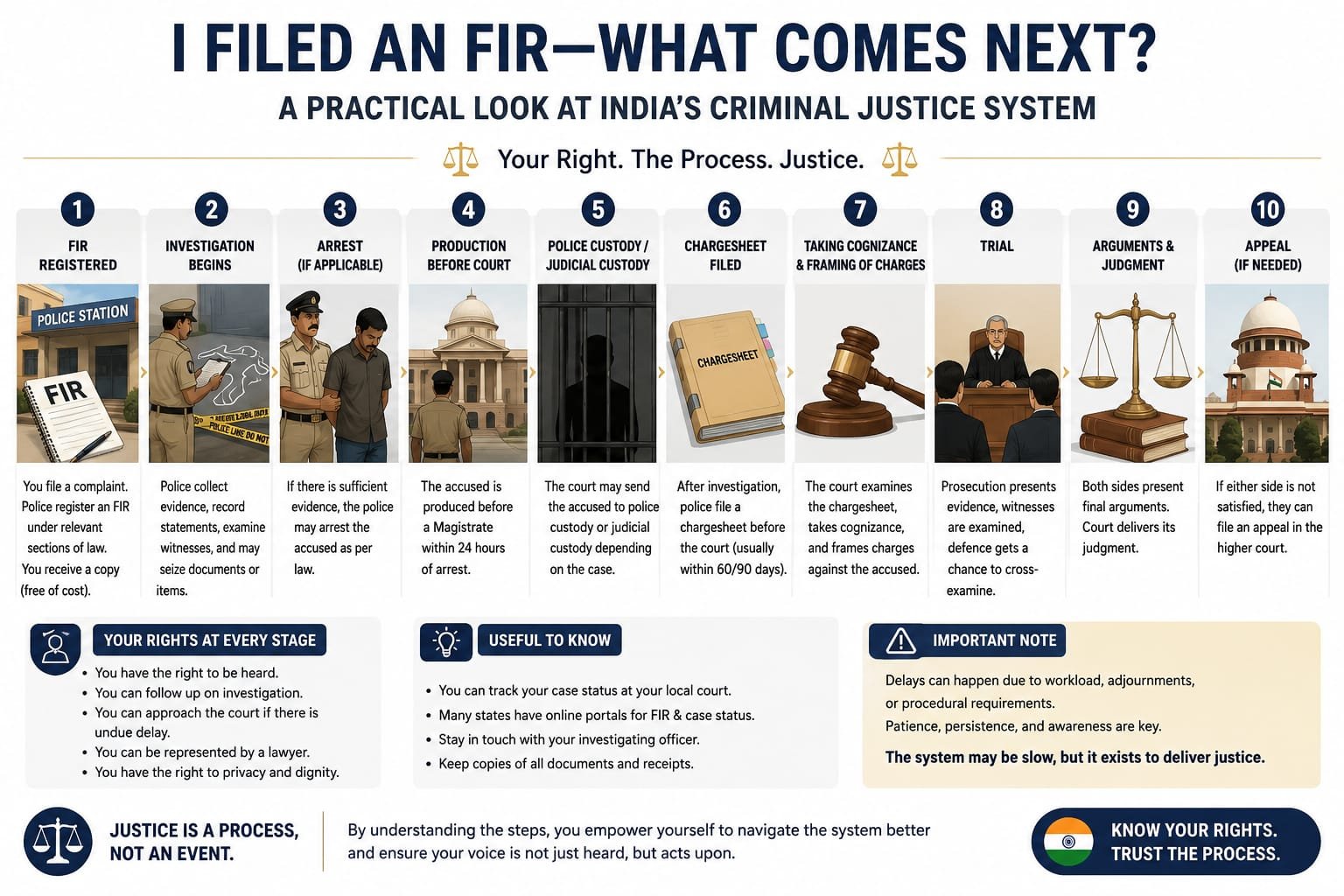
🔹Introduction
“I have filed an FIR. What happens now?”
This is one of the most common questions asked by victims, complainants, accused persons, and their families after entering the criminal justice system. For many citizens, filing an FIR is perceived as the beginning of justice. However, the reality is that the registration of an FIR is merely the first step in a long and often complex legal journey.
India's criminal justice system is built upon the ideals of fairness, accountability, and the rule of law. In theory, the process appears straightforward: a crime is reported, the police investigate, evidence is collected, charges are filed, and a court determines guilt or innocence. In practice, however, the journey from police station to courtroom is influenced by numerous factors, including administrative limitations, procedural delays, legal complexities, social realities, and institutional challenges.
For ordinary citizens, understanding what happens after filing an FIR can be difficult. Legal terminology, procedural requirements, and prolonged timelines often create confusion and frustration. Many people expect immediate action and quick justice, only to discover that criminal proceedings may take months or even years before reaching a conclusion.
This article provides a practical and ground-level examination of India's criminal justice system. Rather than focusing solely on legal provisions, it explores how the system functions in reality, the challenges citizens encounter, and the reforms needed to make justice more accessible, efficient, and fair.
🔹Why Filing an FIR Is Only the Beginning
An FIR (First Information Report) is often viewed as a victory by complainants who successfully persuade authorities to formally record an offence. While registration is an important step, it does not guarantee immediate investigation, arrest, or punishment.
Many citizens assume that:
An FIR automatically leads to arrest.
The accused will immediately face legal consequences.
The case will quickly reach court.
Justice will be delivered within a short period.
The reality is often different.
The FIR merely informs the police that a cognizable offence has allegedly occurred. It initiates the machinery of criminal law but does not determine guilt or innocence.
At the ground level, filing an FIR marks the start of a process rather than the end of a dispute.
🔹The First Visit to the Police Station: Expectations versus Reality
For most citizens, the police station is their first point of contact with the criminal justice system.
Victims often approach the police seeking protection, intervention, and immediate action. However, their experience may vary significantly depending upon factors such as location, infrastructure, workload, and the nature of the complaint.
Common Expectations
People often expect:
Immediate registration of complaints.
Rapid investigation.
Quick identification of suspects.
Prompt recovery of stolen property.
Instant legal relief.
Ground Reality
Police officers frequently deal with:
Large volumes of complaints.
Limited personnel.
Administrative responsibilities.
Resource shortages.
Pressure to maintain law and order.
As a result, the pace of action may not always align with public expectations.
The gap between expectations and institutional capacity often becomes the first source of frustration for complainants.
🔹What Happens After the FIR Is Registered?
Once the FIR is registered, the case is assigned to an investigating officer.
The investigating officer becomes responsible for gathering evidence and determining whether sufficient material exists to proceed against the accused.
This stage generally involves:
Visiting the scene of occurrence.
Recording statements.
Collecting documents.
Identifying witnesses.
Recovering relevant materials.
Coordinating with forensic experts when necessary.
Although these tasks appear straightforward, investigations often encounter practical difficulties that are rarely visible to the public.
The effectiveness of the entire criminal justice process largely depends upon the quality of the investigation conducted at this stage.
🔹The Ground Reality of Criminal Investigations
Popular media often portrays investigations as swift and highly sophisticated. In reality, criminal investigations frequently face significant constraints.
Resource Limitations
Many police stations operate under substantial resource pressures.
Investigators may handle numerous cases simultaneously, reducing the amount of time available for each investigation.
Increasing Complexity of Crime
Modern crimes frequently involve:
Digital communication.
Financial transactions.
Cyber platforms.
Electronic records.
Such cases require specialized expertise that may not always be readily available.
Dependence on Witnesses
Investigations often rely heavily on witness cooperation.
However, witnesses may:
Be reluctant to participate.
Fear retaliation.
Change their statements.
Become unavailable over time.
These factors can complicate the search for reliable evidence.
🔹The Question Everyone Asks: Will the Accused Be Arrested?
One of the most common questions after filing an FIR is whether the accused will be arrested immediately.
The public often associates criminal justice with arrest. However, arrest is only one of several investigative tools available to law enforcement authorities.
Public Perception
Many complainants believe that:
Arrest equals justice.
Failure to arrest indicates inaction.
Custody guarantees conviction.
Legal Reality
Arrest is not intended as punishment.
Its primary purposes include:
Preventing further offences.
Ensuring cooperation with investigation.
Protecting evidence.
Securing the presence of the accused.
Not every FIR necessarily results in immediate arrest.
This distinction is often misunderstood, leading to dissatisfaction among complainants and anxiety among accused persons.
🔹The Human Impact of Criminal Allegations
The criminal justice process affects more than legal rights. It also affects reputations, relationships, careers, and mental health.
For complainants, the process can involve:
Emotional distress.
Financial expenditure.
Repeated interactions with authorities.
Social pressure.
For accused persons, allegations may result in:
Public stigma.
Employment difficulties.
Social isolation.
Psychological stress.
Even before a court reaches a conclusion, the consequences of criminal proceedings can be substantial.
This reality highlights the importance of procedural fairness and responsible investigation.
🔹Bail: A Concept Frequently Misunderstood
Another stage that often generates confusion is bail.
When an accused person obtains bail, complainants sometimes perceive it as a failure of the justice system.
However, bail is rooted in a fundamental principle: an individual is presumed innocent until proven guilty.
Why Bail Exists
Bail seeks to:
Protect personal liberty.
Prevent unnecessary detention.
Ensure appearance before the court.
Ground-Level Perception
Many citizens interpret bail as:
Release from responsibility.
Escape from punishment.
Weakness of the legal system.
The difference between legal principles and public expectations often creates misunderstanding and dissatisfaction.
🔹Why Cases Take So Long
Perhaps the most frequently asked question in criminal justice is:
“Why is my case not moving forward?”
The answer lies in a combination of structural and procedural factors.
Heavy Caseloads
Police officers, prosecutors, and courts handle enormous numbers of cases.
Evidence Collection
Obtaining documents, forensic reports, and witness statements often takes time.
Administrative Processes
Every stage of criminal proceedings involves documentation and procedural compliance.
Court Backlogs
The judiciary faces significant case pendency, resulting in delays at various stages.
These factors collectively contribute to the prolonged duration of criminal proceedings.
🔹Victims and the Search for Closure
Victims frequently enter the criminal justice system seeking acknowledgment, accountability, and closure.
However, prolonged proceedings can create feelings of frustration and disappointment.
Many victims face:
Repeated court appearances.
Travel expenses.
Emotional exhaustion.
Delayed outcomes.
The justice process may become a source of additional hardship rather than relief.
Improving victim support mechanisms is therefore essential for enhancing public confidence in legal institutions.
Witnesses: The Invisible Stakeholders
Witnesses are among the most important yet least discussed participants in criminal proceedings.
Without witnesses, many cases cannot be effectively prosecuted.
However, witnesses often encounter significant difficulties:
Time-consuming court appearances.
Fear of intimidation.
Financial costs.
Professional disruptions.
Over time, these challenges may affect the quality and reliability of testimony.
Protecting and supporting witnesses is critical for ensuring effective criminal justice.
🔹The Importance of Forensic Evidence
Modern criminal investigations increasingly depend upon scientific evidence.
Forensic methods help establish facts through objective analysis rather than speculation.
Important forensic tools include:
DNA analysis.
Fingerprint identification.
Cyber forensics.
Digital evidence recovery.
Scientific examination of physical evidence.
While forensic science has transformed criminal investigations, delays in obtaining reports remain a practical challenge.
Strengthening forensic infrastructure can significantly improve both accuracy and efficiency.
🔹Entering the Court System
After the investigation is completed, the matter moves into the judicial phase.
For many citizens, the courtroom represents the place where justice will finally be delivered.
However, court proceedings involve multiple stages:
Examination of documents.
Framing of charges.
Witness testimony.
Presentation of evidence.
Legal arguments.
Each stage requires time and procedural compliance.
As a result, the transition from investigation to trial often takes longer than citizens expect.
🔹The Reality of Criminal Trials
Television dramas frequently portray trials as fast-paced and dramatic.
Actual criminal trials are often slow, document-intensive, and highly procedural.
Several factors contribute to delays:
Witness availability.
Judicial workload.
Adjournments.
Procedural objections.
Administrative challenges.
While these safeguards are intended to ensure fairness, they can also extend the duration of proceedings.
Balancing efficiency and fairness remains one of the central challenges of criminal justice administration.
Justice Delayed: The Everyday Reality
The phrase "justice delayed is justice denied" resonates strongly within the criminal justice context.
Delays affect everyone involved:
Victims
They wait years for closure.
Accused Persons
They face prolonged uncertainty.
Witnesses
Their memories fade and participation becomes difficult.
Society
Public confidence in institutions declines.
A justice system must not only be accurate but also timely.
Timeliness is itself an essential component of fairness.
🔹The Role of Lawyers
Lawyers play a vital role in navigating the complexities of criminal proceedings.
They assist by:
Explaining legal rights.
Preparing legal documents.
Challenging procedural irregularities.
Representing parties before courts.
However, access to quality legal representation is not always equal.
Economic disparities often influence a person's ability to obtain legal assistance.
Improving access to legal services remains an important reform priority.
🔹Media, Social Media, and Public Opinion
Today's criminal cases are often discussed not only in courtrooms but also across television channels and social media platforms.
While public awareness is valuable, media attention can create challenges:
Premature judgments.
Spread of misinformation.
Pressure on institutions.
Reputational damage.
The legal process must remain guided by evidence and judicial reasoning rather than public sentiment.
Maintaining this balance is increasingly important in the digital age.
🔹Technology and Criminal Justice
Technology is gradually transforming the criminal justice landscape.
Recent developments include:
Digital records.
Online case tracking.
Virtual hearings.
Electronic evidence management.
These innovations improve transparency and accessibility.
However, technological progress must also address concerns regarding privacy, cybersecurity, and digital inclusion.
The future of criminal justice will depend upon how effectively technology is integrated into existing institutions.
🔹What Ordinary Citizens Need to Understand
One of the most important realities of criminal justice is that legal processes rarely move as quickly as people expect.
Citizens should understand that:
Filing an FIR does not guarantee immediate results.
Investigation takes time.
Arrest is not automatic punishment.
Bail does not determine guilt.
Trials may extend over several years.
Courts rely upon evidence rather than allegations.
Greater public awareness can reduce misconceptions and improve engagement with legal institutions.
🔹Reforming the System: The Way Forward
Improving the criminal justice system requires reforms at multiple levels.
Strengthening Police Resources
Better staffing and infrastructure can improve investigations.
Expanding Forensic Capacity
Scientific evidence should become more accessible and timely.
Reducing Judicial Backlogs
Additional courts and improved case management can accelerate proceedings.
Supporting Victims and Witnesses
Comprehensive support systems can enhance participation and trust.
Enhancing Legal Awareness
Citizens should be empowered through legal education.
Promoting Technology
Digital tools should be used to improve efficiency while safeguarding rights.
🔹Conclusion
Filing an FIR marks the beginning of the criminal justice process, not its conclusion. The journey from investigation to trial often involves multiple procedures, challenges, and delays. Understanding these realities helps citizens better navigate the system and appreciate the importance of due process. Ultimately, a fair and effective criminal justice system must ensure that justice is not only delivered but delivered in a timely and transparent manner.
🔸Disclaimer
This article is intended for educational, informational, and academic purposes only. It does not constitute legal advice or professional consultation.

Leave a Comment
Your email address and mobile number will not be published. Required fields are marked *