📖 Introduction
A vibrant capital market is built on one indispensable foundation—investor confidence. Investors, whether institutional or retail, commit their capital with the expectation that the market operates fairly, transparently, and efficiently. In the absence of adequate legal safeguards, confidence erodes, investments decline, and economic growth suffers. Consequently, investor protection has emerged as one of the most significant objectives of modern financial regulation.
India's journey toward a robust investor protection regime has been shaped by economic reforms, market expansion, technological innovation, and regulatory evolution. From the liberalization era of the 1990s to the rise of digital trading platforms and fintech ecosystems, the Indian securities market has witnessed remarkable growth. Simultaneously, it has confronted numerous challenges, including securities scams, insider trading, accounting frauds, market manipulation, cyber threats, and corporate governance failures.
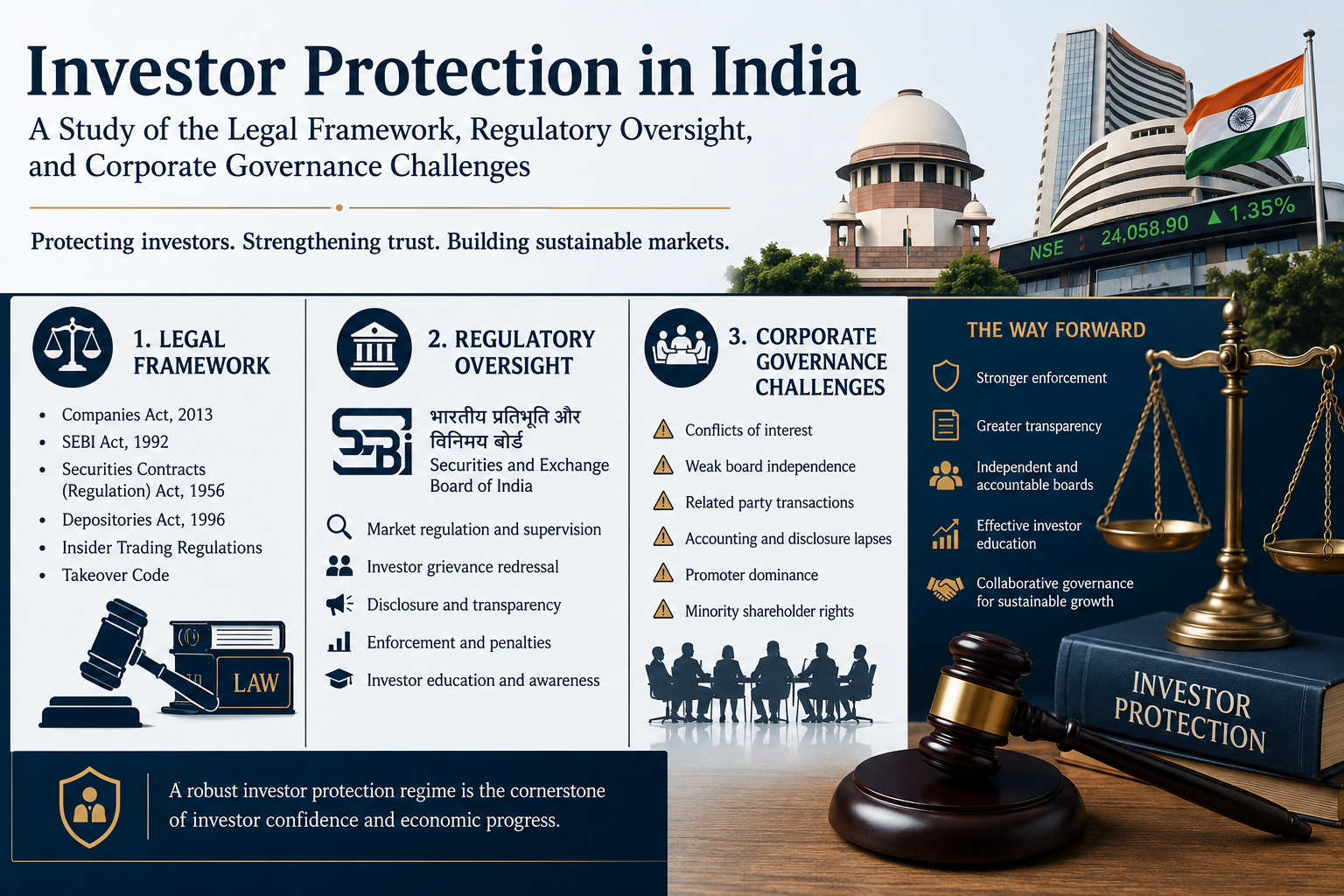
To address these concerns, India has developed a comprehensive legal and regulatory framework centered on the Securities and Exchange Board of India Act, 1992, the Companies Act, 2013, and various regulations framed by the Securities and Exchange Board of India. These laws seek to balance market development with investor protection by promoting transparency, accountability, disclosure, and ethical corporate conduct.
As India aspires to become a global economic powerhouse, investor protection has acquired renewed significance. Modern challenges such as digital trading, algorithmic decision-making, environmental and social governance (ESG) disclosures, and cross-border investments require regulators to continuously adapt. Investor protection today extends beyond preventing fraud; it encompasses ensuring fairness, corporate responsibility, market integrity, and sustainable governance.
This article explain the legal framework governing investor protection in India, analyzes the role of regulatory institutions, explores the significance of corporate governance, reviews important judicial decisions, and evaluates emerging challenges confronting regulators in the twenty-first century.
🏛️ Historical Evolution of Investor Protection in India
The development of investor protection in India is closely linked with the evolution of the country's financial markets.
Before economic liberalization, India's securities market operated within a relatively controlled economic framework. Regulatory mechanisms were fragmented and often inadequate to address sophisticated market abuses.
The primary statutes included:
The Companies Act, 1956
The Securities Contracts (Regulation) Act, 1956
The Capital Issues (Control) Act, 1947
Although these laws provided basic oversight, they lacked a specialized regulator dedicated to investor protection.
The turning point came with the 1992 Securities Scam, popularly associated with stockbroker Harshad Mehta. The scam exposed serious weaknesses in market supervision, banking controls, and regulatory coordination. Investor confidence suffered significantly, highlighting the urgent need for institutional reform.
In response, Parliament strengthened the powers of SEBI through the Securities and Exchange Board of India Act, 1992. Since then, India has progressively moved toward a sophisticated regulatory system emphasizing transparency, disclosure, accountability, and investor welfare.
Over the last three decades, regulatory reforms have transformed India's capital markets into one of the world's largest and fastest-growing investment destinations.
⚖️ Constitutional Foundations of Investor Protection: Although the Constitution of India does not expressly recognize investor rights, several constitutional provisions indirectly support investor protection.
Article 14: Equality Before Law
Investors are entitled to equal treatment and protection against arbitrary regulatory action or discriminatory corporate practices.
Article 19(1)(g): Freedom of Trade and Business
Investment activities form an important component of economic freedom protected under the Constitution.
Article 300A: Right to Property
Investor assets and investments constitute property interests protected against unlawful deprivation.
Directive Principles of State Policy
The Directive Principles encourage the State to promote economic justice, prevent concentration of wealth, and ensure equitable distribution of resources. These principles support regulatory interventions aimed at preventing market abuse and protecting investors.
Thus, investor protection derives legitimacy not only from statutory provisions but also from broader constitutional values promoting fairness, equality, and economic justice.
🏢 The Role of SEBI in Investor Protection
The establishment of SEBI marked a transformative moment in Indian securities regulation.
SEBI functions as the principal regulator of India's securities market and serves as the primary guardian of investor interests.
Objectives of SEBI
Section 11 of the SEBI Act identifies three core objectives:
✅ Protection of investors
✅ Development of securities markets
✅ Regulation of securities markets
These objectives reflect a balanced approach that seeks both market growth and investor welfare.
🔍 Regulatory Powers of SEBI
SEBI possesses extensive powers to regulate market participants and enforce compliance.
Regulatory Functions
SEBI regulates:
Stock exchanges
Depositories
Mutual funds
Investment advisers
Merchant bankers
Credit rating agencies
Portfolio managers
Through licensing and supervision, SEBI seeks to maintain market discipline.
Investigative Powers
SEBI may:
Inspect books and records
Conduct investigations
Summon documents
Examine witnesses
These powers enable effective detection of market misconduct.
Enforcement Powers
SEBI can:
Impose monetary penalties
Suspend trading activities
Debar market participants
Issue cease-and-desist orders
Direct refunds to investors
Such powers play a crucial role in deterring securities violations.
📜 The Legal Framework for Investor Protection
Investor protection in India operates through multiple legislative instruments.
1. Securities and Exchange Board of India Act, 1992
The SEBI Act serves as the cornerstone of securities regulation.
It empowers SEBI to regulate market activities and prevent practices detrimental to investors.
The Act provides the legal basis for:
Market surveillance
Investor education
Enforcement proceedings
Regulatory oversight
2. Companies Act, 2013
The Companies Act significantly strengthens shareholder protection.
Important provisions include:
Section 166
Establishes fiduciary duties of directors.
Directors must:
Act in good faith
Exercise due care
Avoid conflicts of interest
Promote the interests of the company
Section 245
Introduces class action suits, enabling investors to collectively seek remedies against wrongful corporate conduct.
Sections 241–244
Protect minority shareholders from oppression and mismanagement.
These provisions enhance accountability and corporate responsibility.
3. Securities Contracts (Regulation) Act, 1956
The Act regulates stock exchanges and securities trading.
Its objective is to ensure fair and orderly markets while preventing fraudulent transactions.
4. Depositories Act, 1996
The Depositories Act facilitates electronic holding and transfer of securities.
The dematerialization of securities has significantly reduced fraud and enhanced investor convenience.
📊 Disclosure and Transparency: The Cornerstone of Investor Protection
One of the most effective forms of investor protection is transparency.
Investors make decisions based on information. Therefore, disclosure obligations are essential for informed investment choices.
SEBI mandates:
Quarterly financial reporting
Annual disclosures
Material event disclosures
Shareholding pattern disclosures
Corporate governance reports
Transparency reduces information asymmetry between management and investors.
When information is accurate and timely, investors can evaluate risks more effectively.
🏛️ Corporate Governance and Investor Protection
Corporate governance refers to the mechanisms through which corporations are directed and controlled.
Good governance serves multiple functions:
Preventing fraud
Enhancing accountability
Protecting shareholder rights
Improving corporate performance
Building investor confidence
Corporate governance has become a central pillar of investor protection in India.
👥 Independent Directors and Board Accountability
Independent directors are expected to serve as impartial guardians of shareholder interests.
Their responsibilities include:
Monitoring management conduct
Evaluating related-party transactions
Protecting minority shareholders
Enhancing board independence
The Companies Act and SEBI regulations have expanded their role significantly.
However, concerns remain regarding the actual independence and effectiveness of such directors.
📋 Audit Committees and Financial Integrity
Financial reporting forms the backbone of investor confidence.
Audit committees are responsible for:
Reviewing financial statements
Monitoring internal controls
Preventing accounting fraud
Ensuring auditor independence
Strong audit oversight reduces the risk of financial manipulation.
⚠️ Corporate Governance Failures and Their Lessons
Satyam Scandal
The collapse of Satyam Computer Services remains one of India's most significant corporate scandals.
Founder B. Ramalinga Raju admitted to large-scale financial statement manipulation.
The scandal revealed failures in:
Board oversight
Auditor independence
Internal controls
The incident directly influenced reforms incorporated into the Companies Act, 2013.
IL&FS Crisis
The crisis involving Infrastructure Leasing & Financial Services exposed governance weaknesses within systemically important financial institutions.
Key concerns included:
Excessive leverage
Weak risk management
Inadequate oversight
The episode highlighted the importance of proactive governance.
Yes Bank Governance Concerns
Governance issues involving Yes Bank reinforced concerns regarding concentration of power, inadequate supervision, and board effectiveness.
These cases demonstrate how governance failures can directly affect investor wealth and market stability.
💻 Emerging Challenges in Investor Protection
Digital Trading and Retail Participation
The growth of mobile trading platforms has democratized investing.
Millions of first-time investors now access capital markets through smartphones.
While accessibility has improved, new risks have emerged, including:
Impulsive trading
Misinformation
Speculative behavior
Online fraud
Regulators must balance innovation with investor safeguards.
Social Media and Financial Influencers
Financial influencers increasingly shape investment decisions.
Potential risks include:
Unverified recommendations
Hidden sponsorships
Conflicts of interest
Market manipulation
Regulating digital financial advice presents a significant challenge.
Algorithmic Trading
Algorithmic trading introduces concerns regarding:
Market fairness
Price volatility
Information advantages
As technology evolves, regulatory frameworks must adapt accordingly.
Cybersecurity Risks
The digitalization of financial markets increases vulnerability to cyber threats.
Investors face risks such as:
Data breaches
Identity theft
Unauthorized transactions
Hacking attacks
Robust cybersecurity governance has become indispensable.
🌱 ESG Investing and Investor Protection
Environmental, Social, and Governance (ESG) considerations are increasingly influencing investment decisions.
Investors now seek information concerning:
Environmental impact
Corporate ethics
Social responsibility
Sustainability performance
Recognizing this trend, SEBI has introduced sustainability reporting requirements.
However, ESG disclosures also create new challenges.
Greenwashing
Greenwashing occurs when companies exaggerate sustainability achievements.
Misleading ESG claims may distort investor decisions.
Regulators therefore face the challenge of ensuring credibility and verification of sustainability disclosures.
⚖️ Judicial Contribution to Investor Protection
Indian courts have played a crucial role in strengthening investor rights.
Sahara India Real Estate Corporation Ltd. v. SEBI
The Supreme Court affirmed SEBI's authority to protect investors and ordered substantial refunds to investors affected by unlawful fundraising practices.
The decision strengthened SEBI's enforcement credibility.
Needle Industries (India) Ltd. v. Needle Industries Newey (India) Holding Ltd.
The Court clarified legal principles governing minority shareholder protection and oppression claims.
Tata Consultancy Services Ltd. v. Cyrus Investments Pvt. Ltd.
The judgment contributed significantly to contemporary discussions on corporate governance and shareholder rights.
Collectively, these decisions reinforce accountability and investor confidence.
🌍 International Perspectives
Investor protection has become a global concern.
International standards developed by organizations such as:
Organisation for Economic Co-operation and Development
International Organization of Securities Commissions
have influenced Indian reforms.
Global best practices emphasize:
Board independence
Disclosure standards
Shareholder rights
Effective enforcement
India increasingly aligns its regulatory framework with these international norms.
🚀 The Future of Investor Protection in India
Investor protection must continuously evolve to address emerging market realities.
Future reforms are likely to focus on:
Artificial Intelligence-Based Surveillance
Advanced analytics can detect suspicious market activity more efficiently.
Enhanced Corporate Governance
Strengthening board accountability and independent oversight.
Investor Education
Financial literacy remains essential for informed investment decisions.
ESG Verification Mechanisms
Improving credibility of sustainability disclosures.
Stronger Cybersecurity Regulations
Protecting investors in increasingly digital markets.
Cross-Border Regulatory Cooperation
Addressing global investment and enforcement challenges.
These developments will shape the next phase of investor protection in India.
📌 The Way Forward
To strengthen investor protection further, India should:
✅ Enhance board independence and effectiveness.
✅ Improve enforcement against securities fraud.
✅ Strengthen whistleblower protection mechanisms.
✅ Expand investor awareness initiatives.
✅ Increase transparency in ESG reporting.
✅ Develop robust cybersecurity standards.
✅ Utilize artificial intelligence for market surveillance.
✅ Promote greater accountability among corporate leadership.
🎯 Conclusion
Investor protection is fundamental to maintaining trust, transparency, and stability in India's financial markets. Through the combined efforts of the Securities and Exchange Board of India, the Companies Act, 2013, and evolving corporate governance standards, India has established a strong legal framework to safeguard investor interests. However, emerging challenges such as digital fraud, cybersecurity risks, ESG compliance, and governance failures require continuous regulatory adaptation. Strengthening accountability, transparency, and investor awareness will be essential to ensuring sustainable market growth and long-term investor confidence.
⚠️ Disclaimer
This article is intended solely for educational, informational, and academic purposes.

Leave a Comment
Your email address and mobile number will not be published. Required fields are marked *