📖 Introduction
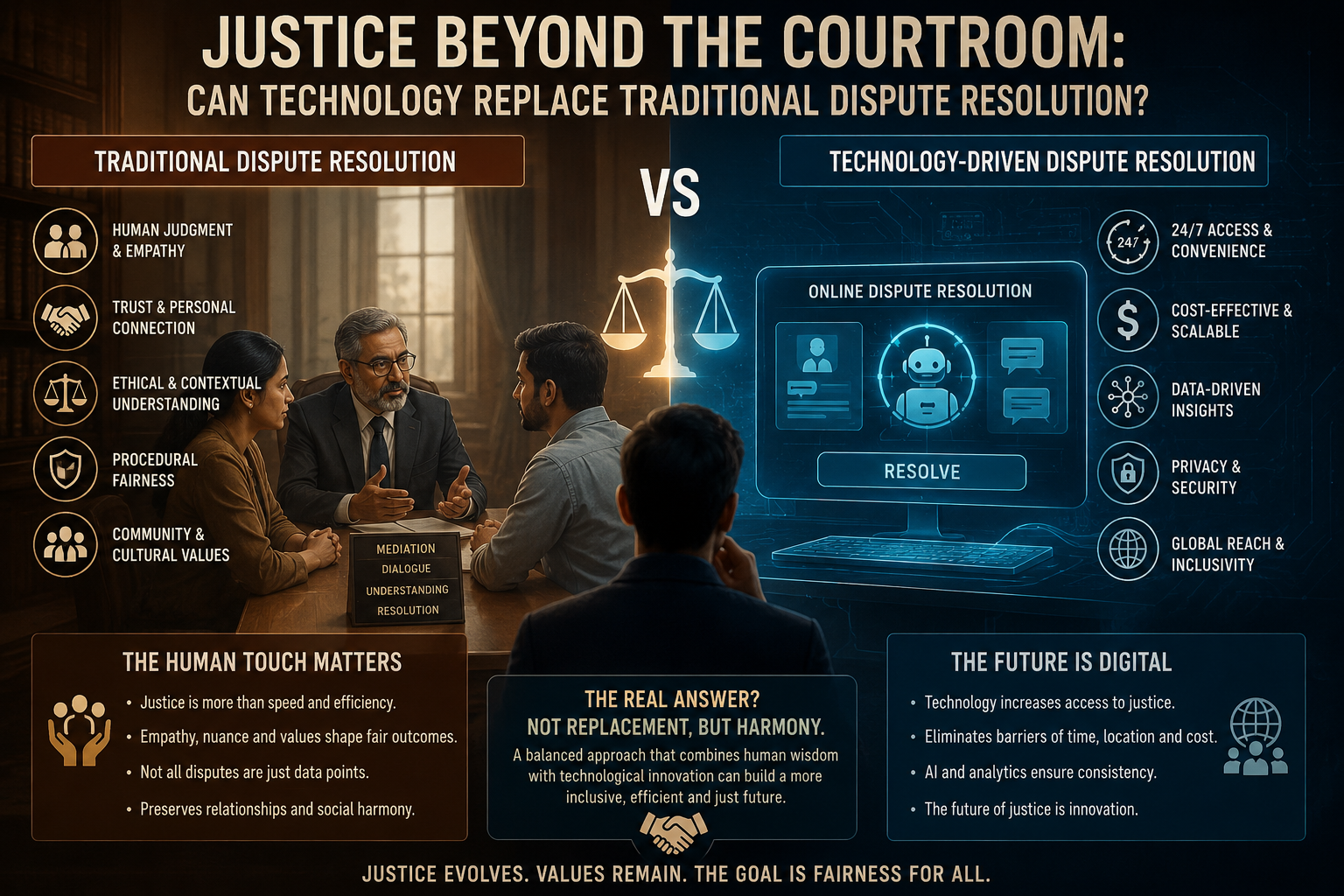
The administration of justice has traditionally been associated with courtrooms, judges, lawyers, physical evidence, and lengthy legal procedures. For centuries, the courtroom has served as the primary institution through which societies resolve disputes, enforce rights, and uphold the rule of law. However, the twenty-first century has witnessed an unprecedented technological revolution that is transforming every sphere of human activity, including the legal system.
The rise of Artificial Intelligence (AI), Online Dispute Resolution (ODR), blockchain technology, virtual courts, smart contracts, and predictive analytics has sparked a profound debate among legal scholars, policymakers, judges, and practitioners. Can technology fundamentally alter how disputes are resolved? More importantly, can technology eventually replace traditional dispute resolution mechanisms?
This debate gained further momentum during the COVID-19 pandemic when courts across the world rapidly adopted virtual hearings and digital filing systems. What initially emerged as an emergency response soon evolved into a broader conversation regarding the future of justice delivery.
While proponents argue that technology can make justice faster, cheaper, and more accessible, critics warn that justice is not merely a mechanical process that can be automated. They contend that legal disputes often involve human emotions, ethical dilemmas, cultural nuances, and constitutional values that technology may struggle to comprehend.
This article explain both sides of the debate and explores whether technology can truly replace traditional dispute resolution or whether it should instead function as a complementary tool within the justice system.
⚖️ Understanding Traditional Dispute Resolution
Before evaluating technological alternatives, it is necessary to understand what traditional dispute resolution entails.
Traditional dispute resolution generally includes:
✅ Litigation before courts
✅ Arbitration
✅ Mediation
✅ Conciliation
✅ Lok Adalats
These mechanisms rely heavily upon human decision-makers who interpret laws, assess evidence, evaluate credibility, and deliver reasoned decisions.
The traditional legal system is built upon several foundational principles:
Fair hearing
Due process
Judicial independence
Transparency
Natural justice
Human judgment
Despite these strengths, traditional systems often suffer from serious challenges.
🚨 Major Challenges
1. Judicial Backlog
Millions of cases remain pending before courts worldwide.
In India alone, judicial pendency continues to pose a major challenge, affecting access to timely justice.
2. High Costs
Legal representation, court fees, travel expenses, and procedural delays significantly increase litigation costs.
3. Procedural Complexity
Many citizens find legal procedures intimidating and difficult to navigate.
4. Geographic Barriers
People residing in rural or remote regions often struggle to access courts.
5. Time Consumption
Civil disputes frequently take years or even decades before reaching final resolution.
These shortcomings have encouraged governments and legal innovators to explore technological alternatives.
🤖 The Rise of Technology in Dispute Resolution
Technology has gradually entered the legal sector through various innovations.
Major Technological Developments
💻 Online Dispute Resolution (ODR)
ODR utilizes digital platforms to facilitate negotiation, mediation, and arbitration.
📹 Virtual Courts
Remote hearings enable judges, lawyers, and litigants to participate through video conferencing.
🧠 Artificial Intelligence
AI systems assist in:
Legal research
Contract analysis
Document review
Case prediction
Evidence management
🔗 Blockchain Technology
Blockchain creates tamper-proof records and enables smart contracts.
📊 Predictive Analytics
Algorithms analyze previous judgments to estimate likely legal outcomes.
📂 E-Courts
Digital filing, electronic records, and automated scheduling have significantly improved administrative efficiency.
These innovations have led some scholars to suggest that technology could eventually replace many traditional dispute-resolution processes.
✅ The Case FOR Technology Replacing Traditional Dispute Resolution
Supporters present several compelling arguments.
1. Speed and Efficiency
Technology dramatically reduces procedural delays.
AI can process thousands of legal documents within minutes.
ODR platforms can resolve simple disputes in days rather than years.
For example:
Consumer disputes
Insurance claims
E-commerce disagreements
Small contractual disputes
can often be resolved rapidly through digital mechanisms.
Faster dispute resolution enhances public confidence in the justice system.
2. Reduced Costs
Traditional litigation is expensive.
Technology reduces:
Administrative expenses
Travel costs
Paperwork
Infrastructure burdens
ODR allows parties to participate from their homes.
This is particularly beneficial for low-income litigants.
Justice becomes more affordable and inclusive.
3. Greater Accessibility
Millions of people remain excluded from legal systems due to geographical limitations.
Technology can bridge this gap.
A person living in a remote village may participate in mediation through a smartphone.
Digital justice platforms increase legal accessibility for:
Rural populations
Persons with disabilities
Senior citizens
Migrant workers
Technology democratizes access to justice.
4. Elimination of Human Bias
Human decision-makers may be influenced by:
Prejudice
Emotions
Fatigue
Personal assumptions
Supporters argue that properly designed algorithms can offer greater consistency and neutrality.
Automated systems can apply legal rules uniformly.
This could potentially reduce discriminatory outcomes.
5. Data-Driven Decision-Making
AI systems can analyze:
Thousands of precedents
Statutory provisions
Judicial trends
within seconds.
Human judges cannot process comparable volumes of information.
Technology may therefore improve accuracy and consistency.
6. Scalability
Traditional courts face resource constraints.
Technology can handle enormous caseloads simultaneously.
This is particularly valuable for:
Consumer complaints
Banking disputes
Tax claims
Online marketplace conflicts
Mass dispute resolution becomes feasible.
7. Globalization of Justice
Cross-border disputes are increasing.
ODR platforms facilitate international dispute resolution without requiring physical presence.
This reduces jurisdictional barriers and promotes efficient global commerce.
❌ The Case AGAINST Technology Replacing Traditional Dispute Resolution
Despite its advantages, significant concerns remain.
1. Justice Is Not Merely an Algorithm
Law involves more than rule application.
Legal disputes frequently involve:
Human suffering
Emotional trauma
Moral complexity
Social context
Judges often exercise discretion based on unique circumstances.
Algorithms may struggle to appreciate these human dimensions.
Justice requires empathy as well as logic.
2. Risk of Algorithmic Bias
Contrary to popular belief, AI is not inherently neutral.
Algorithms learn from historical data.
If historical decisions contain biases, AI may reproduce or even amplify those biases.
Examples include:
Racial bias
Gender bias
Economic discrimination
Algorithmic decision-making may create new forms of injustice.
3. Transparency Concerns
Many AI systems operate as “black boxes.”
Parties may not understand:
How decisions were reached
Which factors influenced outcomes
Whether errors occurred
Transparency is essential for legal legitimacy.
Opaque algorithms undermine public trust.
4. Threat to Due Process
Traditional courts provide:
Oral hearings
Cross-examination
Judicial reasoning
Appeals
Automated systems may weaken procedural safeguards.
Efficiency should never come at the cost of fairness.
5. Digital Divide
Not everyone possesses:
Internet access
Digital literacy
Technological resources
Marginalized populations may face exclusion.
Technology can unintentionally widen inequality.
Justice must remain accessible to all citizens.
6. Cybersecurity Risks
Digital systems are vulnerable to:
Data breaches
Hacking
Identity theft
System failures
Compromised judicial data can threaten both privacy and legal integrity.
7. Constitutional and Ethical Concerns
Many constitutional rights depend upon human accountability.
Questions arise:
Who is responsible for AI errors?
Can an algorithm be challenged?
How should accountability be assigned?
The law has not yet fully addressed these concerns.
🇮🇳 The Indian Perspective
India has emerged as a significant laboratory for digital justice.
E-Courts Mission Mode Project
The initiative has promoted:
E-filing
Digital records
Virtual hearings
Online case tracking
Online Dispute Resolution Growth
India has witnessed rapid growth in ODR platforms for:
Commercial disputes
Consumer grievances
Banking conflicts
Supreme Court's Digital Initiatives
The judiciary has increasingly embraced technology to improve efficiency and accessibility.
However, concerns regarding digital literacy and infrastructure remain substantial.
⚖️ Landmark Judicial Developments
Justice K.S. Puttaswamy v. Union of India
The Supreme Court recognized privacy as a fundamental right, influencing future discussions on digital justice and data protection.
Swapnil Tripathi v. Supreme Court of India
The Court supported transparency through technological innovation, encouraging greater public access to judicial proceedings.
NITI Aayog
NITI Aayog has actively promoted Online Dispute Resolution as a mechanism for improving access to justice.
🧠 Can Artificial Intelligence Become a Judge?
Perhaps the most controversial aspect of the debate concerns AI judges.
Supporters argue:
✅ Faster decisions
✅ Reduced backlog
✅ Consistency
✅ Lower costs
Critics argue:
❌ Lack of empathy
❌ Inability to understand social realities
❌ Threats to judicial independence
❌ Constitutional concerns
A judge does more than apply legal rules.
Judging involves:
Moral reasoning
Interpretation
Compassion
Contextual analysis
These qualities remain uniquely human.
⚖️ The Hybrid Model: The Most Realistic Future
Most experts now reject the idea of fully automated justice.
Instead, they advocate a hybrid model.
Technology Handles
✅ Administrative tasks
✅ Scheduling
✅ Legal research
✅ Document review
✅ Case management
✅ Preliminary dispute resolution
Human Judges Handle
✅ Complex legal questions
✅ Constitutional disputes
✅ Criminal trials
✅ Human rights issues
✅ Ethical dilemmas
This model combines technological efficiency with human wisdom.
🔮 Future Challenges
Several questions remain unresolved:
How should AI be regulated?
Who bears liability for automated decisions?
Can algorithmic transparency be guaranteed?
How can digital inclusion be ensured?
What safeguards should protect due process?
The answers will shape the future of justice systems worldwide.
📚 Conclusion
The debate over whether technology can replace traditional dispute resolution reflects a broader tension between efficiency and humanity. Technology undeniably offers transformative opportunities to reduce delays, lower costs, expand accessibility, and modernize justice delivery. Online dispute resolution, virtual courts, artificial intelligence, and blockchain-based systems have already demonstrated their ability to improve various aspects of legal administration.
⚠️ Disclaimer
This blog is for educational and informational purposes only.

Leave a Comment
Your email address and mobile number will not be published. Required fields are marked *