🌟Introduction
Road accidents are among the leading causes of accidental deaths in India. Every year, thousands of families lose their loved ones due to negligent driving, reckless conduct, poor road conditions, or violations of traffic laws. While the legal system cannot undo the tragedy of losing a family member, it seeks to provide financial relief through compensation under the Motor Vehicles Act, 1988.
Among the various categories of claimants in motor accident cases, parents who lose a son or daughter occupy a particularly sensitive position. The grief suffered by parents after the death of a child is profound and often lifelong. In many cases, the deceased child may have been the family's emotional anchor, future breadwinner, caretaker, or source of hope and support.
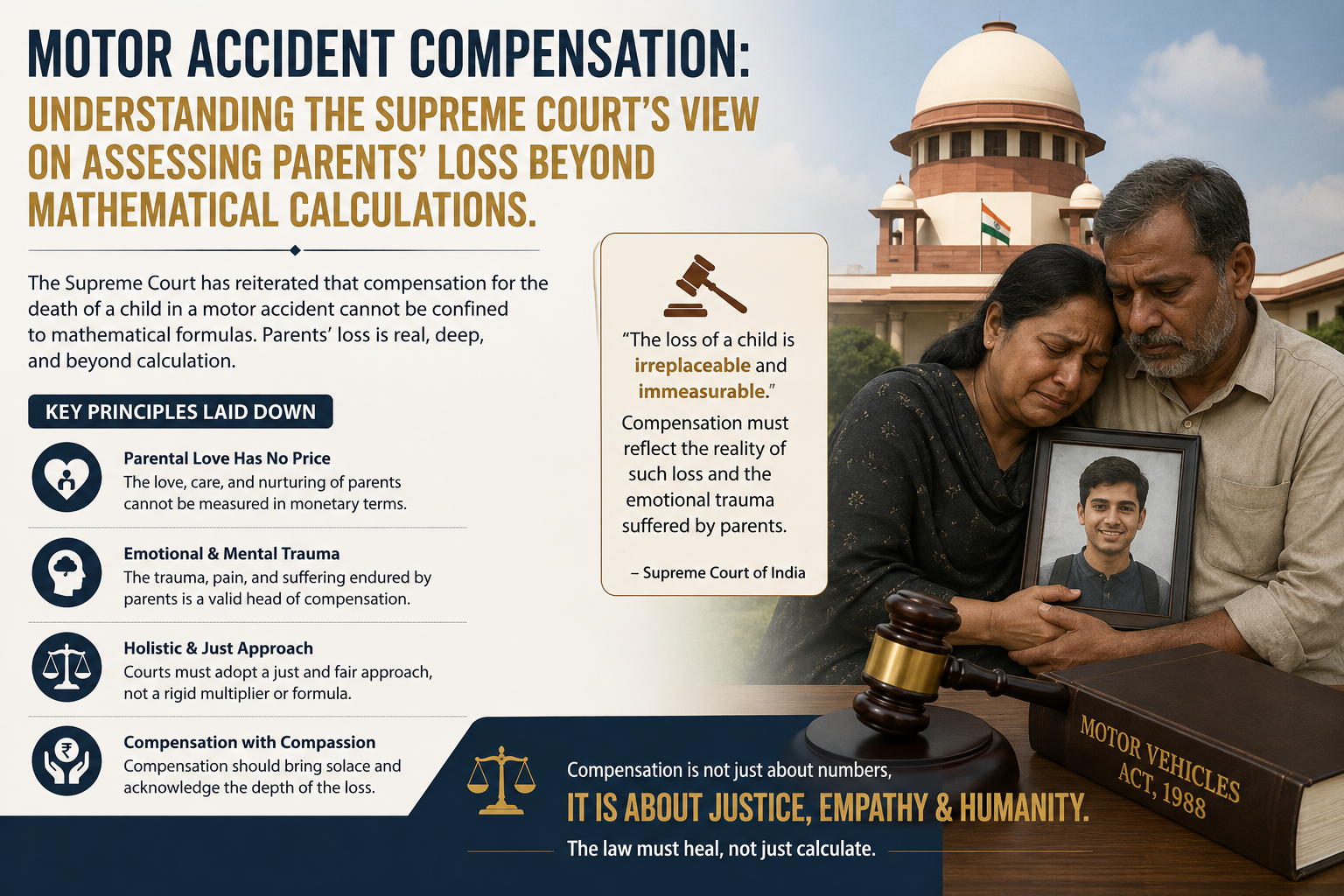
Recognizing this reality, the Supreme Court of India has repeatedly emphasized that the loss suffered by parents in fatal motor accident cases cannot always be assessed through rigid mathematical calculations. While legal formulas and established principles help maintain consistency, they cannot fully capture the emotional, social, and future economic loss experienced by bereaved parents.
This evolving judicial approach reflects an important principle of compensation law: human loss cannot always be reduced to numbers.
This article explores the legal framework governing motor accident compensation, the Supreme Court's approach toward parental claims, the concept of "just compensation," and the reasons why courts increasingly look beyond arithmetic formulas while determining compensation.
⚖️🚗Understanding Motor Accident Compensation in India
Motor accident compensation is governed primarily by the Motor Vehicles Act, 1988.
The Act provides a mechanism through which victims of road accidents and their families can seek monetary compensation for losses caused by negligent driving.
The purpose of compensation is not punishment.
Rather, it aims to:
✅ Provide financial assistance to victims and dependents.
✅ Offset economic losses caused by death or injury.
✅ Recognize certain non-economic losses.
✅ Promote fairness and social justice.
✅ Ensure accountability for negligent conduct.
Compensation attempts to place the affected family, as far as possible, in the position they would have occupied had the accident not occurred.
However, because human life has no fixed market value, courts must often rely on legal principles and judicial discretion.
⚖️The Meaning of "Just Compensation"
One of the most important principles in motor accident jurisprudence is the concept of just compensation.
The Motor Vehicles Act requires courts and Motor Accident Claims Tribunals (MACTs) to award compensation that is fair, reasonable, and equitable.
The Supreme Court has consistently held that compensation should not be:
❌ Excessively low.
❌ Arbitrarily high.
❌ Based on speculation.
❌ Determined mechanically.
Instead, compensation must reflect the actual circumstances of each case.
The idea of "just compensation" recognizes that every accident affects families differently.
No two victims have identical backgrounds, earning capacities, family responsibilities, or future prospects.
Therefore, while standardized methods are useful, justice often requires flexibility.
Why Parents' Loss Is Different 💔
When a parent loses a child in a motor accident, the loss extends far beyond financial considerations.
Parents often lose:
❤️ Love and affection
👨👩👧 Emotional companionship
🏡 Family support
👴 Care during old age
🌟 Future expectations
🎓 The fruits of years of nurturing and sacrifice
Unlike damage to property, these losses cannot be measured precisely.
A damaged vehicle can be valued.
A destroyed building can be assessed.
But the value of a parent-child relationship cannot be determined through accounting principles.
This is one of the primary reasons courts have recognized the limitations of mathematical formulas.
📜The Historical Approach to Compensation
Historically, courts focused primarily on economic dependency.
Compensation was often calculated by examining:
Income of the deceased
Financial contribution to dependents
Age of the deceased
Expected working years
Under this approach, compensation largely depended upon financial loss.
If parents were financially dependent on the deceased child, compensation was easier to justify.
If they were not financially dependent, courts sometimes awarded comparatively lower amounts.
Over time, however, the judiciary recognized the inadequacy of this approach.
Families do not function solely on economic relationships.
Human relationships have emotional, social, and practical dimensions.
This realization gradually transformed compensation jurisprudence.
⚖️The Supreme Court's Evolving Perspective
The Supreme Court has played a crucial role in modernizing motor accident compensation law.
The Court has repeatedly emphasized that:
Compensation must reflect the realities of life and family relationships.
The Court has observed that:
Human life cannot be valued with mathematical precision.
Future possibilities are often uncertain.
Emotional losses are genuine and significant.
Family relationships deserve legal recognition.
This approach has led to a broader understanding of parental loss.
Today, courts increasingly recognize that parents suffer not merely a financial loss but also the loss of companionship, care, emotional support, and future security.
📊The Multiplier Method: A Useful Tool, Not a Perfect Formula
One of the most widely used methods for calculating compensation is the multiplier method.
Under this approach:
Step 1
Determine annual income of the deceased.
Step 2
Deduct personal expenses.
Step 3
Calculate annual contribution to dependents.
Step 4
Apply an appropriate multiplier based on age.
The result becomes the compensation for loss of dependency.
This method promotes consistency and predictability.
However, even the Supreme Court has recognized its limitations.
The multiplier method can estimate economic loss.
It cannot accurately calculate:
Emotional suffering.
Loss of companionship.
Psychological trauma.
Future family support.
Personal relationships.
Therefore, courts supplement mathematical calculations with broader considerations.
🔮The Problem of Predicting the Future
Fatal accident claims often require courts to make assumptions about the future.
Questions frequently arise:
❓ What career would the deceased have pursued?
❓ Would the deceased have received promotions?
❓ Would income have increased?
❓ Would parents have received financial support?
❓ What role would the deceased have played in family life?
No one can answer these questions with certainty.
Courts therefore rely on probabilities rather than certainties.
This necessarily limits the precision of compensation calculations.
🎓Compensation for the Death of Young Persons
Cases involving students and young adults present special challenges.
A young engineering student may not yet have an income.
A medical student may still be studying.
A talented athlete may not have begun earning.
Yet their future prospects may be exceptionally promising.
If courts focus solely on present earnings, compensation may become unfairly low.
Recognizing this issue, courts increasingly consider:
📚 Educational qualifications
🎯 Career potential
🏆 Academic achievements
🌟 Future earning capacity
👨👩👧 Family circumstances
This approach ensures a more realistic assessment.
Understanding Filial Consortium ❤️
One of the most important developments in recent compensation law is the recognition of filial consortium.
Filial consortium refers to compensation awarded to parents for the loss of a child.
It acknowledges:
❤️ Loss of love
❤️ Loss of affection
❤️ Loss of companionship
❤️ Loss of care
❤️ Loss of emotional support
The recognition of filial consortium reflects the judiciary's understanding that family relationships have intrinsic value.
The law now recognizes that parents suffer a distinct and compensable injury when they lose a child.
⚖️❤️Why Emotional Loss Matters
Critics sometimes argue that emotional loss cannot be measured and therefore should not influence compensation.
However, courts have rejected this argument.
The fact that a loss cannot be measured precisely does not mean it should be ignored.
For example:
Pain and suffering are compensable.
Mental trauma is compensable.
Loss of consortium is compensable.
Similarly, parental grief deserves legal recognition.
The Supreme Court has repeatedly stressed that justice requires courts to acknowledge these realities.
💰Financial Dependency Is Not the Only Test
Insurance companies often challenge claims by arguing that parents were not financially dependent upon the deceased.
While dependency remains relevant, courts increasingly recognize that:
✔ Adult children often support parents in later years.
✔ Emotional dependency is real.
✔ Future financial assistance may reasonably be expected.
✔ Family relationships extend beyond monetary support.
As a result, compensation cannot be denied merely because parents had independent income.
👨👩👧The Human Side of Compensation
Behind every compensation claim lies a human story.
Parents may have:
Invested decades in raising a child.
Sacrificed personal opportunities.
Funded education.
Supported career aspirations.
Built hopes for the future.
A sudden accident destroys not only a life but also years of dreams and expectations.
Courts increasingly recognize this human dimension while assessing compensation.
⚖️Role of Motor Accident Claims Tribunals (MACT)
Motor Accident Claims Tribunals serve as specialized forums for resolving compensation disputes.
Their objectives include:
✅ Speedy adjudication.
✅ Simplified procedures.
✅ Victim-friendly justice.
✅ Fair compensation.
Unlike ordinary civil courts, MACT proceedings are intended to be less technical and more accessible.
Tribunals are expected to adopt a practical approach that advances justice rather than obstructs it.
Evidence Required in Fatal Accident Claims 📂
Although compensation cannot be calculated with exact precision, evidence remains critical.
Important documents include:
📑 FIR
📑 Charge sheet
📑 Post-mortem report
📑 Medical records
📑 Educational certificates
📑 Salary slips
📑 Income tax returns
📑 Bank statements
📑 Employment records
📑 Witness statements
Strong evidence enables tribunals to make informed decisions.
📈The Importance of Future Prospects
The Supreme Court has recognized that a person's income generally increases over time.
Therefore, compensation should not be based solely on current earnings.
Future prospects account for:
📈 Promotions
📈 Salary growth
📈 Career advancement
📈 Increased earning capacity
This principle ensures that compensation reflects realistic economic expectations.
⚖️Balancing Uniformity and Fairness
Courts face a difficult challenge.
If every case is treated differently, inconsistency may arise.
If rigid formulas are applied, justice may suffer.
The judiciary therefore seeks a balance.
Mathematical formulas provide structure.
Judicial discretion provides fairness.
Together, they help achieve just compensation.
🏢Common Defenses Raised by Insurance Companies
Insurance companies often challenge compensation claims by arguing:
Excessive income assessment.
Incorrect multiplier.
Lack of dependency.
Speculative future prospects.
Contributory negligence.
While such defenses may be legally valid in certain cases, courts ensure that technical arguments do not defeat legitimate claims.
⚖️Social Justice and Compensation Law
Motor accident compensation law is rooted in social justice.
Road accidents frequently leave families financially vulnerable.
Compensation serves as an important welfare mechanism.
The law therefore favors interpretations that:
✔ Protect victims.
✔ Support dependents.
✔ Promote fairness.
✔ Advance justice.
The Supreme Court has repeatedly emphasized that beneficial legislation should receive a liberal interpretation.
Challenges in Assessing Non-Economic Losses 💔
One of the greatest difficulties faced by courts is assessing non-economic damages.
Unlike salary or medical bills, emotional losses cannot be documented through receipts.
Questions arise:
How much is parental grief worth?
What is the value of companionship?
How should future emotional support be assessed?
There are no perfect answers.
Consequently, courts rely on experience, precedent, and judicial wisdom.
📊❌Why Courts Reject Purely Arithmetical Approaches
A purely mathematical approach may ignore critical realities.
For example:
A highly talented student with enormous future potential may have no present income.
A disabled parent may rely heavily on emotional support rather than financial support.
An only child may represent a family's entire future.
Strict formulas cannot adequately address such situations.
The Supreme Court therefore emphasizes that compensation should not become an exercise in accounting alone.
🇮🇳The Constitutional Dimension
Compensation law is closely linked with constitutional values.
The Constitution of India recognizes:
✔ Human dignity
✔ Equality
✔ Social justice
✔ Protection of life
A compensation system that ignores the realities of human suffering would undermine these values.
The Supreme Court's approach reflects an effort to harmonize compensation law with constitutional principles.
📝Practical Guidance for Families Seeking Compensation
Families pursuing compensation claims should:
Report the Accident Promptly
Ensure that the incident is properly documented.
Preserve All Records
Maintain copies of relevant documents.
Gather Income Evidence
Collect salary records, tax returns, and employment details.
Retain Educational Documents
Academic achievements may support claims regarding future prospects.
Consult Legal Professionals
Professional guidance can help maximize lawful compensation.
Avoid Unnecessary Delays
Timely action strengthens the claim.
🌍Broader Impact of the Supreme Court's Approach
The Supreme Court's emphasis on human realities has transformed compensation jurisprudence.
The approach recognizes that:
❤️ Families are more than economic units.
❤️ Human relationships have value.
❤️ Emotional suffering deserves recognition.
❤️ Justice requires compassion.
This philosophy ensures that compensation law remains responsive to real-world circumstances.
🏁Conclusion
The Supreme Court has emphasized that a parent's loss in a fatal motor accident case goes beyond financial calculations. Compensation must reflect not only economic loss but also the emotional and human impact of losing a child, ensuring a fair and just outcome.
📚Disclaimer
This article is intended solely for informational and educational purposes.

Leave a Comment
Your email address and mobile number will not be published. Required fields are marked *