🔹Introduction:
The digital revolution has transformed modern society in unprecedented ways. Among the most significant developments of the twenty-first century is the rapid growth of online gaming, which has evolved from a niche recreational activity into a global industry worth billions of dollars. In India, the widespread availability of smartphones, affordable internet access, and increasing digital literacy have contributed to a remarkable expansion of online gaming platforms. Millions of users now engage daily in mobile games, multiplayer competitions, fantasy sports, and real-money gaming applications.
While online gaming has emerged as a major source of entertainment, social interaction, skill development, and economic opportunity, its rapid expansion has also generated serious concerns regarding addiction, mental health, financial instability, and social welfare. Increasingly, policymakers, healthcare professionals, and courts are recognizing that excessive gaming can transcend mere recreation and develop into a significant public health concern.
This issue gained particular prominence following the observations of the Supreme Court of India in State of Tamil Nadu & Others v. Junglee Games India Pvt. Ltd., where Justices J.B. Pardiwala and R. Mahadevan highlighted the societal dangers posed by online betting and gambling. The Court observed that technological advancements have transformed online gambling into a "virtual common gambling house," making betting activities normalized and easily accessible across society. The Court further emphasized that the widespread prevalence of online gambling poses a serious threat to public order, public tranquility, and public health.
These observations raise an important constitutional and policy question: How should the state balance an individual's freedom to participate in digital entertainment with its responsibility to protect public health and societal welfare? The answer lies at the intersection of constitutional rights, public health principles, technological innovation, and regulatory governance.
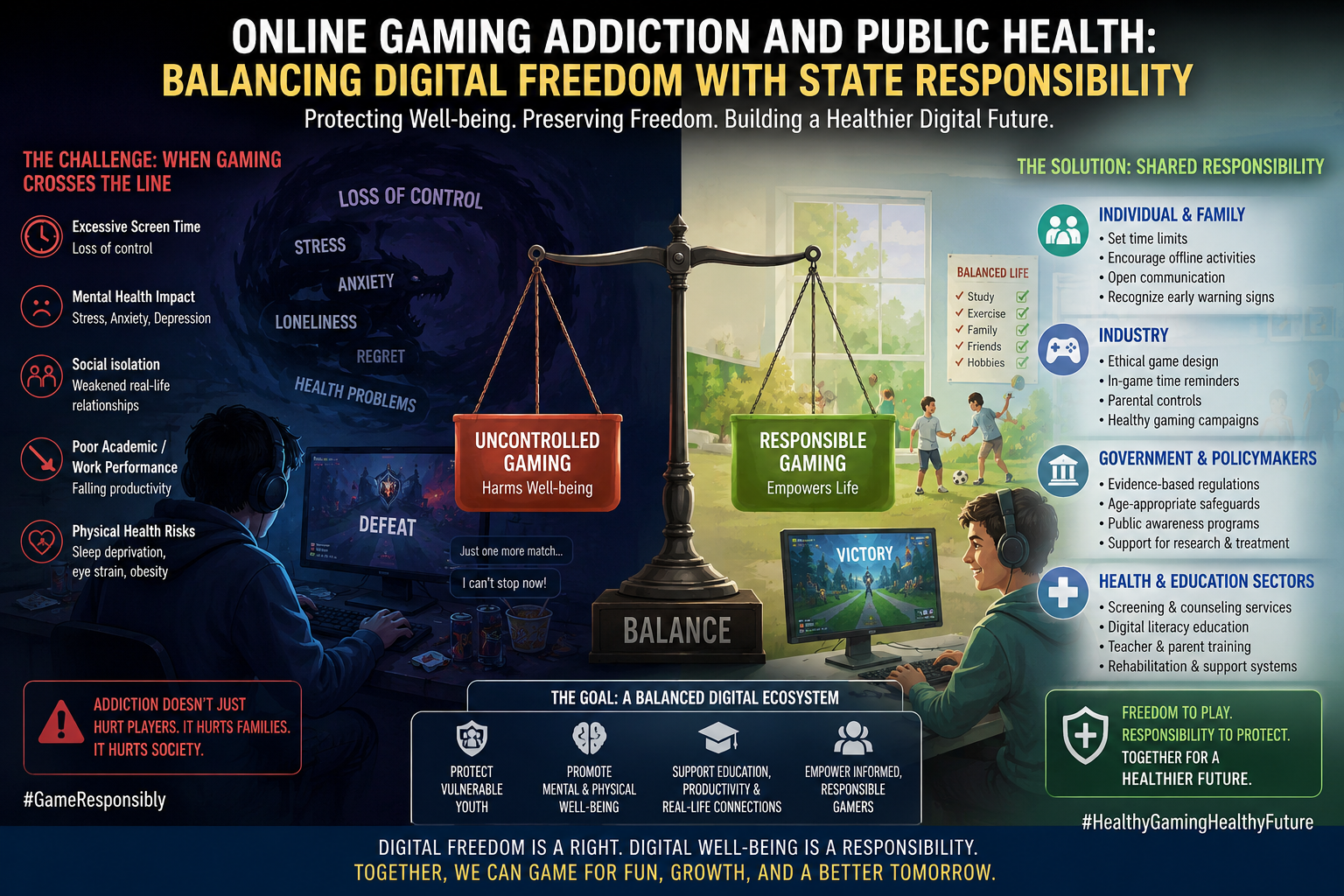
This article explain online gaming addiction as a public health challenge and explores how governments can balance digital freedom with state responsibility in the contemporary digital era.
🔹Understanding Online Gaming Addiction
The Rise of Online Gaming
Online gaming refers to games played over the internet through computers, smartphones, tablets, and gaming consoles. The sector includes a diverse range of activities, such as:
Multiplayer online games
Strategy games
Fantasy sports
Esports tournaments
Casino-style games
Real-money gaming platforms
Skill-based gaming applications
The appeal of online gaming lies in its accessibility, immersive experiences, social connectivity, and reward mechanisms. Unlike traditional games, online platforms are available twenty-four hours a day, enabling continuous participation regardless of geographical boundaries.
What is Gaming Addiction?
Gaming addiction, often referred to as Gaming Disorder, is characterized by persistent and compulsive gaming behavior that interferes with daily life. The World Health Organization (WHO) has officially recognized Gaming Disorder in the International Classification of Diseases (ICD-11).
The disorder typically involves:
Loss of control over gaming habits.
Increasing priority given to gaming over other activities.
Continued gaming despite negative consequences.
Impaired academic, professional, or social functioning.
While not every gamer develops addiction, the growing prevalence of problematic gaming behavior has prompted serious concerns among mental health experts.
Psychological Foundations of Gaming Addiction
Modern online games employ sophisticated psychological techniques designed to maximize engagement. These include:
Reward Systems
Players receive rewards through points, rankings, achievements, virtual currency, and upgrades. Such rewards stimulate dopamine release, reinforcing repetitive behavior.
Social Reinforcement
Multiplayer games create online communities where players gain recognition, status, and social acceptance.
Variable Rewards
Many games use unpredictable reward mechanisms similar to those found in gambling activities. Players remain engaged because rewards are uncertain yet potentially valuable.
Escapism
Gaming often provides temporary relief from stress, loneliness, anxiety, or personal challenges. For some individuals, gaming becomes a coping mechanism rather than a recreational activity.
🔹Online Gaming Addiction as a Public Health Challenge
Mental Health Consequences
The most significant concern associated with excessive gaming is its impact on mental health.
Research increasingly links gaming addiction with:
Anxiety disorders
Depression
Emotional instability
Sleep disorders
Social withdrawal
Reduced attention span
Young individuals are particularly vulnerable because their emotional and cognitive development remains ongoing.
Physical Health Implications
Excessive gaming may also contribute to:
Sedentary lifestyles
Obesity
Eye strain
Musculoskeletal disorders
Poor posture
Sleep deprivation
Extended screen time and reduced physical activity create additional health risks that affect overall well-being.
Financial Harm
The rise of real-money gaming has introduced substantial financial risks.
Many gaming platforms encourage users to:
Purchase virtual goods
Participate in paid competitions
Engage in betting activities
Make repeated in-game transactions
Compulsive spending can result in debt, financial distress, and family conflicts.
Social Consequences
Gaming addiction can adversely affect:
Academic performance
Workplace productivity
Family relationships
Social interactions
Community engagement
The cumulative impact of these consequences extends beyond individual users and affects society as a whole.
🔹Constitutional Dimensions of Digital Freedom
Individual Liberty and Personal Choice
Modern constitutional democracies recognize individual autonomy as a fundamental value. Citizens generally possess the freedom to choose their preferred forms of recreation and entertainment.
Participation in lawful online gaming may be viewed as an aspect of:
Personal liberty
Freedom of expression
Individual autonomy
Digital participation.
Therefore, excessive governmental interference may raise constitutional concerns.
Right to Privacy
The digital environment generates enormous amounts of personal data. Gaming platforms collect information regarding:
User behavior
Spending patterns
Preferences
Location data
Communication activities
Any regulatory framework must respect privacy rights while ensuring public welfare.
Economic Freedom
The gaming industry contributes significantly to:
Employment generation
Technological innovation
Foreign investment
Economic growth
Companies engaged in online gaming may invoke constitutional protections relating to trade and business. Consequently, restrictions must be reasonable, proportionate, and legally justified.
🔹The State's Responsibility to Protect Public Health
Constitutional Duty
Governments possess a constitutional obligation to protect citizens from activities that threaten public welfare.
Traditionally, states regulate:
Tobacco products
Alcohol consumption
Pharmaceutical drugs
Gambling activities
Hazardous industries
The rationale for such regulation lies in minimizing societal harm.
Public Health and Collective Welfare
Public health extends beyond disease prevention. It encompasses the broader social, mental, and physical well-being of communities.
When gaming addiction contributes to:
Mental health crises
Financial losses
Social instability
Youth vulnerability
state intervention may become both legitimate and necessary.
The Precautionary Principle
Public health governance often relies upon the precautionary principle, which supports preventive action where potential harm exists even if complete scientific certainty is unavailable.
Given the growing evidence regarding gaming addiction, policymakers increasingly view preventive regulation as a reasonable response.
Judicial Perspective: State of Tamil Nadu v. Junglee Games India Pvt. Ltd.
A significant development in India's legal discourse on online gaming emerged in State of Tamil Nadu & Others v. Junglee Games India Pvt. Ltd.
The matter involved challenges concerning state regulation of online gaming activities. While examining the broader implications of online betting and gambling, the Supreme Court made important observations regarding the societal consequences of technology-driven gambling practices.
Supreme Court's Observations
Justices J.B. Pardiwala and R. Mahadevan observed that:
Technological developments have transformed online gambling into a virtual common gambling house, making betting and gambling activities normalized and accessible across society.
The Court further noted that:
The widespread prevalence of online gambling poses a serious threat to public order, public tranquility, and public health.
These observations reflect judicial recognition of the fact that technological innovation has significantly altered the nature and scale of gambling-related activities.
Significance of the Judgment
The Court's observations are important for several reasons:
1. Recognition of addiction-related harms.
2. Emphasis on public health concerns.
3. Acknowledgment of technological transformation.
4. Support for reasonable regulatory intervention.
5. Protection of vulnerable populations.
The judgment illustrates the judiciary's increasing awareness of digital-age challenges and the need to balance innovation with societal welfare.
The Distinction Between Gaming and Gambling
One of the most complex legal issues concerns the distinction between gaming and gambling.
Games of Skill
Traditionally, courts have recognized that games predominantly based on skill differ from gambling activities.
Examples include:
Chess
Certain fantasy sports formats
Competitive esports
Strategic card games
Games of Chance
Activities primarily dependent upon chance are generally categorized as gambling.
Examples include:
Roulette
Slot machines
Lottery systems
Betting activities
Emerging Challenges
Modern online platforms often combine elements of both skill and chance.
This creates regulatory difficulties because:
Definitions remain contested.
Technology evolves rapidly.
User behavior varies significantly.
Financial incentives blur traditional distinctions.
Consequently, policymakers face the challenge of developing nuanced regulations that accurately reflect contemporary gaming realities.
Policy Recommendations
A balanced regulatory framework should include:
Age Verification Systems
Robust age verification can prevent underage participation in high-risk gaming activities.
Spending Limits
Platforms should implement spending caps to reduce financial harm.
Time Controls
Gaming applications may include optional or mandatory time-management tools.
Transparency Requirements
Users should receive clear information regarding:
Probabilities of rewards.
Financial risks.
Addiction-related concerns.
Mental Health Support
Governments should expand access to:
Counseling services.
Addiction treatment programs.
Educational initiatives.
Responsible Platform Design
Developers should be encouraged to adopt ethical design practices that minimize addictive features
🔹Conclusion
Online gaming offers valuable opportunities for entertainment and innovation, but its addictive potential presents growing public health concerns. As recognized by the Supreme Court in State of Tamil Nadu v. Junglee Games India Pvt. Ltd., unchecked online gaming and gambling can affect public welfare and social order. Therefore, a balanced regulatory approach that safeguards public health while respecting digital freedom is essential for ensuring responsible and sustainable growth of the online gaming ecosystem.
⚠️ Disclaimer
The information presented in this article is intended solely for educational, academic, and informational purposes.

Leave a Comment
Your email address and mobile number will not be published. Required fields are marked *