📖 Introduction:
The Right to Information (RTI) Act, 2005 stands as one of India's most significant democratic reforms. Enacted to promote transparency, accountability, and citizen participation in governance, the Act transformed the relationship between the State and its citizens by recognizing that information held by public authorities belongs ultimately to the people. Over the last two decades, RTI has empowered millions of citizens to question government actions, expose corruption, monitor public spending, and seek accountability from public officials.
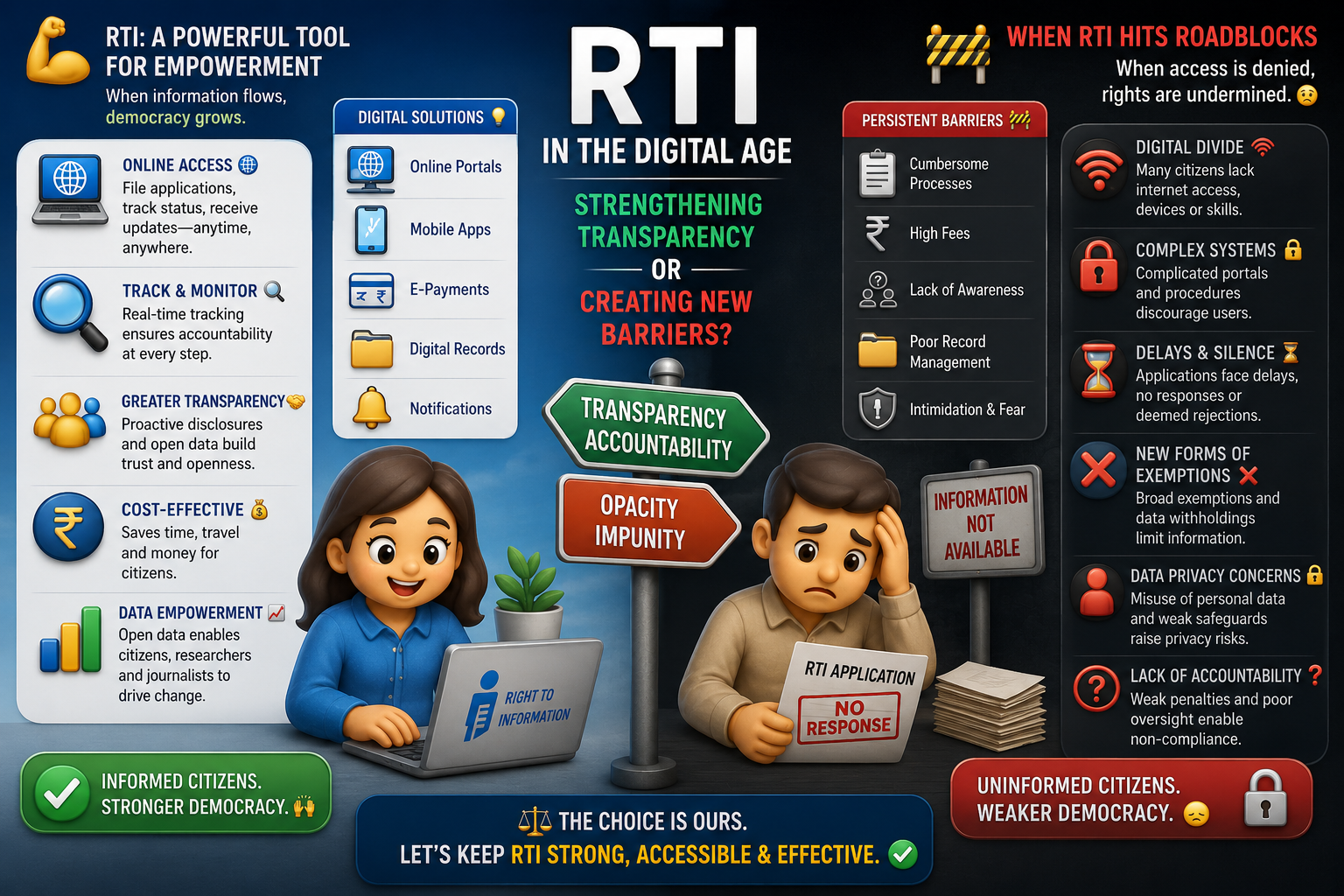
However, the governance landscape of India has changed dramatically since the enactment of the RTI Act. The rapid growth of digital technologies, e-governance platforms, online public services, artificial intelligence, cloud-based data management, and digital recordkeeping has fundamentally altered how governments collect, store, and disseminate information. Citizens today increasingly interact with government authorities through digital portals rather than physical offices. Consequently, the implementation of RTI has also entered the digital age.The digitalization of governance presents unprecedented opportunities for transparency. Online disclosure of government records, digital RTI portals, real-time access to public information, and open data initiatives have significantly enhanced citizens' ability to obtain information. Yet, this technological transformation has also generated new concerns. Digital exclusion, cybersecurity risks, algorithmic decision-making, bureaucratic resistance, and unequal access to technology raise important questions regarding the future of transparency and democratic accountability.This article explaimn whether the digital transformation of RTI has strengthened transparency or inadvertently created new barriers for citizens. It explores the legal framework, judicial developments, benefits and challenges of digital RTI systems, and the broader implications for democratic governance in India.
🏛️ Constitutional Foundation of the Right to Information:
Although the Indian Constitution does not explicitly mention the Right to Information, the judiciary has consistently recognized it as an integral component of the fundamental right to freedom of speech and expression under Article 19(1)(a).
The Supreme Court observed that citizens cannot effectively exercise freedom of speech and expression unless they possess adequate information regarding governmental functioning. Democracy thrives when citizens are informed participants rather than passive observers.
The constitutional basis of RTI emerged through several landmark decisions:
📌 State of Uttar Pradesh v. Raj Narain (1975)
The Supreme Court held that citizens possess a right to know how public authorities function because government accountability depends upon public awareness.
📌 S.P. Gupta v. Union of India (1981)
The Court emphasized that transparency is essential for democratic governance and that secrecy should be the exception rather than the rule.
📌 People's Union for Civil Liberties v. Union of India (2003)
The Court reaffirmed that access to information is a necessary condition for meaningful democratic participation.
These judgments ultimately laid the groundwork for the enactment of the RTI Act, 2005.
📜 The RTI Act, 2005: An Overview
The RTI Act was enacted with the primary objective of promoting transparency and accountability in public authorities.
The Act provides citizens with the right to:
✅ Inspect government records
✅ Obtain certified copies of documents
✅ Access official files and reports
✅ Seek information from public authorities
✅ Examine public works and projects
Under the Act, every public authority must appoint Public Information Officers (PIOs) responsible for responding to RTI applications within prescribed timelines.
The legislation also mandates proactive disclosure of information under Section 4, reducing the need for individual RTI applications.
💻 The Emergence of Digital Governance
Over the past decade, India has witnessed a significant shift toward digital governance.
Major initiatives include:
Digital India Mission
E-Governance Projects
Online Service Delivery Platforms
DigiLocker
Government Open Data Portals
Digital Land Records
E-Courts System
Government agencies increasingly maintain records electronically rather than in physical files.
This transformation naturally influenced RTI implementation.
Citizens can now submit applications online, track requests electronically, and receive information digitally.
🌐 Digital RTI Platforms: A New Era of Transparency:
One of the most significant developments has been the introduction of online RTI portals.
The Central Government's RTI Online Portal enables citizens to:
🖥️ File RTI applications electronically
📩 Receive digital responses
💳 Pay fees online
📊 Track application status
📂 Access appeal mechanisms
Digital platforms have substantially reduced procedural barriers associated with traditional RTI applications.
Previously, citizens often needed to:
Visit government offices
Submit physical applications
Purchase postal orders
Follow up repeatedly
Today, much of this process can be completed remotely.
✅ Advantages of RTI in the Digital Age
1. Greater Accessibility
Digital RTI systems have expanded access to information across geographical boundaries.
Citizens living in remote areas can communicate with authorities without traveling long distances.
This has enhanced administrative efficiency and reduced costs.
2. Faster Information Delivery
Electronic records facilitate quicker retrieval and transmission of information.
Instead of locating physical files, authorities can access databases and send digital copies immediately.
Response times have improved significantly in many departments.
3. Enhanced Transparency Through Proactive Disclosure
Section 4 of the RTI Act encourages public authorities to proactively publish information.
Digital platforms enable disclosure of:
Budgets
Contracts
Tender documents
Policy decisions
Government schemes
When information is available online, citizens need not file RTI applications.
4. Improved Record Management
Digital recordkeeping reduces the risk of lost, damaged, or manipulated files.
Electronic archives facilitate:
📁 Efficient storage
📁 Quick retrieval
📁 Better preservation
📁 Audit trails
Such systems strengthen accountability mechanisms.
5. Citizen Empowerment
Technology has democratized access to government information.
Journalists, researchers, activists, students, and ordinary citizens can analyze public data and engage more effectively in governance.
The result is greater public participation in decision-making processes.
📊 Open Data and RTI
The rise of open data initiatives represents a major advancement in transparency.
Open government data involves making public information freely available in machine-readable formats.
Benefits include:
✔️ Research and innovation
✔️ Public scrutiny
✔️ Evidence-based policymaking
✔️ Economic development
Open data complements RTI by reducing dependence on individual information requests.
⚠️ Challenges and Emerging Barriers:
Despite these advantages, digital RTI implementation raises serious concerns.
1. The Digital Divide
Perhaps the most significant challenge is unequal access to technology.
Millions of Indians still face limitations relating to:
📵 Internet connectivity
📵 Digital literacy
📵 Device ownership
📵 Language barriers
For these citizens, digital RTI systems may create exclusion rather than empowerment.
The shift toward online platforms risks marginalizing vulnerable populations.
2. Technological Illiteracy
Many citizens remain unfamiliar with digital processes.
Filing online applications requires:
Internet access
Basic computer skills
Electronic payment methods
Senior citizens, rural populations, and economically disadvantaged groups often face difficulties navigating these systems.
3. Language Accessibility
Many RTI portals primarily function in English.
This creates barriers for citizens who communicate in regional languages.
True transparency requires multilingual accessibility.
4. Cybersecurity Risks
As government records become digital, concerns regarding cybersecurity intensify.
Potential risks include:
🔒 Data breaches
🔒 Unauthorized access
🔒 Hacking
🔒 Identity theft
Governments must ensure that transparency does not compromise privacy and security.
5. Data Overload
Digital governance produces vast amounts of information.
Citizens may struggle to identify relevant data amidst enormous datasets.
Availability of information does not automatically guarantee meaningful access.
Information must also be understandable and usable.
6. Algorithmic Governance
Governments increasingly utilize automated systems and artificial intelligence for administrative decision-making.
Questions arise regarding:
Algorithmic transparency
Automated decision-making
Accountability of AI systems
Citizens may seek explanations for decisions affecting them.
Traditional RTI mechanisms may be inadequate for addressing such concerns.
⚖️ Privacy Versus Transparency:
One of the most complex legal challenges in the digital age involves balancing transparency with privacy.
The conflict became particularly significant after the Supreme Court's landmark judgment in:
📌 Justice K.S. Puttaswamy v. Union of India
The Court recognized privacy as a fundamental right under Article 21.
This judgment reshaped discussions surrounding information disclosure.
Public authorities must now balance:
Public interest in transparency
Individual privacy rights
The challenge is especially acute where government databases contain personal information.
🏛️ Landmark Judicial Decisions Impacting RTI:
📌 CBSE v. Aditya Bandopadhyay
The Supreme Court held that examinees possess the right to inspect answer sheets under the RTI Act.
The decision reinforced citizen access to information.
📌 Girish Ramchandra Deshpande v. CIC
The Court emphasized privacy protections regarding personal information.
The judgment highlighted limits to disclosure.
📌 Central Public Information Officer, Supreme Court of India v. Subhash Chandra Agarwal
The Court held that even the office of the Chief Justice falls within the RTI framework, subject to reasonable restrictions.
The decision strengthened institutional accountability.
📱 RTI and Social Media Governance
Government agencies increasingly communicate through social media platforms.
Questions arise regarding:
Preservation of digital records
Official communications on social media
Public access to digital interactions
Future RTI frameworks may need to address these evolving forms of governance.
🤖 Artificial Intelligence and the Future of RTI
AI presents both opportunities and challenges.
Potential benefits include:
✅ Faster processing of applications
✅ Automated classification of records
✅ Improved search capabilities
✅ Predictive disclosure systems
However, AI also raises concerns regarding:
❌ Lack of explainability
❌ Algorithmic bias
❌ Reduced human accountability
Transparency must evolve to include algorithmic accountability.
Citizens increasingly need access not merely to decisions but also to the logic underlying automated systems.
🔍 Has Digitalization Strengthened Transparency?
The answer is complex.
In many respects, digital RTI systems have unquestionably enhanced transparency.
Achievements include:
✔️ Faster information access
✔️ Greater administrative efficiency
✔️ Reduced procedural barriers
✔️ Expanded proactive disclosure
✔️ Improved public oversight
Technology has enabled unprecedented public access to government information.
🚧 Or Has It Created New Barriers?
Simultaneously, digital transformation has generated significant obstacles.
Challenges include:
❌ Digital exclusion
❌ Technological inequality
❌ Language barriers
❌ Privacy concerns
❌ Cybersecurity risks
❌ Algorithmic opacity
Without inclusive design, digital transparency may benefit technologically privileged groups while excluding others.
📝 The Way Forward:
To ensure that digital RTI strengthens democracy rather than weakens it, policymakers should consider:
✅ Bridging the Digital Divide
Expand internet access and digital literacy programs.
✅ Multilingual RTI Platforms
Provide services in regional languages.
✅ Strengthening Cybersecurity
Protect government databases and citizen information.
✅ Enhancing Proactive Disclosure
Publish more information before citizens request it.
✅ Algorithmic Transparency
Ensure explainability of AI-based governmental decisions.
✅ Citizen-Centric Design
Develop accessible and user-friendly portals.
✅ Capacity Building
Train officials in digital transparency practices.
Conclusion:
The digitalization of the RTI framework has significantly improved transparency and access to information, but it has also introduced challenges such as digital exclusion, privacy concerns, and technological barriers. To fulfill the true spirit of the RTI Act, digital governance must remain inclusive, secure, and citizen-friendly. Transparency is meaningful only when every citizen can effectively access and use information to hold public authorities accountable.
⚠️ Important Note:
This article is intended for academic, educational, and informational purposes only.

Leave a Comment
Your email address and mobile number will not be published. Required fields are marked *