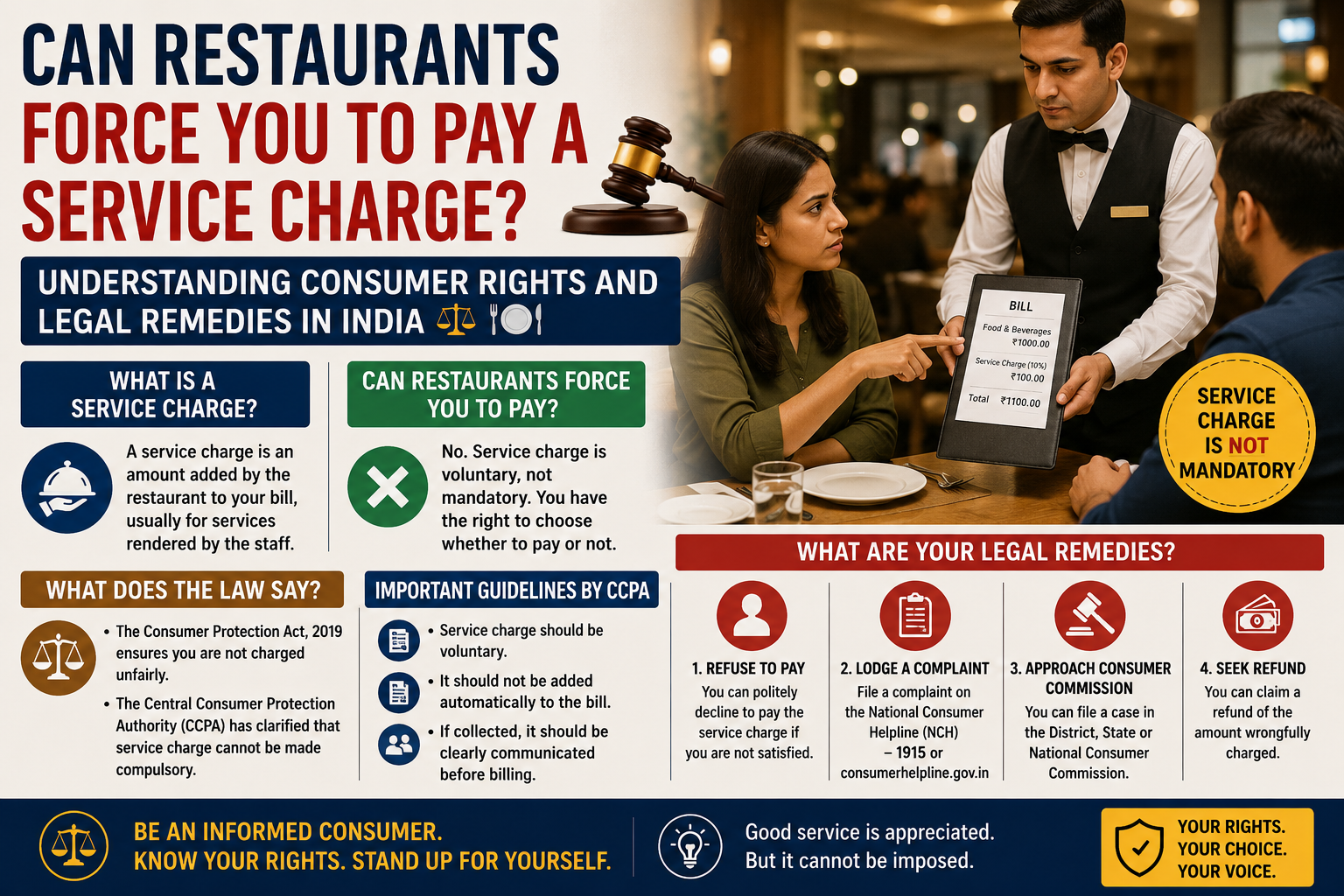
🔹Introduction
Imagine visiting a restaurant for a family dinner. You enjoy the food, receive the bill, and notice an additional charge labeled "Service Charge" amounting to 10% of the total bill. When you ask for its removal, the restaurant staff informs you that the charge is mandatory and cannot be waived.
Many consumers across India have encountered similar situations. While some pay the amount without questioning it, others wonder whether restaurants actually possess the legal authority to compel payment of such charges.
The issue has become increasingly controversial in recent years due to growing consumer complaints, government intervention, and judicial scrutiny. Consumer commissions, courts, and regulatory authorities have repeatedly addressed the legality of mandatory service charges imposed by restaurants and hotels.
A recent consumer dispute involving a restaurant's collection of approximately ₹151 as a service charge and the subsequent award of compensation by a Consumer Commission has once again brought the issue into the spotlight.
This controversy raises several important legal questions:
✔ Is a service charge legally enforceable?
✔ Is service charge the same as GST?
✔ Can a customer refuse to pay it?
✔ What rights do consumers have under Indian law?
✔ What remedies are available if a restaurant insists on collecting it?
✔ Can consumers seek compensation?
This comprehensive guide examines the legal position governing service charges in India and explains the rights available to consumers under modern consumer protection laws.
Understanding the Concept of Service Charge 🍽️
Before examining the legal issues, it is important to understand what a service charge actually means.
A service charge is an amount added by a restaurant, hotel, or food establishment to a customer's bill, usually expressed as a percentage of the total value of food and beverages consumed.
For example:
Food Bill Service Charge (10%)
₹1,000 ₹100
₹2,500 ₹250
₹5,000 ₹500
Restaurants often justify the charge by claiming that it is used to reward staff members for the services they provide to customers.
However, the legal issue does not concern the purpose of the charge but rather whether consumers can be compelled to pay it.
📜Historical Background of Service Charges :
Traditionally, customers voluntarily rewarded good service by leaving a tip.
The practice originated as a gesture of appreciation and remained entirely discretionary.
Over time, many restaurants introduced a separate "service charge" as part of their billing system.
Initially, consumers generally accepted the practice because:
The charge was relatively small.
Few customers challenged it.
Consumer awareness was limited.
As consumer rights awareness increased, many customers began questioning:
Why is the charge automatically added?
Is it mandatory?
Can I refuse payment?
Is it a hidden charge?
These concerns ultimately resulted in regulatory intervention.
💰Service Charge vs. Tip: Understanding the Difference :
One of the biggest misconceptions among consumers is treating service charge and tip as identical concepts.
Legally and practically, they are different.
What Is a Tip?
A tip is:
✅ Voluntary
✅ Paid at the customer's discretion
✅ Based on customer satisfaction
✅ Given directly or indirectly to service staff
The customer determines:
Whether to pay
How much to pay
To whom it should be paid
What Is a Service Charge?
A service charge is:
✅ Added by the establishment
✅ Usually calculated as a percentage
✅ Included in the bill
✅ Collected by the restaurant
Unlike a tip, the customer may not always have complete control over the amount being demanded.
This distinction lies at the heart of the legal controversy.
Is Service Charge the Same as GST? ❌
Many customers mistakenly assume that service charge is a government-imposed tax similar to GST.
This is incorrect.
What Is GST?
Goods and Services Tax (GST) is a statutory tax imposed under law.
Restaurants collect GST on behalf of the government.
Consumers are legally required to pay applicable GST.
What Is Service Charge?
Service charge is not a tax.
It is a charge imposed by the restaurant itself.
Therefore:
GST Service Charge
Government tax Restaurant-imposed charge
Mandatory where applicable Subject to legal dispute
Collected under statute Collected under restaurant policy
Paid to government Retained/distributed by restaurant
Understanding this distinction is essential because consumers often pay service charges believing them to be legally mandatory taxes.
Why Did the Service Charge Issue Become Controversial? ⚖️
Over the last decade, complaints regarding mandatory service charges increased significantly.
Consumers alleged that:
Automatic Addition
The charge appeared on bills without consultation.
Lack of Transparency
Many customers noticed the charge only after receiving the bill.
Coercive Collection
Restaurants allegedly refused to remove the charge even when customers objected.
Misrepresentation
Consumers were sometimes informed that payment was compulsory.
Embarrassment
Customers who objected reportedly faced uncomfortable situations.
These complaints eventually reached consumer authorities and courts.
🛡️Consumer Protection in India: A Brief Overview :
The legal framework governing such disputes primarily arises from the Consumer Protection Act, 2019.
The Act aims to:
Protect consumer interests.
Prevent unfair trade practices.
Ensure transparency.
Provide accessible remedies.
The legislation represents one of the most significant consumer rights reforms in India.
⚖️Important Consumer Rights Relevant to Service Charges :
1. Right to Information 📄
Consumers have a right to receive accurate information regarding:
Price
Quality
Quantity
Charges
Hidden or misleading charges can undermine this right.
2. Right to Choice 🛒
Consumers should have freedom regarding their purchases.
Businesses should not impose unwanted obligations without proper consent.
3. Right to Protection Against Unfair Trade Practices 🚫
Consumers are protected from:
Misleading conduct
False representations
Deceptive pricing
Unfair billing practices
4. Right to Seek Redressal ⚖️
Where consumer rights are violated, individuals may seek remedies through:
Consumer commissions
Regulatory authorities
Grievance redressal mechanisms
The Principle of Consent in Consumer Transactions 🤝
One of the most important legal concepts relevant to service charges is consent.
Every commercial transaction is based upon an agreement between parties.
When a consumer enters a restaurant:
The menu displays prices.
The customer orders food.
Payment is made according to agreed pricing.
Problems arise when additional charges appear that consumers did not clearly understand or voluntarily accept.
The question becomes:
Did the consumer genuinely consent to the additional service charge?
This issue has repeatedly surfaced before consumer forums and courts.
Central Consumer Protection Authority (CCPA) and Service Charges 🏛️
The growing number of complaints led the Central Consumer Protection Authority (CCPA) to intervene.
The CCPA was established under the Consumer Protection Act, 2019 to protect consumer rights and regulate unfair trade practices.
After examining complaints regarding mandatory service charges, the authority issued guidelines concerning the practice.
📜Objectives Behind the Guidelines :
The CCPA sought to address:
✔ Forced collection of service charges.
✔ Misleading billing practices.
✔ Lack of consumer choice.
✔ Consumer harassment.
✔ Non-transparent pricing structures.
The objective was to ensure fairness and protect consumer autonomy.
What the Guidelines Seek to Prevent 🚫
The guidelines emphasize that restaurants should not:
❌ Automatically add service charges without proper consumer choice.
❌ Mislead consumers regarding the nature of the charge.
❌ Present service charges as compulsory government levies.
❌ Deny services because a customer refuses to pay.
❌ Use coercive methods for collection.
These principles have significantly shaped the current debate surrounding service charges.
🍽️Why Consumer Choice Matters :
Consumer law increasingly recognizes that customers are not merely sources of revenue but rights-bearing individuals.
Modern consumer protection focuses on:
Transparency
Consumers should know what they are paying for.
Fairness
Businesses should avoid exploitative practices.
Informed Decision-Making
Customers should make choices based on accurate information.
Freedom
Consumers should not be pressured into accepting unwanted obligations.
Mandatory service charges directly engage all of these principles.
💼The Economics Behind Service Charges
Restaurants often argue that service charges help:
Reward employees.
Maintain service quality.
Reduce dependence on voluntary tipping.
Improve staff welfare.
These objectives may be legitimate from a business perspective.
However, consumer law examines a different question:
Can a restaurant pursue these objectives by compelling consumers to pay additional charges?
This legal distinction forms the basis of many disputes.
Recent Consumer Commission Decision and Its Significance ⚖️
A recent consumer dispute attracted nationwide attention.
A customer challenged the imposition of a service charge amounting to approximately ₹151.
Although the amount involved was relatively small, the legal principle was significant.
The Consumer Commission reportedly:
✅ Ordered refund of the service charge.
✅ Granted compensation.
✅ Awarded litigation expenses.
The decision highlighted an important principle:
Consumer rights do not depend upon the size of the disputed amount.
Even a small wrongful charge may justify legal intervention if consumer rights are violated.
📢Why This Decision Matters :
The ruling sends an important message:
Transparency matters.
Consumer consent matters.
Small disputes can raise large legal principles.
Businesses must respect consumer rights.
It also demonstrates that consumer forums are willing to address unfair practices regardless of the monetary value involved.
⚖️The Core Legal Question :
After understanding the nature of service charges and the consumer rights involved, we now come to the most important question:
Can a restaurant legally force a customer to pay a service charge?
The issue has generated extensive debate among restaurants, consumer organizations, regulators, and courts.
At its heart lies a conflict between:
Restaurant Autonomy 🏢
and
Consumer Choice 🛡️
Restaurants argue that they should be free to determine pricing policies, while consumers maintain that they cannot be compelled to pay charges they did not voluntarily agree to.
The law attempts to balance these competing interests.
The Contractual Relationship Between Restaurant and Customer 🤝
Whenever a customer enters a restaurant and places an order, a contractual relationship is created.
The essential elements include:
Offer
The restaurant offers food and services through its menu.
Acceptance
The customer places an order.
Consideration
The customer pays the price.
Mutual Consent
Both parties agree to the terms.
The controversy arises when additional charges appear that were not clearly understood by the customer at the time of ordering.
This raises questions regarding:
Transparency
Disclosure
Informed consent
Fairness
📜Can Restaurant Policies Override Consumer Rights?
Many restaurants justify service charges by stating:
“It is our policy.”
However, from a legal standpoint, every business policy must comply with applicable laws.
A restaurant cannot simply create internal rules that override:
Consumer protection laws
Fair trade principles
Public policy considerations
In other words:
Business Policy ≠ Legal Authority
A policy becomes legally questionable if it infringes upon consumer rights.
💰Importance of Transparency in Pricing ;
One of the most important principles recognized by consumer law is price transparency.
Consumers should know:
✅ What they are buying.
✅ What they are paying for.
✅ What additional charges may apply.
Hidden or unexpected charges undermine consumer confidence and informed decision-making.
For this reason, consumer authorities place significant emphasis on transparent billing practices.
📖Is Displaying Service Charge on the Menu Enough?
Restaurants often argue that the service charge is mentioned:
On menus
At entrances
On display boards
In billing terms
The legal debate then becomes:
Does mere disclosure automatically make the charge binding?
Consumer forums often examine:
Whether disclosure was clear.
Whether the customer actually had meaningful notice.
Whether the customer had a genuine opportunity to refuse.
Whether the charge was presented as mandatory.
Thus, disclosure alone may not always settle the issue.
The broader question remains whether the consumer retained meaningful choice.
⚠️The Consumer Protection Act and Unfair Trade Practices :
The Consumer Protection Act, 2019 prohibits unfair trade practices.
An unfair trade practice may include conduct that:
Misleads consumers.
Creates false impressions.
Uses deceptive methods.
Interferes with informed decision-making.
When consumers are informed that service charges are compulsory despite legal disputes regarding their mandatory nature, consumer authorities may examine whether such conduct amounts to an unfair trade practice.
What Is an Unfair Trade Practice? 🚫
Generally speaking, an unfair trade practice involves:
Misrepresentation
Providing incorrect information.
Deception
Creating a false impression.
Concealment
Hiding important information.
Coercion
Pressuring consumers into unwanted transactions.
If a restaurant uses any of these methods to recover service charges, consumer protection concerns may arise.
🛡️Why Consumer Consent Is So Important
Modern consumer law increasingly recognizes the concept of informed consent.
Consumers should:
✔ Understand charges beforehand.
✔ Have access to accurate information.
✔ Make decisions voluntarily.
✔ Not be subjected to pressure.
Where consent is absent, legal scrutiny becomes more intense.
💡The Difference Between Suggesting and Compelling
A crucial legal distinction exists between:
Suggesting a Service Charge
and
Compelling Payment
A restaurant may:
✅ Explain its service charge policy.
✅ Request customers to contribute.
✅ Encourage support for staff.
However, problems arise when:
❌ Customers are told they have no choice.
❌ Removal requests are rejected outright.
❌ Staff insist that payment is legally mandatory.
The distinction between recommendation and compulsion often determines whether disputes emerge.
The Role of the Central Consumer Protection Authority (CCPA) 🏛️
The CCPA has played a significant role in shaping the legal landscape.
Its intervention was prompted by numerous complaints from consumers who alleged:
Forced collection.
Lack of transparency.
Misleading representations.
Harassment.
The authority issued guidelines intended to protect consumer interests and preserve freedom of choice.
Consumer Complaints That Triggered Regulatory Action 📢
Common complaints included:
Automatic Billing
Service charges were added without consultation.
Refusal to Remove Charges
Customers were told the charge was non-negotiable.
Embarrassing Situations
Consumers felt pressured in front of friends or family.
Misleading Statements
Some customers reported being informed that service charges were legally mandatory.
These recurring concerns led regulators to scrutinize industry practices.
What Happens When a Customer Objects? 🤔
In practice, disputes often arise at the billing stage.
The customer may:
Request removal of the service charge.
Seek clarification.
Challenge the legality of the charge.
The restaurant may:
Remove it immediately.
Explain its policy.
Refuse removal.
The legal consequences often depend on how the restaurant responds.
Situations That May Raise Legal Concerns 🚨
Consumer forums may pay close attention when:
The Customer Was Never Informed
There was no adequate disclosure.
The Charge Appeared Mandatory
Consumers were told payment was compulsory.
Removal Was Refused
Despite objections.
Misleading Information Was Provided
Customers were incorrectly informed about legal requirements.
Pressure Was Applied
The consumer was embarrassed, intimidated, or harassed.
Such circumstances can strengthen a consumer's claim.
Consumer Dignity and Fair Treatment :
Consumer law protects not only financial interests but also consumer dignity.
A customer should not be:
❌ Humiliated.
❌ Pressured.
❌ Threatened.
❌ Forced into unnecessary disputes.
The law increasingly recognizes that fair treatment is an essential component of consumer rights.
Can Small Amounts Lead to Legal Action? 💰
Many people assume that legal action is justified only when large sums are involved.
This assumption is incorrect.
Consumer law focuses on principles as much as monetary value.
Even:
₹50
₹100
₹151
may become the subject of a valid consumer complaint if unfair conduct is involved.
The issue often concerns consumer rights rather than the amount itself.
⚖️Why Compensation May Be Awarded ;
Consumer commissions do not merely refund disputed amounts.
They may also award compensation for:
Mental Agony
Stress caused by unfair treatment.
Harassment
Unreasonable conduct by businesses.
Inconvenience
Time and effort spent resolving disputes.
Litigation Costs
Expenses incurred during legal proceedings.
This explains why compensation awards can significantly exceed the amount originally disputed.
📚Legal Principles Emerging from Consumer Decisions :
Several principles repeatedly emerge from consumer disputes involving service charges:
Transparency Is Essential
Businesses must be open about pricing.
Consumer Choice Matters
Customers should not be deprived of meaningful choice.
Consent Must Be Genuine
Agreement should be informed and voluntary.
Coercion Is Unacceptable
Pressure tactics undermine consumer rights.
Fair Treatment Is Mandatory
Businesses must deal respectfully with consumers.
These principles guide consumer commissions when deciding disputes.
Responsibilities of Restaurants 🍽️
Restaurants also possess legitimate interests.
They may seek to:
Reward employees.
Improve service quality.
Maintain operational standards.
Create predictable compensation systems.
However, these objectives should be pursued through practices that remain consistent with consumer protection laws.
Transparency and voluntary participation generally reduce legal risks.
Best Practices for Restaurants ✅
To avoid disputes, restaurants should:
✔ Clearly disclose pricing.
✔ Avoid misleading terminology.
✔ Train staff properly.
✔ Respect customer objections.
✔ Maintain professional conduct.
✔ Ensure billing transparency.
Such measures strengthen customer trust and reduce complaints.
Best Practices for Consumers ✅
Consumers should:
✔ Carefully examine bills.
✔ Ask questions where necessary.
✔ Request clarification politely.
✔ Preserve receipts.
✔ Record relevant communications.
✔ Understand their legal rights.
Awareness is often the most effective protection against unfair practices.
The Growing Importance of Consumer Awareness 📢
Today's consumers are increasingly informed.
Digital platforms, legal awareness campaigns, and consumer advocacy groups have made it easier for individuals to understand their rights.
As awareness grows:
Consumers are more likely to challenge questionable charges.
Businesses face greater scrutiny.
Consumer forums receive more complaints.
Transparency becomes increasingly important.
This trend is likely to continue in the future.
When a Service Charge Dispute Becomes a Legal Issue ⚖️
Most service charge disputes begin with a simple disagreement at the billing counter.
A customer notices the charge and requests its removal.
In many cases, the restaurant agrees.
However, a legal dispute may arise when:
❌ The restaurant refuses to remove the charge.
❌ The customer is told the charge is compulsory.
❌ Misleading information is provided.
❌ The consumer feels harassed or pressured.
❌ Additional charges are imposed without adequate disclosure.
At this stage, the issue may move beyond a billing disagreement and enter the realm of consumer protection law.
First Step: Remain Calm and Professional 🤝
Consumers should always handle disputes respectfully.
Avoid:
❌ Arguments.
❌ Aggressive behaviour.
❌ Confrontation.
❌ Disturbing other customers.
Instead:
✅ Ask for clarification.
✅ Request a revised bill.
✅ Speak with management.
✅ Maintain written records wherever possible.
Professional conduct helps preserve credibility and evidence.
Importance of Evidence in Consumer Cases 📂
One of the most important factors in any consumer dispute is evidence.
Consumer forums decide cases on facts and documents.
Therefore, consumers should preserve all relevant materials.
Essential Documents to Keep
Bill or Invoice 🧾
The bill is often the most important piece of evidence.
It establishes:
Amount charged
Description of charges
Date of transaction
Payment Proof 💳
Examples include:
Credit card slips
Debit card records
UPI screenshots
Bank statements
Photographs 📸
Consumers may photograph:
Bills
Menus
Display boards
Notices relating to service charges
Emails and Messages 📧
Any communication with the restaurant should be preserved.
Witness Information 👥
Friends or family members present during the incident may support the consumer's version of events.
Why Documentation Matters 📑
Many valid consumer complaints fail because consumers cannot prove what occurred.
Consumer forums generally rely on documentary evidence.
A well-documented case is significantly stronger than a case based solely on oral assertions.
🏢Approaching Restaurant Management
Before initiating formal proceedings, consumers should consider contacting management.
Many disputes are resolved at this stage.
A written representation may include:
Date of visit
Amount charged
Nature of grievance
Relief sought
Professional communication often produces faster results than litigation.
Consumer Grievance Mechanisms 📞
Consumers may also approach various grievance redressal platforms.
Such mechanisms often encourage settlement and resolution before litigation becomes necessary.
These platforms may:
Forward complaints.
Facilitate communication.
Seek responses from businesses.
In some cases, disputes are resolved without formal proceedings.
⚖️Filing a Consumer Complaint :
If informal efforts fail, consumers may approach the Consumer Commission.
The Consumer Protection Act, 2019 provides a structured mechanism for consumer disputes.
Who Can File a Complaint? 👤
Generally, complaints may be filed by:
✅ Individual consumers.
✅ Consumer associations.
✅ Groups of consumers.
✅ Legal representatives in appropriate cases.
Grounds for Complaint 📜
A consumer may allege:
Unfair Trade Practice
Misleading or coercive conduct.
Deficiency in Service
Failure to provide services in a fair manner.
Unfair Billing
Improper or unauthorized charges.
Consumer Harassment
Conduct causing inconvenience or mental distress.
💰What Relief Can Be Requested?
Consumer commissions possess broad powers.
A consumer may seek:
Refund of Service Charge
The most common remedy.
The commission may direct return of the disputed amount.
Compensation for Harassment
Consumer forums may award compensation where unfair conduct causes:
Mental agony
Stress
Embarrassment
Inconvenience
Litigation Costs
Consumers may recover expenses incurred during proceedings.
Corrective Directions
The commission may issue directions requiring businesses to modify objectionable practices.
⚖️Why Compensation May Exceed the Actual Charge ;
Many consumers are surprised when compensation awards exceed the disputed amount.
For example:
Service charge disputed: ₹151
Compensation awarded: ₹15,000
This occurs because consumer forums consider:
Principle Involved
The issue affects consumer rights.
Conduct of the Business
How the consumer was treated.
Need for Deterrence
Preventing repetition of unfair practices.
Harassment Suffered
The inconvenience caused to consumers.
Thus, compensation often reflects more than the disputed monetary amount.
🏛️Consumer Commissions and Their Approach :
Consumer commissions generally focus on:
Fairness
Was the customer treated fairly?
Transparency
Were charges properly disclosed?
Consumer Choice
Was the customer free to decide?
Good Faith
Did the business act honestly?
Evidence
What do the documents establish?
The outcome often depends upon the specific facts of each case.
📢The Importance of Consumer Awareness :
One reason service charge disputes have gained prominence is increased public awareness.
Modern consumers are more informed than ever before.
They have access to:
Online resources
Consumer forums
Government advisories
Legal information
As awareness grows, businesses face greater accountability.
Practical Tips for Consumers 🍽️
Consumers can protect themselves through a few simple precautions.
Examine the Menu Carefully 📖
Look for any mention of:
Service charges
Additional fees
Billing policies
Review the Bill Thoroughly 🧾
Do not pay immediately without checking the bill.
Examine:
Food charges
Taxes
Additional fees
Seek Clarification
Ask questions whenever charges appear unclear.
Consumers have a right to understand what they are paying for.
Preserve Records
Keep:
Bills
Receipts
Screenshots
Correspondence
Documentation may become valuable later.
Remain Polite
A respectful approach often resolves disputes quickly.
Practical Tips for Restaurants 🍴
Restaurants can avoid disputes through transparency and professionalism.
Clear Disclosure
Inform customers about policies upfront.
Staff Training
Employees should understand consumer rights and billing practices.
Avoid Misleading Statements
Never represent service charges as government taxes.
Respect Consumer Concerns
Handle objections professionally.
Maintain Transparent Billing
Transparency builds customer trust and reduces legal risks.
Broader Impact on Consumer Law ⚖️
The service charge controversy reflects larger themes in consumer protection.
Modern consumer law increasingly emphasizes:
Transparency
Consumers should know what they are paying for.
Accountability
Businesses should justify their practices.
Choice
Consumers should retain meaningful freedom.
Fairness
Commercial relationships should remain balanced.
These principles influence not only restaurant disputes but consumer transactions generally.
Lessons for Businesses 💼
Businesses should recognize that modern consumers are:
✔ More informed.
✔ More aware of legal rights.
✔ More willing to challenge unfair practices.
✔ More likely to pursue remedies.
Organizations that embrace transparency generally experience:
Greater customer trust.
Better reputation.
Fewer disputes.
Reduced litigation risks.
Lessons for Consumers 🛡️
Consumers should remember:
✔ Read bills carefully.
✔ Understand your rights.
✔ Preserve evidence.
✔ Challenge questionable charges respectfully.
✔ Seek legal remedies where necessary.
Even small disputes can raise important legal principles.
Frequently Asked Questions (FAQs) ❓
Is service charge the same as GST?
No. GST is a statutory tax, whereas service charge is imposed by the establishment.
Can consumers object to service charges?
Consumers may raise objections and seek clarification regarding such charges.
Can a restaurant refuse to remove it?
This depends upon the circumstances and remains a subject of consumer disputes and legal scrutiny.
Can compensation be awarded?
Yes. Consumer forums may award compensation where facts justify such relief.
Does the amount involved matter?
Not necessarily. Consumer forums often focus on principles of fairness and consumer rights.
Should consumers keep bills?
Absolutely. Bills are often the most important evidence in consumer disputes.
Conclusion :
Service charges in restaurants remain a significant consumer rights issue in India. While restaurants may seek to levy such charges, consumers cannot be misled or unfairly compelled to pay them. Transparency, informed consent, and fair treatment are at the heart of consumer protection law. If a service charge is imposed unfairly, consumers have the right to object and seek appropriate legal remedies. Ultimately, a fair dining experience depends on clear billing practices and respect for consumer choice.
📌Disclaimer :
This article is intended solely for informational and educational purposes.

Leave a Comment
Your email address and mobile number will not be published. Required fields are marked *