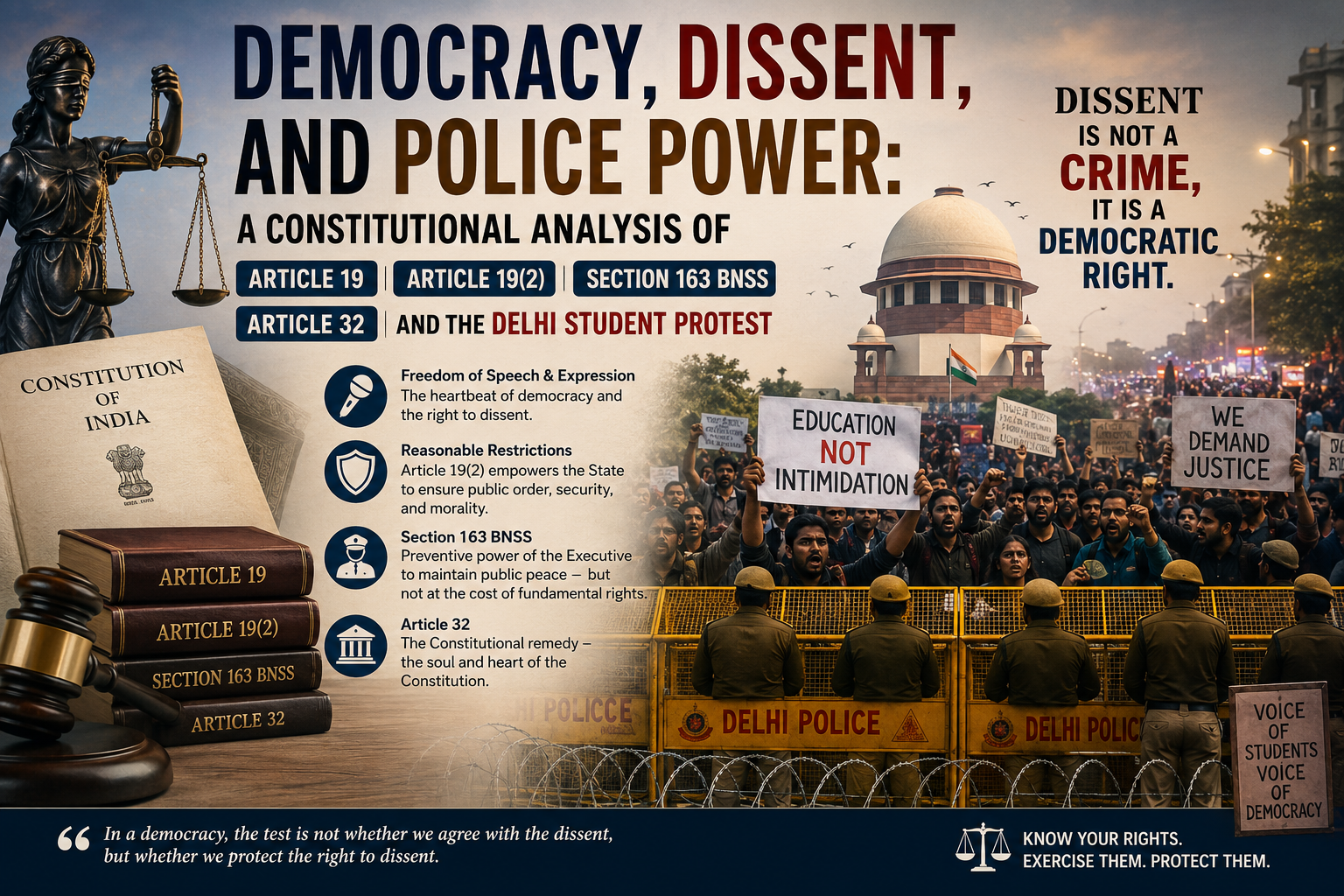
⚖️🇮🇳Introduction: Democracy, Dissent, and the Constitutional Question
“The true strength of a democracy is not tested when citizens agree with the government—it is tested when they disagree.”
Public protests have always been an integral part of India's democratic journey. From the freedom struggle led by Mahatma Gandhi to contemporary movements demanding social, educational, environmental, or political reforms, citizens have exercised their constitutional right to voice dissent. Peaceful protest is not merely a political act; it is a constitutional expression of participation in a democratic society.
The Delhi Student Protest (2026) has once again brought to the forefront a critical constitutional debate. Images and videos circulating on television and social media have triggered widespread public discussion regarding the limits of police power, the rights of protesters, and the obligations of the State in maintaining public order. While some argue that the police acted within the scope of their legal duties to prevent disorder, others contend that the use of force was excessive and inconsistent with constitutional values.
This controversy raises questions that extend beyond a single protest. It requires us to examine the broader constitutional framework governing the relationship between the State and its citizens.
Can citizens assemble to express dissent without fear of excessive State intervention?
Can the State impose restrictions on protests in the interest of public order?
When does a lawful police action become an unlawful use of force?
Can public officials rely solely on superior orders when allegations of excessive force arise?
These questions lie at the heart of constitutional democracy and have repeatedly been considered by Indian courts.
It is important to clarify at the outset that this article does not seek to determine whether the police or the protesters were legally right or wrong in the Delhi Student Protest. Such conclusions can only be reached through competent investigations and judicial proceedings based on admissible evidence. Instead, the purpose of this article is to examine the relevant constitutional provisions, statutory powers, judicial precedents, and international principles that govern police action and the right to protest in India.
The article also explores the constitutional significance of Article 19, the restrictions permitted under Article 19(2), the preventive powers available under Section 163 of the Bharatiya Nagarik Suraksha Sanhita, 2023 (BNSS), and the role of Article 32 in protecting fundamental rights. Additionally, it briefly discusses the Nuremberg Principle as a comparative concept relating to individual responsibility, while making it clear that the principle does not directly apply to domestic policing in India.
Ultimately, the debate surrounding the Delhi Student Protest is not merely about one incident. It is about a larger constitutional question:
How should a democratic State balance public order with the fundamental right of citizens to peacefully express dissent?
The answer to this question defines not only the limits of police power but also the strength of constitutional democracy itself.
🇮🇳⚖️The Right to Protest Under the Constitution of India: Understanding Articles 19, 14 & 21
“The Constitution protects not only the right to agree with the government but also the right to peacefully disagree with it.”
One of the defining characteristics of a constitutional democracy is the ability of its citizens to express opinions, criticize public policies, and assemble peacefully without fear of arbitrary State action. In India, these freedoms are not granted by the government as a matter of policy; they are Fundamental Rights guaranteed by the Constitution.
However, these rights are not absolute. The Constitution itself recognises that individual liberty must sometimes be balanced with public order, national security, and the rights of others. Therefore, understanding the legality of any public protest—including the Delhi Student Protest—requires a careful reading of Articles 19, 14, and 21.
📜 Article 19(1): The Constitutional Foundation of Protest
Article 19(1) guarantees several freedoms to citizens. Three of them are particularly relevant to public demonstrations.
🗣️ Article 19(1)(a): Freedom of Speech and Expression
Article 19(1)(a) guarantees every citizen the right to express opinions freely.
This includes:
Criticising government policies.
Raising social or educational concerns.
Participating in public debates.
Expressing dissent through speeches, placards, slogans, publications, or peaceful demonstrations.
The Supreme Court has consistently recognised that criticism of the government, by itself, is not anti-national and cannot be suppressed merely because it is unpopular or inconvenient.
However, this freedom does not extend to speech that incites violence, promotes hatred, or threatens public order.
👥 Article 19(1)(b): Right to Assemble Peacefully
This provision guarantees the right to assemble peacefully and without arms.
It is the constitutional basis for:
Student demonstrations
Public meetings
Peaceful marches
Candlelight vigils
Sit-ins and rallies
The emphasis is on peaceful assembly.
If an assembly becomes violent, armed, or poses a serious threat to public safety, the State may lawfully intervene in accordance with the Constitution and applicable laws.
🤝 Article 19(1)(c): Freedom to Form Associations
Citizens also have the right to form associations, unions, and organisations.
Student unions, teachers' associations, labour unions, and civil society groups often rely on this constitutional protection when organising collective demonstrations or campaigns.
⚖️ Article 19(2): Why Fundamental Rights Are Not Absolute
A common misconception is that Article 19 gives citizens an unrestricted right to protest.
It does not.
Article 19(2) permits the State to impose reasonable restrictions on freedom of speech and expression in the interests of:
Sovereignty and integrity of India
Security of the State
Friendly relations with foreign States
Public order
Decency or morality
Contempt of court
Defamation
Incitement to an offence
Similarly, the Constitution permits reasonable restrictions on the right to peaceful assembly under Article 19(3).
This means that the government cannot prohibit protests merely because they are critical of its policies, but it may regulate or restrict them where there is a lawful and proportionate need to protect public order or other constitutional interests.
🏛️ What Is a "Reasonable Restriction"?
The Constitution does not define "reasonable restriction" in precise terms. Over time, the Supreme Court has developed certain guiding principles.
A restriction is more likely to be considered reasonable if it:
Is authorised by law.
Pursues a legitimate public purpose.
Is necessary in the circumstances.
Is proportionate to the objective sought to be achieved.
Is not arbitrary or excessive.
For example, regulating the time, place, or route of a protest may be constitutionally valid if done to balance public convenience and safety. However, an absolute or arbitrary prohibition on peaceful protest without adequate justification may be vulnerable to constitutional challenge.
⚖️ Article 14: Equality Before the Law
Article 14 guarantees equality before the law and equal protection of the laws.
In the context of public protests, this means:
Police authorities should apply the law uniformly.
Similar situations should generally receive similar treatment.
Decisions should not be arbitrary, discriminatory, or based on irrelevant considerations.
If State action appears arbitrary or selective, it may be challenged as violating Article 14.
❤️ Article 21: Life, Liberty, and Human Dignity
Article 21 provides that no person shall be deprived of life or personal liberty except according to procedure established by law.
Judicial interpretation has expanded Article 21 far beyond its original wording.
Today, it includes:
Human dignity
Fair procedure
Protection against arbitrary State action
Bodily integrity
Access to justice
Whenever allegations arise regarding excessive police force, unlawful detention, or disproportionate restrictions on liberty, Article 21 often becomes central to constitutional scrutiny.
⚖️ Democracy Requires Both Rights and Responsibility
A democratic society depends on a delicate balance.
Citizens have the responsibility to:
Protest peacefully.
Respect the rights of others.
Avoid violence and destruction of public property.
Comply with lawful directions issued by competent authorities.
The State has the responsibility to:
Respect constitutional freedoms.
Protect peaceful assemblies.
Maintain public order.
Use force only when authorised by law and genuinely necessary.
Ensure that any restriction on fundamental rights is reasonable and proportionate.
Neither side enjoys unlimited freedom. Constitutional democracy requires mutual restraint and respect for the rule of law.
📌 The Constitutional Question Raised by the Delhi Student Protest
The controversy surrounding the Delhi Student Protest should not be reduced to a simple question of whether protests are lawful or whether police action is justified.
The more relevant constitutional questions are:
Was the protest peaceful?
Were any restrictions imposed under lawful authority?
Were those restrictions reasonable and proportionate?
Did the authorities act within constitutional limits?
Were the rights of both protesters and the wider public adequately balanced?
These are the questions that constitutional courts examine—not political slogans or social media narratives.
⚖️👮Police Powers Under Indian Law: Section 163 BNSS, Use of Force, and Constitutional Limits
“The police are guardians of public order, but in a constitutional democracy, every exercise of State power must remain subject to the Constitution.”
The Constitution guarantees citizens the right to peacefully protest, but it also imposes a duty upon the State to maintain public order, protect life and property, and prevent violence. Whenever a large public demonstration takes place, these two constitutional objectives often intersect.
The Delhi Student Protest has once again raised an important legal question:
How far can the police go while controlling a public protest?
The answer lies not in public opinion but in the Constitution, statutory law, and judicial precedents.
👮 Role of the Police in a Constitutional Democracy
Police are not merely an enforcement agency; they are public servants entrusted with preserving the rule of law. Their primary responsibilities include:
Maintaining public order.
Preventing violence and rioting.
Protecting life and property.
Safeguarding both protesters and the general public.
Enforcing lawful orders issued by competent authorities.
At the same time, police are also expected to respect fundamental rights. Their duty is not only to maintain order but to do so lawfully, fairly, and proportionately.
📜 Section 163 of the Bharatiya Nagarik Suraksha Sanhita, 2023 (BNSS)
One of the most important legal provisions relating to public protests is Section 163 of the BNSS, 2023, which replaced the former Section 144 of the Code of Criminal Procedure (CrPC).
This provision empowers a District Magistrate, Sub-Divisional Magistrate, or another authorised Executive Magistrate to issue urgent orders in situations where there is sufficient ground to believe that immediate prevention or speedy remedy is necessary.
Orders under Section 163 may be issued to:
Prevent obstruction or nuisance.
Prevent danger to human life, health, or safety.
Prevent riots or disturbances of public tranquillity.
Maintain public order during situations of imminent risk.
Such orders may temporarily prohibit assemblies, regulate movement, or impose other preventive measures where justified by the circumstances.
However, Section 163 does not suspend the Constitution. It is an emergency preventive power—not an unrestricted licence to curtail civil liberties.
⚖️ Does Section 163 Automatically Make Every Police Action Lawful?
No.
The existence of a lawful order under Section 163 does not automatically validate every action taken in its enforcement.
Courts may examine several questions, including:
Was the order itself issued lawfully?
Was there credible material justifying the restriction?
Was the restriction necessary?
Was it proportionate?
Did the police use only the minimum force reasonably required?
Therefore, legality depends not only on the existence of an order but also on how it is implemented.
🛡️ Doctrine of Necessity
The Doctrine of Necessity recognises that, in exceptional situations, the State may take measures that interfere with individual liberties if such action is genuinely required to prevent imminent harm.
In the context of public protests, necessity means:
Force should not be the first response.
Dialogue, persuasion, and warnings should ordinarily be attempted first.
Physical intervention should occur only if less restrictive measures are ineffective or clearly inadequate.
The objective is to prevent harm—not to punish protesters.
⚖️ Doctrine of Proportionality
The Doctrine of Proportionality is one of the cornerstones of Indian constitutional law.
It requires that any restriction on a fundamental right must:
Pursue a legitimate objective.
Be suitable to achieve that objective.
Be necessary, with no less restrictive alternative available.
Maintain a fair balance between public interest and individual rights.
In the context of crowd control, proportionality means that the level of force—if force becomes necessary—should correspond to the actual level of threat.
For example, a peaceful gathering generally requires a different policing response from a violent riot.
🚨 When Can Police Use Force?
Indian law does not permit arbitrary or punitive use of force.
Broadly, force may become legally justifiable where it is:
Authorised by law.
Necessary to prevent violence or serious disorder.
Used for a legitimate public purpose.
Reasonable and proportionate in the circumstances.
Whether force was excessive is always a fact-specific question. It depends on evidence, witness testimony, official records, medical reports, and judicial scrutiny—not merely on public perception or isolated video clips.
📱 Does the Presence of Viral Videos Decide the Issue?
In today's digital age, videos recorded on mobile phones often shape public opinion within minutes.
However, from a legal perspective:
A viral video may be relevant evidence, but it is not conclusive proof by itself.
Courts consider the entire factual context, including authenticity, continuity, surrounding circumstances, witness accounts, and other corroborative evidence.
Selective or edited clips may not present the complete sequence of events.
Thus, while digital evidence can be significant, legal conclusions require a comprehensive assessment.
⚖️ Balancing Public Order and Constitutional Liberty
The Constitution expects both citizens and the State to act responsibly.
Protesters must exercise their rights peacefully and lawfully.
Police must enforce the law with restraint, professionalism, and respect for constitutional guarantees.
Neither unrestricted protest nor unrestricted police power is consistent with constitutional democracy.
The challenge lies in maintaining public order without unnecessarily infringing fundamental rights.
Public Order vs Constitutional Liberty: The Delhi Student Protest Debate ⚖️🕊️
“The Constitution protects both public order and public dissent. The challenge lies in preserving one without destroying the other.”
The Delhi Student Protest has generated an intense national debate. While one section of society argues that the police acted within their legal authority to maintain law and order, another believes that the response amounted to excessive or disproportionate use of force.
In a constitutional democracy, such questions cannot be answered merely through public opinion, political narratives, or social media videos. The legality of police action depends upon constitutional principles, statutory powers, judicial precedents, and the facts established through lawful investigation.
To understand the controversy fairly, both perspectives deserve careful consideration.
🛡️ Perspective One: The Police and the State
From the perspective of the State, the primary constitutional obligation of the police is to maintain public order and protect life and property.
Police authorities may argue that:
Large gatherings can sometimes escalate unexpectedly.
Intelligence inputs may indicate a risk of violence or disruption.
Delayed intervention may lead to greater harm to protesters, bystanders, or public property.
Police officers often have to make decisions within seconds in rapidly changing situations.
Where lawful prohibitory orders (such as those issued under Section 163 BNSS) are in force, authorities may contend that they are legally obligated to enforce those orders.
According to this view, police action is not intended to suppress dissent but to prevent disorder and ensure public safety.
However, even from this perspective, police action must remain within the limits prescribed by law.
🎓 Perspective Two: The Protesters
From the perspective of the students and civil society, peaceful protest is a constitutionally protected democratic right.
Those critical of the police response may argue that:
Peaceful assembly is protected by Article 19(1)(b).
Freedom of expression is guaranteed under Article 19(1)(a).
Human dignity forms an essential part of Article 21.
Excessive force, if established, undermines constitutional democracy and public confidence in law enforcement.
Where allegations of unnecessary force arise, affected individuals may seek judicial review, compensation, or independent investigation.
It is important to note that an allegation alone does not establish legal liability. Equally, the mere existence of police powers does not automatically validate every action taken in their exercise.
The determination must ultimately be based on credible evidence and judicial scrutiny.
⚖️ Public Order vs Civil Liberties: A Constitutional Balance
Neither public order nor civil liberties enjoy absolute supremacy.
The Constitution protects:
The right of citizens to peacefully express dissent, and
The duty of the State to preserve peace and public safety.
Courts therefore seek to balance these competing interests by examining questions such as:
Was the protest peaceful?
Was there a genuine threat to public order?
Were restrictions imposed under lawful authority?
Was the response necessary?
Was the force, if any, proportionate?
This balancing exercise lies at the heart of constitutional adjudication.
🌍 The Debate on “Following Orders”
One of the most enduring legal questions in discussions of public authority is:
Can a public official avoid responsibility simply by saying, "I was only following orders"?
This question gained global attention after the Nuremberg Trials (1945–46), where several accused argued that they should not be held personally responsible because they had acted under superior orders.
The Tribunal rejected the idea that obedience to superior orders should automatically exempt an individual from legal responsibility.
This principle later came to be reflected in Nuremberg Principle IV, which broadly recognises that obedience to superior orders does not, by itself, eliminate responsibility where a genuine legal or moral choice existed.
⚠️ Does the Nuremberg Principle Apply Here?
The answer is No—not directly.
The Nuremberg Principles were developed in the context of international criminal law, dealing with war crimes, crimes against humanity, and crimes against peace.
They do not directly regulate police operations or crowd-control measures in India.
Their relevance in this article is comparative, not direct.
They illustrate a broader constitutional idea:
Public authority must always remain accountable to law, and the existence of an order does not automatically resolve questions of legality.
🇮🇳 The Indian Constitutional Position
Indian police officers are governed by:
The Constitution of India,
The Bharatiya Nagarik Suraksha Sanhita (BNSS),
Other statutory laws,
Police rules,
Departmental instructions, and
Judicial precedents.
Therefore, in India, the real legal questions are:
Were the orders lawful?
Were they implemented according to law?
Was the force, if any, necessary?
Was it proportionate?
What does the evidence establish?
These questions—not assumptions or public sentiment—determine legal responsibility.
📌 Democracy Requires Accountability from All Sides
A mature constitutional democracy expects responsibility from both citizens and the State.
Citizens must exercise their rights peacefully and responsibly.
The police must enforce the law fairly, impartially, and with restraint.
Governments must ensure that restrictions on fundamental rights remain lawful, necessary, and proportionate.
Courts must remain the final constitutional guardians when disputes arise.
Ultimately, the strength of a democracy is measured not by the absence of protest but by its ability to address disagreement within the framework of the Constitution and the rule of law.
⚖️Judicial Perspective: How Has the Supreme Court Interpreted the Right to Protest and Police Accountability?
“The Constitution speaks through its courts. Whenever a conflict arises between State power and individual liberty, it is ultimately the judiciary that interprets the limits of both.”
The legality of police action during public protests cannot be determined solely by statutory provisions or administrative orders. Over the years, the Supreme Court of India has developed important constitutional principles through landmark judgments dealing with police accountability, civil liberties, and the right to protest.
Although these cases arose in different factual contexts, they collectively provide a framework for analysing controversies such as the Delhi Student Protest.
⚖️ 1. D.K. Basu v. State of West Bengal (1997)
This landmark judgment is one of India's most significant decisions on police accountability and protection of individual liberty.
The Supreme Court recognised that abuse of police power threatens the rule of law and held that arrests and detention must follow fair, transparent, and legally prescribed procedures.
The Court laid down safeguards such as:
Proper identification of arresting officers.
Preparation of an arrest memo.
Informing a relative or friend of the arrested person.
Medical examination of the detainee.
Maintenance of official records.
Relevance to Public Protests
If individuals are detained during a protest, the constitutional safeguards recognised in D.K. Basu continue to apply. The existence of public disorder does not suspend due process.
⚖️ 2. Ramlila Maidan Incident v. Home Secretary, Union of India (2012)
This case arose after police dispersed a public gathering at Delhi's Ramlila Maidan during the night.
The Supreme Court emphasised that the State possesses the authority to maintain public order, but such authority must be exercised fairly, reasonably, and proportionately.
The Court observed that:
Peaceful assembly enjoys constitutional protection.
State action should satisfy the test of proportionality.
The use of force must be justified by the circumstances.
Why This Case Matters
It is one of the leading authorities on balancing police powers with the constitutional right to peaceful protest.
⚖️ 3. Mazdoor Kisan Shakti Sangathan (MKSS) v. Union of India (2018)
The Supreme Court examined restrictions on public demonstrations at Jantar Mantar in New Delhi.
The Court held that:
Citizens possess a constitutional right to protest peacefully.
However, this right is not absolute.
Authorities may regulate protests to balance the interests of protesters, local residents, and public convenience.
The judgment highlights that constitutional rights often require a process of balancing rather than choosing one right over another.
⚖️ 4. Anuradha Bhasin v. Union of India (2020)
Although this case primarily concerned internet restrictions in Jammu and Kashmir, the Court reaffirmed important constitutional principles relevant to civil liberties.
The Court emphasised:
Restrictions on fundamental rights must have a legal basis.
They should satisfy the test of proportionality.
Executive decisions are subject to judicial review.
This judgment reinforces the idea that emergency powers are not beyond constitutional scrutiny.
⚖️ Other Important Judicial Principles
Several other decisions have contributed to India's constitutional understanding of protest rights and State power. Collectively, they establish that:
The Constitution protects peaceful dissent.
Public order is a legitimate governmental objective.
Restrictions on rights must be lawful, reasonable, and proportionate.
Courts remain the final guardians of constitutional freedoms.
🛡️ Article 32: The Right to Constitutional Remedies
Dr. B.R. Ambedkar described Article 32 as the “heart and soul of the Constitution.”
It empowers any person whose Fundamental Rights have been violated to approach the Supreme Court of India directly.
Where allegations arise regarding unlawful restrictions, excessive use of force, arbitrary detention, or violation of constitutional rights, affected individuals may invoke Article 32 seeking:
Appropriate writs.
Protection of Fundamental Rights.
Judicial review of executive action.
Compensation in appropriate cases, where recognised by law.
Similarly, Article 226 empowers High Courts to protect constitutional and legal rights.
⚖️ Legal Remedies Available
Depending upon the facts of a particular case, legal remedies may include:
1. Constitutional Remedies
Writ Petition under Article 32 (Supreme Court).
Writ Petition under Article 226 (High Courts).
2. Human Rights Mechanisms
Complaint before the National Human Rights Commission (NHRC).
Complaint before the State Human Rights Commission, where applicable.
3. Departmental Action
Internal inquiry into alleged misconduct.
Disciplinary proceedings where warranted.
4. Criminal Proceedings
Where credible evidence suggests commission of an offence, criminal investigation may be initiated in accordance with law. Liability depends upon the facts established during investigation and trial.
📌 Judicial Message
The consistent message emerging from Supreme Court jurisprudence is clear:
The right to protest is constitutionally protected.
Public order is equally important.
Police powers are necessary but not unlimited.
Every restriction on liberty must satisfy constitutional standards.
Courts remain the ultimate arbiters in resolving conflicts between State authority and individual rights.
Evidence, Burden of Proof, FAQs, Key Takeaways & Conclusion ⚖️📚
“In constitutional democracies, justice is not delivered by public opinion or viral content—it is delivered through evidence, due process, and the rule of law.”
📹 Can Viral Videos Alone Prove Police Brutality?
In today's digital era, incidents during public protests are often recorded on mobile phones and instantly shared across social media platforms. These videos can significantly influence public opinion and shape the national discourse. However, from a legal perspective, a viral video alone does not automatically establish either police misconduct or the innocence of protesters.
Under the Bharatiya Sakshya Adhiniyam, 2023 (BSA), electronic records—including videos, photographs, CCTV footage, and digital recordings—may be admissible as evidence, provided they satisfy the legal requirements regarding authenticity and admissibility.
While a video may appear persuasive, courts generally examine:
Whether the video is genuine or edited.
Whether it captures the entire incident or only a part of it.
The sequence of events before and after the recording.
Testimony of witnesses.
Medical reports, forensic evidence, and official records.
Thus, viral videos are relevant evidence, but they are not conclusive proof by themselves.
⚖️ Who Bears the Burden of Proof?
In legal proceedings, allegations must ordinarily be supported by evidence.
If a person alleges unlawful detention, excessive force, or violation of constitutional rights, those claims are examined through the judicial process. Likewise, if the State justifies restrictions on fundamental rights in the interest of public order, it must demonstrate that such restrictions have a lawful basis and satisfy constitutional standards.
Ultimately, courts assess the entire body of evidence, rather than relying on assumptions or public sentiment.
❓ Frequently Asked Questions (FAQs)
Q1. Is the right to protest a Fundamental Right?
Yes. Peaceful protest derives constitutional protection primarily from Articles 19(1)(a), 19(1)(b), and 19(1)(c), subject to reasonable restrictions imposed by law.
Q2. Can the government prohibit every public protest?
No. The government may regulate or restrict protests only where permitted by the Constitution and applicable laws. Blanket or arbitrary restrictions may be subject to judicial review.
Q3. Does Section 163 BNSS permanently prohibit public gatherings?
No. Section 163 is a preventive measure intended to address urgent situations affecting public order or safety. It does not permanently extinguish constitutional freedoms.
Q4. Can police use force to disperse a protest?
Police may use force only where authorised by law and where such force is necessary, reasonable, and proportionate to the circumstances. Whether these conditions were satisfied depends upon the facts of each case.
Q5. Does the Nuremberg Principle directly apply to police action in India?
No. The Nuremberg Principles were developed in the context of international criminal law. In this article, they are discussed only as a comparative legal concept relating to accountability, not as a direct source of Indian law governing public protests.
Q6. What remedies are available if Fundamental Rights are violated?
Depending on the facts, individuals may seek constitutional remedies before the Supreme Court or High Courts, approach the National or State Human Rights Commissions, or pursue other remedies available under law.
📌 Key Takeaways
🇮🇳 The Constitution protects peaceful protest as a Fundamental Right.
⚖️ These rights are subject to reasonable restrictions in the interest of public order and other constitutional objectives.
👮 Police possess lawful powers to maintain order, but those powers are not unlimited.
📜 Section 163 of the BNSS is a preventive mechanism and must be exercised consistently with constitutional principles.
⚖️ The doctrines of necessity and proportionality are central to assessing the legality of police action.
🌍 International standards such as the UN Basic Principles and the ICCPR reinforce values of restraint, accountability, and respect for human dignity.
🏛️ Supreme Court judgments continue to shape the constitutional balance between public order and civil liberties.
📱 Viral videos can be important evidence but are not, by themselves, decisive proof in legal proceedings.
📚 Allegations against either protesters or police must ultimately be evaluated through lawful investigation and judicial scrutiny.
🏛️ Balanced Conclusion
The debate surrounding the Delhi Student Protest is not merely about one protest or one police action. It reflects a larger constitutional conversation about the nature of democracy itself.
A vibrant democracy must provide space for peaceful dissent, because disagreement is an essential feature of constitutional governance. At the same time, the State has a legitimate responsibility to protect public order, safeguard life and property, and prevent violence.
Neither constitutional liberty nor State authority is absolute. The Constitution requires that both be exercised responsibly and within the limits of law. Public protests should remain peaceful and respectful of the rights of others, while police action must remain lawful, necessary, proportionate, and accountable.
Ultimately, the legitimacy of both protesters and the State depends upon their fidelity to the Constitution. In moments of public tension, the rule of law—not public emotion, political rhetoric, or social media narratives—must remain the guiding principle.
The Delhi Student Protest controversy therefore serves as an important reminder that constitutional democracy is strengthened not when one side defeats the other, but when disputes are resolved through law, judicial oversight, and constitutional values.
⚠️ Legal Disclaimer
This article is intended solely for educational and informational purposes.

Leave a Comment
Your email address and mobile number will not be published. Required fields are marked *