Introduction 🌐
In the digital era, messaging platforms have become an inseparable part of everyday life. Applications such as Telegram, WhatsApp, Signal, and similar services are used not only for personal communication but also for education, business, journalism, governance, and professional collaboration. Millions of Indians rely on these platforms daily to exchange information instantly and securely.
However, the growing use of encrypted messaging applications has also presented new challenges for law enforcement agencies. In recent years, several incidents involving alleged examination paper leaks have raised concerns that private groups and channels on messaging platforms are being misused to circulate confidential question papers, answer keys, and examination material before scheduled tests.
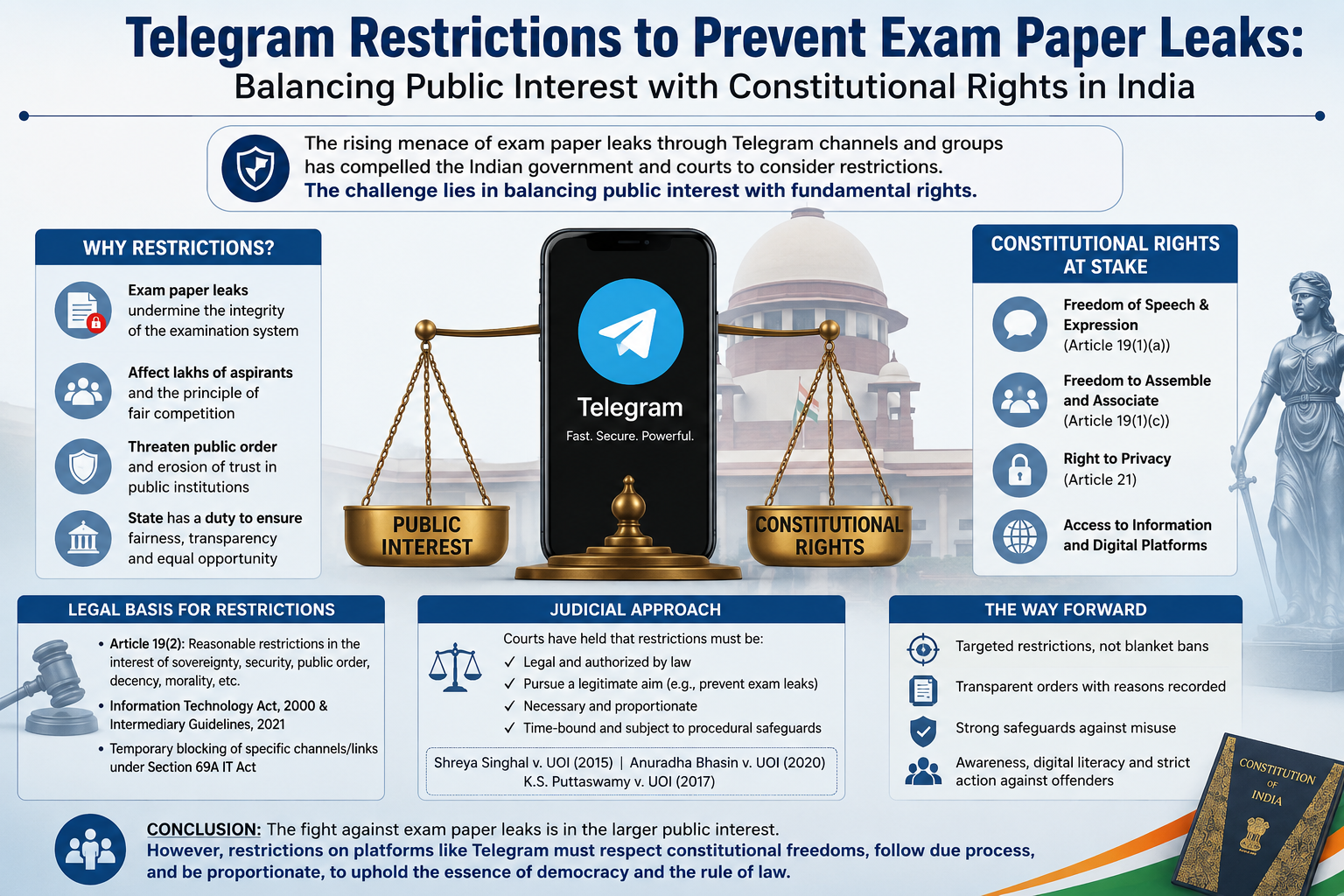
These incidents have sparked an important constitutional debate: Can the Government legally restrict access to a messaging platform like Telegram to prevent exam paper leaks, even if such action affects millions of law-abiding users?
The issue extends beyond examination fraud. It concerns the broader relationship between technology, governance, constitutional freedoms, cybersecurity, and proportional regulation in a democratic society.
On one side lies the legitimate objective of preserving the integrity of public examinations and protecting deserving candidates from unfair practices. On the other lies the constitutional commitment to freedom of speech and expression, privacy, access to information, and the ability of citizens to communicate and conduct lawful activities online.
Finding the appropriate balance between these competing interests is one of the most significant legal challenges facing modern democracies, including India.
This article examines the constitutional principles, statutory framework, practical concerns, and policy considerations involved in any proposal to restrict messaging platforms in response to examination-related misconduct while emphasizing the importance of proportionality and the rule of law.
📚 Why Exam Paper Leaks Are a Serious Public Concern
Competitive examinations determine admissions to universities, appointments to government services, and recruitment for numerous public sector positions.
When confidential examination material is leaked before an exam:
🎓 Honest candidates suffer.
⚖️ Merit-based selection is compromised.
🏛️ Public confidence in institutions declines.
💰 Governments incur significant costs for re-examinations.
📉 Administrative efficiency is affected.
👥 Social trust in recruitment processes weakens.
Consequently, preventing paper leaks is undoubtedly a legitimate public objective deserving serious attention.
📱 The Growing Role of Messaging Platforms
Modern messaging applications provide features such as:
🔐 End-to-end encryption
👥 Large groups and channels
📂 File sharing
📸 Image transmission
📄 PDF distribution
☁️ Cloud storage integration
📹 Video sharing
While these features support legitimate communication and educational collaboration, they may also be exploited by individuals engaged in unlawful activities.
Importantly, however, misuse by certain users does not necessarily imply wrongdoing by every person using the platform.
This distinction becomes legally significant when considering large-scale restrictions.
⚖️ Understanding the Constitutional Dimension
The Indian Constitution protects several rights that become relevant whenever online communication platforms are restricted.
Among them are:
🗣️ Freedom of Speech and Expression
Digital platforms have become primary spaces for communication, academic discussion, journalism, political participation, and exchange of ideas.
Restricting access may affect citizens' ability to express themselves and receive information.
💼 Freedom to Carry on Trade and Profession
Numerous businesses rely heavily upon messaging applications for:
Customer service
Internal communication
Marketing
Sales
Professional coordination
Interruptions may significantly affect commercial activities.
🔒 Privacy Interests
Private conversations increasingly occur through encrypted messaging services.
Restrictions or surveillance involving these platforms therefore engage broader concerns regarding informational privacy and digital autonomy.
📚 Access to Education
Students frequently depend on messaging applications for:
Classroom updates
Study groups
Assignment discussions
Online coaching
Academic collaboration
Platform-wide restrictions may unintentionally affect educational continuity for millions of users.
🏛️ Are Constitutional Rights Absolute?
No.
Fundamental rights may be subject to lawful and reasonable restrictions under appropriate circumstances.
However, constitutional jurisprudence generally requires that such restrictions satisfy standards including:
📜 Legal authority
🎯 Legitimate objective
⚖️ Necessity
🛡️ Proportionality
🔍 Procedural safeguards
👨⚖️ Availability of judicial review
Therefore, the mere existence of examination fraud does not automatically justify unrestricted governmental action.
The nature and extent of any restriction must remain proportionate to the objective sought to be achieved.
📖 Public Interest Versus Individual Rights
The debate surrounding Telegram restrictions illustrates a classic constitutional balancing exercise.
Public Interest Considerations
The State seeks to:
Prevent examination malpractice.
Protect merit-based recruitment.
Safeguard institutional credibility.
Deter organized criminal networks.
Maintain public confidence.
Individual Rights Considerations
Citizens seek protection of:
Freedom of communication.
Privacy.
Business continuity.
Educational access.
Digital participation.
Access to lawful online services.
Neither interest can be ignored.
The challenge lies in ensuring that measures adopted against unlawful actors do not disproportionately burden innocent users.
📲 Should Millions of Users Lose Access Because of the Misconduct of a Few?
This question lies at the heart of the legal controversy.
Suppose investigators identify that a leaked examination paper circulated through one private Telegram channel containing several hundred members.
Would blocking the entire platform affecting millions of users constitute a proportionate response?
Many constitutional scholars argue that enforcement should ideally focus upon:
👤 Individual offenders.
👥 Specific unlawful groups.
📂 Particular channels.
📄 Identified illegal content.
🏛️ Organized criminal networks.
Targeted enforcement often minimizes collateral impact on lawful users while still addressing criminal conduct effectivly.
⚖️ The Legal Basis for Restricting Digital Platforms in India
Whenever the Government considers restricting access to an online platform, such action must be supported by a valid legal framework and exercised in accordance with constitutional principles. India’s legal system recognizes that digital platforms play a crucial role in modern communication, but it also permits reasonable restrictions in specific circumstances where public interest so requires.
Any decision affecting millions of users must therefore be based on law, follow due process, and remain open to judicial scrutiny where applicable.
The central constitutional question is not whether the Government has regulatory powers—it does—but whether the exercise of those powers is proportionate, necessary, and the least restrictive means available to achieve the intended objective.
🏛️ The Doctrine of Proportionality
One of the most significant principles governing restrictions on constitutional rights is the doctrine of proportionality.
In simple terms, proportionality means that the State should adopt measures that are:
✅ Suitable to achieve a legitimate objective.
✅ Necessary in the circumstances.
✅ Least restrictive of individual rights.
✅ Balanced against the harm caused to the public.
For example, if authorities identify one Telegram channel allegedly distributing leaked examination papers, shutting down access to the entire platform for millions of users may be questioned as a disproportionate response if narrower alternatives are available.
Courts often examine whether targeted enforcement could achieve the same objective without causing widespread disruption.
📱 End-to-End Encryption: A Double-Edged Sword
Telegram and several other messaging platforms provide strong encryption and privacy features.
These technologies protect users from:
🔒 Unauthorized surveillance.
💻 Cybercriminals.
🕵️ Identity theft.
📂 Data breaches.
📡 Interception by malicious actors.
However, investigators argue that the same encryption may also make it difficult to identify those responsible for organized crimes, including paper leak syndicates.
The legal debate therefore extends beyond examination fraud and touches broader issues concerning digital privacy and cybersecurity.
Weakening encryption could potentially expose millions of ordinary users to increased cyber risks.
Conversely, complete anonymity may complicate criminal investigations.
Balancing these competing interests remains a major policy challenge worldwide.
🎓 Why Blanket Restrictions May Affect Honest Students
Ironically, restrictions intended to protect examinations may themselves create educational difficulties.
Students increasingly use messaging applications for:
📚 Study groups.
📝 Assignment discussions.
🎥 Online classes.
📖 Sharing notes.
👨🏫 Coaching updates.
📅 Examination notifications.
A platform-wide restriction during examination periods may unintentionally disrupt the education of countless students who have no connection with any unlawful activity.
This practical consequence becomes relevant when evaluating proportionality.
💼 Impact on Businesses and Professionals
Millions of professionals depend on messaging applications every day.
Among those affected by restrictions may be:
🏢 Small businesses.
👨⚕️ Doctors.
👩⚖️ Lawyers.
👨💻 Software companies.
🛒 Online sellers.
🚚 Delivery services.
📰 Journalists.
📈 Financial consultants.
Temporary disruption may delay client communication, contractual obligations, and commercial transactions.
For many entrepreneurs, messaging platforms function as their primary business infrastructure.
🌍 Comparative International Practice
Countries around the world have adopted different approaches to regulating digital platforms.
Some governments emphasize:
National security.
Public safety.
Crime prevention.
Others focus more heavily on:
Freedom of expression.
Privacy.
Judicial oversight.
Platform accountability.
An emerging international trend is to prefer targeted action against unlawful content or specific offenders rather than imposing broad restrictions affecting all users.
Such approaches seek to minimize collateral impact while preserving effective law enforcement.
🤖 The Responsibility of Technology Platforms
Technology companies also have an important role in combating misuse.
Reasonable measures may include:
🚫 Removing unlawful public content when legally required.
📢 Cooperating with lawful investigations.
🔍 Detecting suspicious spam networks.
🛡️ Improving reporting mechanisms.
👤 Verifying channels where appropriate.
⚙️ Investing in abuse prevention technologies.
At the same time, platforms must also safeguard legitimate user privacy and avoid unnecessary interference with lawful communication.
👮 The Role of Law Enforcement
Police agencies investigating examination fraud increasingly rely upon:
📱 Digital forensic analysis.
💻 Cyber intelligence.
📊 Data analytics.
🌐 Open-source intelligence.
🤝 Coordination with intermediaries.
📂 Electronic evidence preservation.
Modern investigations often require technological expertise in addition to traditional policing methods.
Strengthening investigative capacity may reduce the need for broad restrictions affecting the general public.
📑 Could Better Examination Security Solve the Problem?
Many experts argue that the root cause of paper leaks often lies not in messaging platforms but in failures occurring before dissemination.
Possible vulnerabilities include:
Insider corruption.
Unauthorized access to confidential servers.
Printing press leaks.
Weak document security.
Human negligence.
Organized criminal collusion.
Accordingly, reforms may focus on:
✅ End-to-end encryption of question papers.
✅ Last-minute digital transmission.
✅ Multi-factor authentication.
✅ AI-assisted monitoring.
✅ Strict access controls.
✅ Comprehensive audit trails.
Preventing leaks at their source may prove more effective than restricting communication platforms after information has already been compromised.
📋 Practical Policy Recommendations
A balanced regulatory strategy could include:
🎯 Targeted action against offending channels.
👥 Investigation of responsible individuals.
🤖 AI-based leak detection systems.
🔍 Improved cyber forensic capabilities.
🏛️ Transparent legal procedures.
⚖️ Judicial oversight where appropriate.
📚 Better examination security protocols.
🤝 Cooperation between regulators and technology companies.
Such measures seek to preserve both examination integrity and constitutional freedoms.
❓ Frequently Asked Questions (FAQs)
Q1. Can the Government completely ban a messaging platform because of exam paper leaks?
Any such measure would need to be supported by law and satisfy constitutional principles, including necessity and proportionality. Its legality would depend on the specific facts and applicable legal framework.
Q2. Does the misuse of a platform automatically make the platform itself illegal?
No. The unlawful conduct of individual users does not automatically render the platform unlawful. Legal responsibility depends on the facts and the applicable regulatory framework.
Q3. Can encrypted platforms cooperate with investigations?
Cooperation mechanisms vary depending on the platform’s architecture, applicable law, and lawful requests from competent authorities.
Q4. Are there alternatives to blocking an entire platform?
Yes. Authorities may consider targeted investigations, action against specific accounts or channels, stronger cybersecurity measures, and enhanced examination security protocols.
Q5. Why is proportionality so important?
Because constitutional governance requires that restrictions on fundamental rights should not exceed what is reasonably necessary to achieve a legitimate public objective.
🏁 Conclusion
Preventing exam paper leaks is crucial to preserving the fairness and credibility of India's education and recruitment systems. 📚 However, any restriction on messaging platforms like Telegram must strike a careful balance between public interest and the constitutional rights of millions of legitimate users. ⚖️ A targeted, transparent, and proportionate legal approach—combined with stronger examination security and effective law enforcement—is likely to be more sustainable than broad platform-wide restrictions in addressing this growing challenge.
⚠️ Disclaimer
This article is intended solely for general informational and educational purposes .

Leave a Comment
Your email address and mobile number will not be published. Required fields are marked *