✨ Introduction:
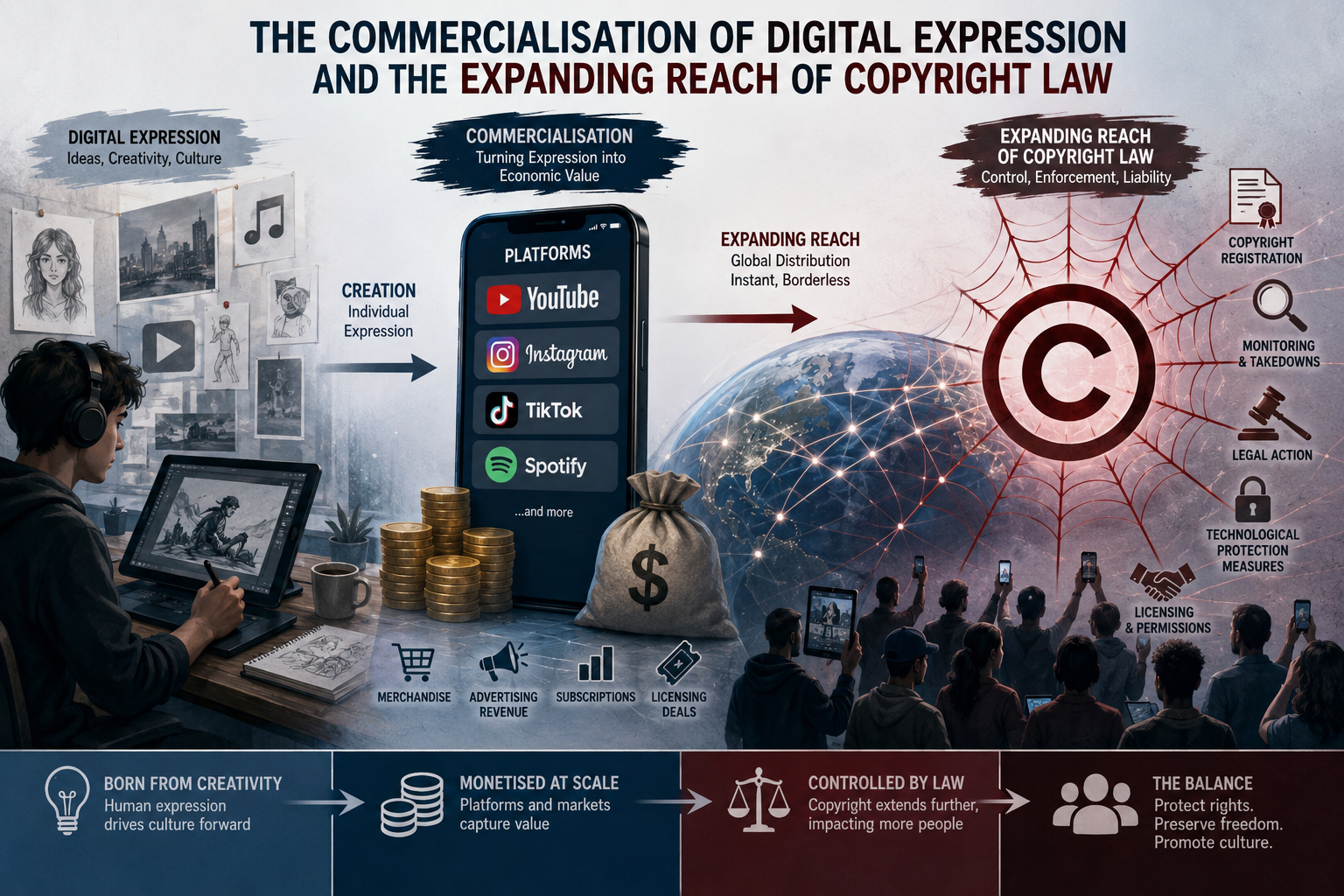
The digital revolution has transformed human expression in ways unimaginable just two decades ago. Today, a teenager with a smartphone can create viral videos, artists can distribute music globally without record labels, writers can publish independently online, and influencers can monetise opinions through social media platforms. Digital expression has become the foundation of the modern internet economy. Every meme, reel, podcast, livestream, tweet, digital artwork, YouTube video, or AI-generated image represents a form of expression capable of generating commercial value. In this new ecosystem, creativity is no longer limited to traditional artists or media corporations; it has become democratised and monetised simultaneously. However, with commercialisation comes conflict. As digital expression increasingly becomes a source of profit, copyright law has expanded aggressively to regulate ownership, reproduction, and distribution of online content. This expansion has triggered a global debate:
⚡ Is copyright law protecting creativity, or is it gradually restricting freedom of expression and innovation in the digital age?
On one side, creators argue that stronger copyright protection is necessary to prevent piracy, content theft, and unauthorised exploitation of creative works. On the other side, critics claim that modern copyright enforcement excessively empowers corporations and platforms while threatening internet culture, fair use, public access, and digital creativity itself.
The debate becomes even more complex with the rise of Artificial Intelligence ,algorithmic content generation, NFTs, streaming platforms, reaction videos, memes, and influencer economies. Copyright law, originally designed for books and printed works, now struggles to govern an internet built on sharing, remixing, reposting, and rapid digital consumption.
This blog explain the growing commercialisation of digital expression and analyses how copyright law is expanding into nearly every corner of online life. It further explores the legal, ethical, constitutional, and technological challenges emerging from this transformation, with special reference to India and global developments.
📜 Understanding Copyright Law in the Digital Era
Copyright refers to the legal protection granted to creators for their original literary, artistic, musical, dramatic, and digital works. It gives creators exclusive rights to reproduce, distribute, communicate, adapt, and monetise their content.
In India, copyright law is primarily governed by the Copyright Act, 1957, along with amendments introduced to address digital technology and online dissemination.
Traditionally, copyright law aimed to balance two competing interests:
🎨 Protecting creators and rewarding innovation
📚 Ensuring public access to knowledge and culture
However, the internet has fundamentally disrupted this balance.
Digital content can now be copied infinitely, shared instantly, edited easily, and monetised globally within seconds. This has forced governments and corporations to expand copyright enforcement mechanisms far beyond traditional publishing industries.
Today, copyright law affects:
📱 Social media posts
🎥 YouTube videos
😂 Memes and GIFs
🎮 Gaming streams
🎵 Music remixes
🤖 AI-generated art
📸 Photography
🎙️ Podcasts
📰 Online journalism
🧠 Educational content
The modern internet economy is therefore deeply dependent on intellectual property ownership.
The Commercialisation of Digital Expression:
🌟 Rise of the Creator Economy
The internet has created a “creator economy” where individuals monetise creativity directly through platforms such as YouTube, Instagram, TikTok, and Spotify.
Content is no longer merely expressive — it is commercial property.
For example:
Influencers earn through sponsorships
Musicians profit through streaming royalties
Streamers monetise live gaming
Meme pages generate advertising revenue
AI-generated art is sold online
Podcasts receive subscription income
Digital expression has effectively become a business model.
This commercialisation has increased demands for stricter copyright protection because online content now carries substantial economic value.
⚔️ The Expanding Reach of Copyright Law:
📈 Why Copyright Enforcement Is Becoming Stronger
Governments and corporations argue that stronger copyright law is essential because digital piracy causes enormous financial losses.
Streaming piracy, illegal downloads, reposting of videos, unauthorised reproductions, and AI content scraping threaten the revenue of creators and media industries. Consequently, copyright enforcement mechanisms have become more aggressive.
These include:
🚫 Automated takedown systems
🤖 AI copyright detection tools
⚖️ Platform liability rules
📡 Content monitoring algorithms
🌍 Cross-border enforcement actions
The modern digital ecosystem increasingly prioritises ownership verification and content control.
However, critics argue that this expansion has serious consequences for freedom of expression and internet culture.
😂 Memes, Remix Culture, and Fair Use Debate
One of the biggest controversies in copyright law concerns memes and remix culture. Internet users frequently reuse copyrighted images, film clips, music, and videos to create humorous or transformative content.
The key legal question becomes:
⚡ Should memes and remix content be treated as copyright infringement or creative expression?
Supporters of strong copyright laws argue:
Original creators deserve compensation
Viral reposting harms ownership rights
Commercial meme pages profit unfairly
Critics argue:
Memes are transformative expression
Internet culture depends on sharing
Strict enforcement threatens creativity
This debate reflects the broader conflict between private ownership and digital freedom.
🎥 YouTube, Streaming Platforms, and Copyright Control
Platforms like YouTube operate sophisticated copyright enforcement systems such as Content ID, which automatically detects copyrighted material in uploaded videos.
While these systems protect rights holders, they also create controversy.
⚠️ Common Criticisms
False copyright claims
Abuse of takedown mechanisms
Suppression of criticism and commentary
Unfair demonetisation
Algorithmic censorship
Many creators argue that automated copyright enforcement often punishes legitimate fair use content, including:
Educational videos
Reviews
Reaction content
Satire
Commentary
This has led to concerns regarding digital free speech and corporate control over online expression.
🤖 Artificial Intelligence and Copyright Crisis:
Artificial Intelligence has created perhaps the greatest challenge in modern copyright law.
AI systems are trained using massive datasets collected from:
Books 📚
Paintings 🎨
Music 🎵
Online articles 📰
Photographs 📸
Videos 🎥
Many creators argue that AI companies unlawfully exploit copyrighted works without consent or compensation.
Meanwhile, technology companies claim:
AI training constitutes fair use
Innovation requires large-scale data access
Restrictive regulation may hinder technological progress
The controversy raises difficult legal questions:
Who owns AI-generated content?
Can AI be considered an author?
Is training AI on copyrighted material legal?
Should creators receive compensation for AI training datasets?
These questions currently remain unresolved in many jurisdictions.
🇮🇳 Indian Perspective on Digital Copyright:
India’s digital economy is expanding rapidly, making copyright protection increasingly significant.
The Information Technology Act, 2000 and the Copyright Act, 1957 collectively regulate many aspects of online intellectual property.
Indian courts have gradually recognised the importance of balancing:
Intellectual property rights
Technological innovation
Freedom of speech
Public interest
However, India still faces major challenges:
Digital piracy
Unauthorised streaming
Copyright awareness gaps
Weak enforcement mechanisms
Cross-border infringement
The rapid growth of AI-generated content will likely intensify future legal disputes in India.
⚖️ Landmark Cases Shaping Digital Copyright Debate
📚 Indian Performing Right Society Ltd. v. Eastern India Motion Pictures Association
The Supreme Court examined ownership and royalty rights concerning music and cinematographic works, shaping India’s copyright jurisprudence.
📚 Super Cassettes Industries Ltd. v. MySpace Inc.
This important case dealt with intermediary liability and online copyright infringement involving user-generated content platforms.
The judgment highlighted the growing responsibility of digital platforms in monitoring infringing content.
📚 Google LLC v. Oracle America, Inc.
The U.S. Supreme Court recognised certain forms of software copying as fair use, significantly influencing global digital copyright debates.
🌐 Platform Power and Corporate Dominance
Modern copyright enforcement is increasingly controlled by large technology corporations.
Major platforms possess:
Algorithmic moderation tools
Automated takedown systems
Monetisation controls
Digital surveillance infrastructure
Critics argue this creates a dangerous concentration of power where private corporations effectively regulate online speech.
The concern is no longer limited to copyright protection alone. It now involves:
🌍 Internet governance
🗣️ Freedom of expression
💼 Market dominance
🔒 Digital monopolies
Thus, copyright law has evolved into both a legal and political issue.
📢 Freedom of Speech vs Copyright Protection
The expansion of copyright law frequently clashes with constitutional values, especially freedom of speech and expression.
In democratic societies, free expression is essential for:
Journalism 📰
Criticism 🗣️
Education 📚
Satire 😂
Political commentary ⚖️
Excessive copyright enforcement may suppress lawful expression under the pretext of intellectual property protection.
This creates an important constitutional debate:
⚡ Can copyright law become a tool for censorship?
The answer depends largely on how courts balance private ownership rights against public democratic freedoms.
🌍 Digital Piracy: Crime or Accessibility Issue?
Another controversial issue concerns digital piracy.
Entertainment industries consider piracy a serious economic threat. However, critics argue piracy often emerges due to:
High subscription costs
Regional inaccessibility
Educational inequality
Lack of affordable legal alternatives
In developing countries, many students rely on pirated educational materials because legitimate access remains expensive.
This raises ethical questions:
Should access to knowledge outweigh commercial ownership?
Can strict copyright laws deepen inequality?
The debate remains highly contested.
🧠 Ethical Questions in the Digital Economy
The commercialisation of digital expression also raises broader ethical concerns.
❓ Key Ethical Issues
Should human creativity become purely commercial?
Are creators adequately compensated online?
Do corporations profit excessively from user-generated content?
Is AI exploiting human labour indirectly?
Can digital culture survive hyper-commercialisation?
Modern copyright debates therefore extend beyond law into morality, economics, and social philosophy.
🚀 The Future of Copyright Law
The future of copyright law will likely depend on balancing three competing interests:
🎨 Protection of Creators
Creators deserve fair compensation and recognition.
🌐 Public Access and Innovation
The internet thrives on openness, collaboration, and creativity.
🤖 Technological Development
AI and digital technologies require legal flexibility for innovation.
Future legal reforms may include:
AI-specific copyright regulations
Stronger fair use protections
Platform accountability standards
International digital copyright treaties
Creator compensation mechanisms for AI training
The challenge is ensuring that copyright law evolves without destroying the open and participatory nature of the internet itself.
⚖️ Conclusion:
The commercialisation of digital expression has expanded the influence of copyright law across online platforms, AI technologies, and digital culture. While stronger protection safeguards creators and innovation, excessive enforcement may threaten free expression, fair use, and public access. The future of copyright law lies in achieving a balanced framework that protects creativity without restricting the openness and collaborative nature of the digital world.
⚠️ Disclaimer:
This blog is intended solely for educational, informational, and academic discussion purposes.

Leave a Comment
Your email address and mobile number will not be published. Required fields are marked *