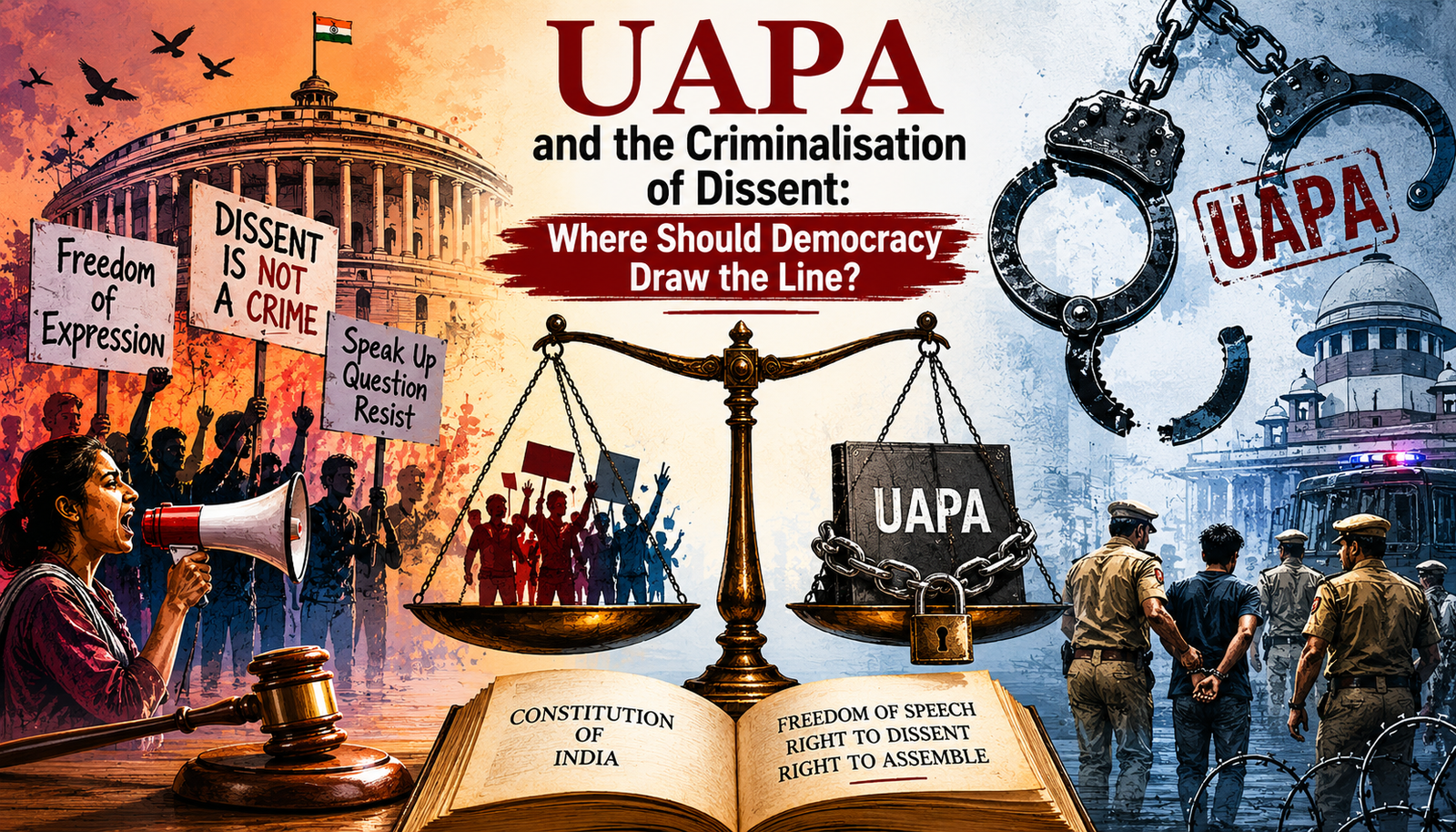
🖋️ Introduction: Democracy, Dissent, and the Fear of Silence
In every constitutional democracy, dissent acts as a safety valve. It allows citizens to question authority, challenge injustice, protest against government policies, and demand accountability from those in power. A democracy without dissent gradually transforms into a system where obedience replaces participation. India’s constitutional framework recognises this reality by guaranteeing freedom of speech, expression, peaceful assembly, and association under Article 19 of the Constitution. However, modern democracies also face another undeniable reality — the growing threat of terrorism, extremism, separatism, and organised violence. States across the world have strengthened national security laws to prevent terror attacks and protect public order. In India, the Unlawful Activities (Prevention) Act, 1967 (UAPA) has emerged as the country’s primary anti-terror legislation. While supporters view the UAPA as an essential weapon against terrorism, critics increasingly argue that the law is being used beyond its intended purpose. According to them, the broad powers under the legislation, coupled with strict bail provisions and expansive definitions, risk transforming democratic dissent into criminal suspicion.
This has generated one of the most important constitutional debates in contemporary India:
❓ Can a democracy protect national security without suppressing civil liberties?
Or more importantly:
❓ Where should democracy draw the line between dissent and anti-national activity?
The debate surrounding the UAPA is not merely legal; it is deeply political, constitutional, and philosophical. It forces India to confront difficult questions regarding liberty, security, State power, judicial oversight, and the future of democratic culture.
This article critically examines both sides of the debate — the State’s argument for strong anti-terror laws and the growing concerns surrounding the criminalisation of dissent.
📜 Understanding the UAPA: A Historical Perspective
The Unlawful Activities (Prevention) Act was enacted in 1967 during a period when India was confronting secessionist tendencies and threats to territorial integrity. Initially, the law primarily focused on banning organisations involved in unlawful or anti-national activities.
At the time of its enactment, the UAPA was not a full-fledged anti-terror statute. However, over the decades, the law underwent significant transformation.
The turning point came after the repeal of:
- The Terrorist and Disruptive Activities (Prevention) Act (TADA)
- The Prevention of Terrorism Act (POTA)
Both laws had faced severe criticism due to allegations of misuse, arbitrary arrests, custodial abuse, and low conviction rates. After POTA was repealed in 2004, many of its provisions were absorbed into the UAPA.
Subsequent amendments in:
2004, 2008,2012,2019
expanded the scope of the legislation significantly.
Today, the UAPA:
✔️ Defines terrorist acts
✔️ Allows designation of terrorist organisations
✔️ Permits designation of individuals as terrorists
✔️ Imposes strict bail restrictions
✔️ Grants broad investigative powers to agencies
As a result, the law has become one of the strongest anti-terror frameworks in India.
🛡️ The State’s Argument: Why India Needs Strong Anti-Terror Laws
Any balanced debate on the UAPA must first acknowledge India’s security realities.
India has faced:
- Cross-border terrorism
- Insurgency movements
- Maoist extremism
- Radicalisation networks
- Terror financing operations
- Organised extremist violence
From the Parliament attack to the Mumbai terror attacks, India has repeatedly experienced large-scale security threats capable of destabilising society and endangering civilian lives.
Supporters of the UAPA argue that ordinary criminal laws are insufficient to deal with modern terrorism because terror networks:
- Operate secretly
- Use encrypted communication
- Function across borders
- Involve ideological indoctrination
- Require preventive intelligence-based operations
According to the State’s perspective, anti-terror laws cannot function reactively. Waiting until violence actually occurs may prove disastrous.
Thus, the UAPA is defended as:
✅ A preventive security framework
✅ A mechanism to disrupt terror networks early
✅ A legal tool to protect sovereignty and public safety
Governments worldwide, including democracies such as the United States, the United Kingdom, and France, have adopted stringent anti-terror measures after major attacks.
From this viewpoint, weakening anti-terror laws may embolden extremist groups and compromise national security.
🗣️ The Counterargument: Is Dissent Being Criminalised?
Despite the security justification, critics argue that the UAPA increasingly extends beyond terrorism into the realm of democratic dissent.
This criticism lies at the heart of the national debate.
⚠️ Broad and Ambiguous Definitions
One of the strongest criticisms concerns the broad language used in the law.
Terms such as:
- “Unlawful activity”
- “Support”
- “Association”
- “Terrorist act”
can sometimes be interpreted expansively.
Legal scholars argue that vague terminology creates space for subjective enforcement.
The concern is that:
🧑🎓 Student activism
📰 Investigative journalism
✊ Political protests
🎓 Academic discussions
📱 Social media expression
may be viewed through a national security lens despite lacking direct involvement in violence.
🔒 The Bail Problem: “Process as Punishment”
Perhaps the most controversial feature of the UAPA is Section 43D(5), which imposes extremely strict bail conditions.
Under ordinary criminal law:
“Bail is the rule and jail is the exception.”
However, under the UAPA, courts are required to deny bail if the prosecution’s allegations appear prima facie credible.
This creates a situation where accused persons may remain imprisoned for years before trial concludes.
Critics describe this as:
⚖️ “Process becoming punishment.”
Even without conviction, prolonged incarceration can:
- Destroy careers
- Damage reputations
- Affect mental health
- Silence political participation
- Create fear among dissenters
Supporters of the law respond that terrorism investigations are highly complex and require extended evidence collection and intelligence coordination.
Nevertheless, the constitutional concern remains significant because liberty is affected long before guilt is proven.
📚 Constitutional Protection of Dissent
The Indian Constitution protects:
- Freedom of speech and expression
- Peaceful assembly
- Association
under Article 19.
These rights form the backbone of democratic participation.
India’s freedom movement itself was built upon dissent against colonial rule. Many leaders once considered “anti-establishment” later became architects of the nation.
This historical reality makes the debate surrounding dissent particularly sensitive in India.
⚖️ Supreme Court and the Limits of State Power
The Supreme Court of India has consistently emphasised that even while dealing with national security concerns and anti-terror legislation like the UAPA, the powers of the State are not absolute. Constitutional courts remain the guardians of fundamental rights, personal liberty, and democratic freedoms.
Several landmark and recent cases demonstrate how the judiciary has attempted to balance national security with constitutional protections.
🏛️ National Investigation Agency v. Zahoor Ahmad Shah Watali (2019)
In this important judgment, the Supreme Court adopted a strict interpretation of bail provisions under Section 43D(5) of the UAPA. The Court held that while deciding bail applications, courts should not conduct a detailed examination of evidence if the prosecution’s allegations appear prima facie true.
📌 Impact:
- Made bail under UAPA significantly more difficult
- Strengthened the State’s investigative powers
- Triggered concerns regarding prolonged incarceration without trial
Critics argue that the judgment weakened personal liberty protections, while supporters maintain that stringent standards are necessary in terrorism-related investigations.
🏛️ Union of India v. K.A. Najeeb (2021)
In a major constitutional development, the Supreme Court recognised that prolonged incarceration without timely trial may violate Article 21 of the Constitution.
The Court held that constitutional courts can grant bail even under strict UAPA provisions if:
- Trials are excessively delayed
- Continued detention becomes unjustified
📌 Significance:
- Reaffirmed the importance of personal liberty
- Strengthened the right to speedy trial
- Limited the absolute operation of Section 43D(5)
This judgment became an important safeguard against indefinite pre-trial detention.
🏛️ Vernon Gonsalves v. State of Maharashtra (2023)
The Supreme Court clarified that merely possessing literature or holding ideological beliefs cannot automatically amount to terrorist activity unless linked to violence or incitement.
📌 Constitutional Importance:
- Protected freedom of thought and expression
- Distinguished dissent from terrorism
- Reinforced democratic values and civil liberties
The judgment highlighted that unpopular or critical opinions alone cannot justify anti-terror prosecution.
🏛️ Recent Delhi Riots UAPA Bail Proceedings
In recent hearings concerning UAPA cases related to the Delhi riots conspiracy investigations, the Supreme Court revisited concerns regarding prolonged incarceration and strict bail standards.
The Court observed:
“Bail is the rule and jail is the exception.”
The judiciary also indicated that earlier interpretations of UAPA bail provisions may require reconsideration in light of constitutional protections under Article 21.
📌 Ongoing Constitutional Debate:
These proceedings raise important questions:
- Can prolonged detention become indirect punishment?
- Should anti-terror laws override personal liberty indefinitely?
- Where should courts draw the line between dissent and violent conspiracy?
⚖️ Judicial Balancing of Liberty and Security
These cases collectively demonstrate that the Supreme Court continues to play a vital role in defining the constitutional limits of State power under the UAPA.
While the judiciary acknowledges the importance of national security, it has also repeatedly stressed that:
✔️ Fundamental rights cannot be ignored
✔️ Liberty cannot be indefinitely suspended
✔️ Peaceful dissent cannot automatically be equated with terrorism
The evolving judicial approach reflects the continuing constitutional struggle to balance collective security with democratic freedom in India.
🔍 UAPA Cases and Public Controversy
Over the years, several:
- Activists
- Journalists
- Students
- Academics
- Political figures
have faced investigation under the UAPA.
Critics argue that this creates a chilling effect where citizens begin to fear participation in public discourse.
❄️ What Is the “Chilling Effect”?
The chilling effect occurs when people:
- Avoid criticism
- Stop participating in protests
- Self-censor opinions
- Fear legal consequences
even when their actions are constitutionally protected.
A democracy may formally guarantee free speech while practically discouraging it through fear of prosecution.
🧠 Media, Universities, and Democratic Space
The debate extends beyond courts into universities and newsrooms.
📰 Journalism Under Pressure
Journalists reporting on:
- Conflict regions
- State action
- Minority issues
- Protest movements
sometimes encounter national security scrutiny.
Critics argue that investigative journalism is essential for accountability and should not be confused with anti-State activity.
🎓 Universities and Intellectual Freedom
Universities traditionally function as spaces for:
- Debate
- Ideological disagreement
- Research
- Political thought
When academic spaces become securitised, concerns arise regarding:
⚠️ Freedom of thought
⚠️ Academic independence
⚠️ Democratic culture
However, governments maintain that educational institutions cannot become platforms for violent radicalisation.
📉 The Conviction Rate Debate
Another major criticism concerns conviction statistics under the UAPA.
Critics highlight that:
📌 Arrests are relatively high
📌 Conviction rates remain comparatively low
This raises concerns that:
- Detention may become preventive rather than prosecutorial
- The law may be used excessively during investigations
- Innocent individuals may suffer long incarceration
Supporters counter that terror cases are:
- Intelligence-sensitive
- Difficult to prosecute
- Preventive in nature
Thus, they argue that conviction rates alone cannot fully evaluate anti-terror laws.
🌍 International Perspective: A Global Democratic Dilemma
India is not alone in confronting this challenge.
After major terror attacks, countries such as:
🇺🇸 United States
🇬🇧 United Kingdom
🇫🇷 France
🇦🇺 Australia
also expanded anti-terror powers.
However, democracies worldwide continue debating:
- Surveillance limits
- Privacy rights
- Executive power
- Preventive detention
- Free speech restrictions
The global lesson is clear:
Extraordinary powers introduced during crises often become permanent features of governance.
⚔️ The Core Debate: Security vs Liberty
The debate over the UAPA ultimately revolves around two competing constitutional priorities:
🛡️ Security Perspective
Supporters argue:
- National security is essential for democracy
- Terrorism threatens sovereignty and public safety
- Preventive laws are necessary
- Anti-State networks may misuse democratic freedoms
🕊️ Civil Liberties Perspective
Critics argue:
- Liberty is equally essential for democracy
- Dissent should not be securitised
- Broad laws enable misuse
- Fear weakens democratic participation
Both arguments possess constitutional legitimacy.
The challenge lies not in choosing one over the other but in balancing them responsibly.
❓ Where Should Democracy Draw the Line?
A constitutional democracy must draw a careful distinction between:
✔️ Violent extremism
and
✔️ Peaceful dissent
The line should be crossed only when:
- Violence is involved
- Public safety is threatened
- Terror financing exists
- Organised extremist activity is proven
- Direct incitement occurs
However:
🗣️ Criticism of government
✊ Peaceful protest
📰 Journalism
🎓 Academic discussion
📱 Political expression
should remain protected democratic activities.
The distinction between:
«“Anti-government”
and
“Anti-national”»
must remain constitutionally clear.
🏛️ The Need for Reform:
The debate surrounding the UAPA does not necessarily require abolition of anti-terror laws. Rather, it raises questions regarding safeguards and accountability.
🔧 Suggested Reforms
1️⃣ Narrower Definitions
Ambiguous terms should be clarified to reduce arbitrary interpretation.
2️⃣ Judicial Oversight
Independent review mechanisms should monitor executive action.
3️⃣ Bail Reform
Prolonged incarceration without trial should not become indirect punishment.
4️⃣ Speedy Trials
UAPA cases should be resolved within reasonable timelines.
5️⃣ Accountability of Investigative Agencies
Extraordinary powers require extraordinary responsibility.
📌Conclusion:
UAPA is an important law for protecting India against terrorism and threats to national security. However, in a democracy, laws meant for security should not suppress peaceful dissent, criticism, or free speech. The real challenge is to maintain a balance where terrorism is strictly punished, but constitutional freedoms and democratic values remain protected. A strong democracy must fight violence without silencing dissent.
⚠️Important Note:
This article is published solely for educational, informational, and academic discussion purposes.

Leave a Comment
Your email address and mobile number will not be published. Required fields are marked *