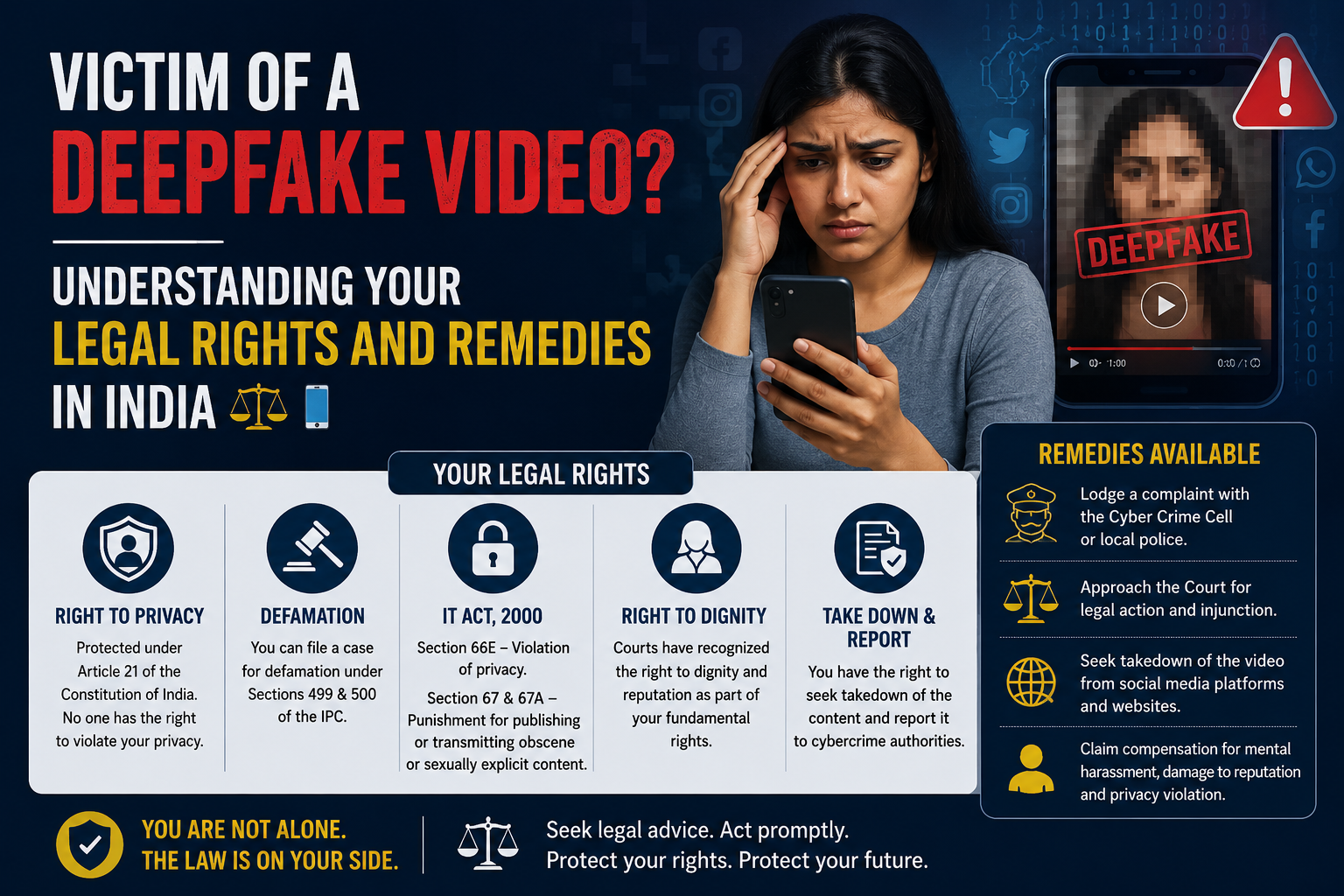
Introduction 🌐
Artificial Intelligence (AI) has undoubtedly become one of the most transformative technologies of the twenty-first century. From healthcare and education to finance and legal services, AI is revolutionizing industries at an unprecedented pace. However, alongside these technological advancements comes a darker reality—the rapid emergence of deepfake technology. While AI can create realistic voices, images, and videos for beneficial purposes, the same technology is increasingly being exploited to deceive, manipulate, harass, and financially exploit innocent individuals.
In recent years, India has witnessed a significant rise in AI-generated deepfake videos involving celebrities, politicians, business leaders, social media influencers, and even ordinary citizens. A person's face can now be digitally superimposed onto another body with astonishing realism. Similarly, AI can replicate an individual's voice after analyzing only a few seconds of audio, enabling fraudsters to create convincing fake phone calls and video messages.
The consequences are alarming. Victims have suffered reputational damage, emotional trauma, financial losses, identity theft, cyber extortion, workplace harassment, and even criminal investigations triggered by fabricated digital content. Businesses have lost crores of rupees after employees transferred funds believing they were acting on instructions from senior executives whose voices had been cloned using AI. Families have transferred emergency money after receiving fake distress calls that appeared to come from loved ones. Politicians have faced misinformation campaigns through manipulated speeches, while ordinary citizens have become victims of morphed intimate videos circulated online without consent.
This growing misuse of AI raises an important legal question:
If someone creates or circulates a deepfake video using your face or voice, what legal remedies are available under Indian law?
The answer is more nuanced than many people realize. India currently does not have a single dedicated statute dealing exclusively with deepfakes. Instead, victims often rely on a combination of criminal law, cyber law, privacy principles, constitutional protections, and other statutory remedies depending on the nature of the offence.
This article explores the legal position surrounding deepfake videos in India, examines whether existing laws are sufficient to protect victims, and provides practical guidance on the remedies available when AI-generated content is used for fraud, defamation, impersonation, or harassment
🤖 What Is a Deepfake?
The word "deepfake" combines the terms "deep learning" and "fake." It refers to synthetic media generated through artificial intelligence that realistically imitates a person's face, expressions, voice, gestures, or speech.
Unlike traditional photo editing, deepfake technology uses machine learning models trained on thousands of images and videos. The result is content that often appears authentic even to trained observers.
Today, freely available software can create:
🎥 Fake video interviews
🎙️ AI-generated voice recordings
📸 Manipulated photographs
🗣️ Synthetic speeches
👤 Digital impersonations
🎬 Realistic face swaps
As AI tools become cheaper and more accessible, the risk of misuse increases significantly.
📈 Why Are Deepfakes Becoming a Serious Concern?
Several factors contribute to the rapid growth of deepfake misuse:
Easy access to AI software.
Availability of public photographs on social media.
Massive online data collection.
Low cost of content generation.
Global anonymity through the internet.
Difficulty in detecting manipulated media.
A fraudster no longer needs advanced technical expertise. In many cases, publicly available AI applications can generate convincing fake content within minutes.
🚨 Common Types of Deepfake Frauds in India
💰 1. Financial Scams
AI-generated voice cloning is increasingly being used to impersonate family members, employers, or company directors.
Victims receive urgent calls requesting immediate money transfers, believing they are helping someone they know.
By the time the deception is discovered, the funds may already have been transferred through multiple accounts.
👩💼 2. CEO Fraud
Corporate employees receive fake video meetings or voice messages apparently from senior management directing confidential payments.
Internationally, several companies have suffered losses running into millions due to such attacks.
📱 3. Fake Celebrity Advertisements
Popular actors and public figures are digitally altered to appear as endorsing investment schemes, trading platforms, or health products they have never supported.
Consumers relying on such endorsements may become victims of fraud.
😔 4. Morphed Intimate Videos
Perhaps the most damaging misuse involves creating fabricated intimate videos using another person's face.
Victims often experience:
Emotional distress
Workplace humiliation
Family disputes
Social stigma
Online harassment
Blackmail demands
Women and young adults are particularly vulnerable targets.
🏛️ 5. Political Misinformation
Deepfake speeches can falsely portray political leaders making controversial statements, influencing public opinion and democratic processes.
The speed at which misinformation spreads online often exceeds the speed of legal correction.
⚖️ Does India Have a Separate Deepfake Law?
At present, India does not have a dedicated legislation exclusively regulating deepfake technology.
Instead, authorities rely upon existing legal provisions dealing with:
🛑 Identity theft
🛑 Cheating
🛑 Impersonation
🛑 Forgery
🛑 Defamation
🛑 Cyber offences
🛑 Extortion
🛑 Criminal intimidation
🛑 Privacy violations
Depending on the facts of each case, multiple legal provisions may apply simultaneously.
🇮🇳 Constitutional Protection: The Right to Privacy
The right to privacy has been recognised as a fundamental right under Article 21 of the Constitution of India through judicial interpretation.
Deepfake misuse directly interferes with:
Personal autonomy
Individual dignity
Reputation
Informational privacy
Bodily integrity
Freedom from unauthorized digital exploitation
Where a person's likeness is exploited without consent, privacy concerns become central to any legal assessment.
📹 Can Creating a Deepfake Amount to Defamation?
Yes, in many situations.
Suppose someone creates an AI-generated video falsely showing a doctor accepting bribes or a teacher making offensive remarks.
Even if viewers later discover that the content was fabricated, the person's reputation may already have suffered irreversible harm.
Victims may therefore explore appropriate legal remedies based on the circumstances, including claims relating to reputational injury where supported by law.
💻 AI Fraud and Identity Theft
Deepfake technology has significantly expanded the scope of identity theft.
Instead of merely stealing passwords or documents, criminals can now digitally recreate an individual's:
Face 👤
Voice 🎙️
Expressions 😊
Speech 🗣️
Video presence 🎥
This synthetic identity may then be used to deceive employers, financial institutions, customers, or family members.
From a legal perspective, AI-enabled impersonation may constitute far more than harmless entertainment when deployed for fraudulent purposes.
🔐 Deepfake Videos and AI Fraud: The Growing Threat to Ordinary Citizens
Until a few years ago, deepfake technology was largely associated with entertainment, film production, and research laboratories. Today, however, it has become a powerful tool in the hands of cybercriminals. With freely available AI applications and minimal technical knowledge, almost anyone can create a convincing fake video or clone another person's voice in a matter of minutes. 🚨
What makes this threat particularly dangerous is that victims often do not realize they have been targeted until the fake content has already gone viral or financial damage has occurred.
For instance, imagine a college student discovering that an AI-generated explicit video using her face is circulating on social media. She never participated in the recording, yet the damage to her reputation, mental health, and personal relationships may be immediate and devastating.
Similarly, consider a businessman receiving a video call that appears to come from his company's Managing Director instructing him to transfer ₹50 lakh to a foreign account for an urgent acquisition. The face, voice, and mannerisms all appear genuine. Only later does he discover that the call was entirely AI-generated.
These examples demonstrate why deepfakes are no longer merely technological curiosities—they are serious legal and cybersecurity concerns.
⚖️ Are India's Existing Laws Enough?
One of the most debated legal questions today is whether India's present legal framework is capable of dealing with AI-generated fraud.
The answer lies somewhere in the middle.
✅ Existing laws can punish many consequences.
If a deepfake is used for:
💰 Cheating
🎭 Impersonation
🏦 Financial fraud
📢 Defamation
🔐 Identity theft
📱 Cyber harassment
😨 Criminal intimidation
💵 Extortion
then existing criminal and cyber laws may provide remedies.
❌ However, there are significant gaps.
Current laws were enacted before the explosion of generative AI.
They generally punish the result of the misconduct rather than regulating the creation and distribution of AI-generated synthetic media itself.
Consequently:
There is no comprehensive statutory definition of “deepfake.”
Liability standards remain fragmented.
Platform responsibilities are still evolving.
Victims often struggle to obtain rapid removal of harmful content.
🌐 The Problem of Anonymous Perpetrators
Unlike traditional crimes, deepfake creators often hide behind:
VPN services
Foreign servers
Fake email addresses
Cryptocurrency payments
Anonymous social media accounts
Encrypted communication platforms
As a result, identifying the actual offender may require international cooperation and advanced digital forensic investigation.
Even when authorities identify the account used to upload the content, determining who actually created the deepfake can be significantly more difficult.
📱 Social Media Platforms and Their Responsibility
Deepfake videos usually spread through:
X (formerly Twitter)
YouTube
Telegram
Short-video platforms
Once uploaded, a manipulated video may be copied thousands of times within hours.
This creates an important legal issue:
Should social media companies bear responsibility for hosting or failing to remove deepfake content after receiving notice?
Globally, lawmakers continue debating intermediary liability.
In India, platforms are generally expected to cooperate with lawful government directions and applicable regulatory obligations, but practical implementation often depends upon the facts of each case.
🏛️ Can Victims Approach the Police?
Yes. ✅
Victims should report AI-generated fraud or malicious deepfakes as early as possible.
Delay can make:
identification of perpetrators,
preservation of electronic evidence,
and removal of online content
far more difficult.
While every case differs, early reporting substantially improves investigative prospects.
🧾 Evidence Every Victim Should Preserve
Before attempting deletion, victims should preserve available evidence.
Important materials include:
📸 Screenshots
🔗 URLs
📹 Video files
🎙️ Audio recordings
📱 Chat conversations
📧 Emails
💳 Payment receipts
🕒 Date and time records
💻 Device logs where available
📂 Metadata if accessible
This documentation may prove extremely valuable during investigation or court proceedings.
🔍 Can Deepfakes Be Forensically Detected?
Yes—but detection is becoming increasingly challenging.
Experts often examine:
unnatural blinking patterns,
facial inconsistencies,
audio artifacts,
lighting mismatches,
compression signatures,
pixel irregularities,
machine-learning fingerprints.
AI detection technology continues evolving, but so do generation techniques.
This technological race creates ongoing challenges for investigators and courts.
👩⚖️ How Might Courts Evaluate Deepfake Evidence?
Courts generally examine electronic evidence with caution.
If one party alleges that a video has been manipulated using AI, the authenticity of the material may become a central issue.
Judicial evaluation may involve:
expert testimony,
forensic examination,
corroborative evidence,
surrounding circumstances,
witness statements,
technical reports.
Merely producing a realistic-looking video does not automatically establish its reliability.
💼 Corporate Risks Created by Deepfakes
Businesses increasingly face AI-related threats beyond financial fraud.
Potential consequences include:
fake executive announcements,
fabricated investor communications,
manipulated earnings presentations,
counterfeit recruitment messages,
false compliance documents,
reputational attacks.
Organizations therefore need internal verification protocols rather than relying solely upon voice or video communications.
👨👩👧 Impact on Families
Deepfakes can destroy trust within families.
Parents may receive AI-generated calls apparently from children requesting emergency money.
Family disputes may arise after manipulated recordings circulate online.
Relationships built over decades may collapse because individuals initially believe fabricated digital evidence.
The emotional consequences often extend far beyond financial losses.
🧠 Mental Health Consequences
Victims frequently experience:
anxiety 😟
depression 😔
panic attacks 😰
social isolation 😞
professional embarrassment 😓
reputational harm 😢
Where intimate content is fabricated, psychological trauma may continue long after the material has been removed from public platforms.
🌍 International Regulatory Trends
Countries around the world are actively considering AI governance reforms.
Common proposals include:
✅ Mandatory AI disclosure labels
✅ Watermarking synthetic content
✅ Election-specific restrictions
✅ Criminalization of malicious deepfakes
✅ Enhanced platform accountability
✅ Transparency obligations for AI developers
✅ Stronger privacy protections
These developments indicate growing global recognition that traditional legal frameworks alone may not sufficiently address emerging AI risks.
🇮🇳 Does India Need a Dedicated Deepfake Law?
Many experts believe that India should consider comprehensive legislation specifically addressing AI-generated synthetic media.
Possible features could include:
statutory definition of deepfakes,
expedited takedown procedures,
victim compensation mechanisms,
criminal penalties for malicious creation,
obligations for commercial AI providers,
transparency standards,
biometric data protections,
safeguards during elections.
At the same time, lawmakers must ensure that regulation does not unnecessarily stifle innovation, artistic expression, or legitimate research.
The challenge lies in balancing technological progress with protection of constitutional right
🛡️ Practical Legal Remedies Available to Victims of Deepfake Videos in India
The first reaction of many victims is panic. They fear that once a manipulated video is uploaded online, nothing can be done. Fortunately, that is not entirely true. While removing deepfake content from the internet can be challenging, timely legal action and proper evidence preservation can significantly improve the chances of obtaining relief. ⚖️
The moment you discover that your face, voice, or identity has been misused through AI-generated content, you should act without delay.
📌 Step 1: Preserve Every Piece of Evidence
Before requesting removal or confronting the perpetrator, collect and preserve all available evidence.
Maintain copies of:
📸 Screenshots of the post
🔗 URL or web link
🎥 Original video or audio file
🕒 Date and time of publication
👤 Username or profile details of the uploader
💬 Comments or conversations related to the content
📱 Emails or messages received
💳 Financial transaction records (if fraud is involved)
Deleting or reporting the content without preserving evidence may make future legal proceedings more difficult.
🚔 Step 2: Report the Incident Immediately
Where the deepfake involves:
Financial fraud 💰
Identity theft 👤
Blackmail 😨
Extortion 💵
Cyber harassment 📱
Sexual exploitation 🚫
Fake investment schemes 📈
the matter should be reported to the appropriate law enforcement authorities without unnecessary delay.
Early reporting may allow investigators to:
Trace IP addresses
Preserve electronic logs
Contact intermediaries
Freeze suspicious accounts where legally permissible
Identify digital footprints before they disappear
🌐 Step 3: Request Immediate Removal from Online Platforms
Most major digital platforms provide reporting mechanisms for manipulated or harmful content.
Victims should request prompt removal by:
Reporting impersonation
Reporting privacy violations
Reporting harassment
Reporting non-consensual content
Reporting fraudulent advertisements
Although removal is not always instantaneous, early reporting reduces further circulation.
💼 Step 4: Consult a Legal Professional
Every deepfake incident is unique.
A lawyer can evaluate:
Whether criminal remedies are available.
Whether civil proceedings are appropriate.
Whether injunctions may be sought.
Whether damages may be recoverable.
Whether additional digital evidence should be preserved.
Legal advice becomes especially important where commercial losses or reputational injury are substantial.
💰 Can Victims Claim Compensation?
One of the most common questions asked by victims is:
“Can I receive compensation for the losses caused by a deepfake?”
The answer depends upon the facts of each case.
Potential losses may include:
💵 Financial losses
💼 Loss of employment opportunities
📉 Business reputation damage
📱 Cyber fraud losses
🧠 Psychological harm
👨👩👧 Social consequences
📚 Academic disruption
The availability and extent of compensation depend upon applicable legal principles, evidence, and judicial determination.
🎭 Deepfake Blackmail and Sextortion
One of the fastest-growing categories of AI abuse involves fabricated intimate content.
Criminals may generate fake explicit videos using publicly available photographs and then threaten victims by demanding money.
Common threats include:
“Pay ₹50,000 or we will upload this everywhere.”
“Transfer cryptocurrency immediately.”
“Your family and employer will receive this video.”
Victims often panic because the content appears realistic.
However, paying extortion demands rarely guarantees deletion.
Instead, payments may encourage repeated blackmail.
Prompt reporting and evidence preservation are generally far more effective responses.
👩 Women and Young Adults Face Higher Risks
Although anyone can become a victim, women frequently experience disproportionate harm from AI-generated abuse.
Consequences may include:
Social stigma
Online bullying
Career setbacks
Educational disruption
Family pressure
Emotional trauma
Students and young professionals often become targets simply because their photographs are publicly accessible through social media profiles.
Digital awareness and privacy settings therefore play an increasingly important preventive role.
🏢 Corporate Compliance in the AI Era
Businesses must also adapt.
Recommended safeguards include:
✅ Multi-factor payment approvals
✅ Independent verification for urgent transfers
✅ Employee awareness training
✅ AI fraud simulations
✅ Executive communication protocols
✅ Cybersecurity audits
✅ Vendor verification systems
No organization should authorize high-value transactions solely based on voice or video communications.
🎓 Educational Institutions Must Raise Awareness
Schools, colleges, and universities increasingly face incidents involving AI-generated harassment among students.
Awareness programmes should educate learners about:
Responsible AI use
Digital ethics
Consent
Privacy
Cybercrime reporting
Legal consequences
Preventive education may prove more effective than punitive action after harm occurs.
📱 How Ordinary Citizens Can Protect Themselves
Simple precautions can significantly reduce risk.
🔒 Limit Public Exposure
Avoid unnecessarily sharing:
High-resolution photographs
Voice recordings
Personal identity documents
on public platforms.
🔐 Strengthen Privacy Settings
Review privacy controls across:
Social media
Cloud storage
Video-sharing platforms
Professional networking sites
👀 Verify Before Trusting
If someone requests urgent money through video or voice communication:
☎️ Make an independent phone call.
📩 Send a separate message.
👥 Contact another family member.
Never rely solely upon appearance or voice.
🚫 Ignore "Guaranteed Investment" Videos
Many fraudulent advertisements falsely portray celebrities recommending cryptocurrency, stock trading, or AI investment platforms.
Always verify information independently before investing.
❓ Frequently Asked Questions (FAQs)
Q1. Can AI-generated fake videos lead to criminal liability?
Yes. If used for fraud, impersonation, extortion, harassment, or other unlawful purposes, existing legal provisions may become applicable depending on the facts.
Q2. Is creating a deepfake always illegal?
Not necessarily.
Deepfakes created for satire, research, education, cinema, or artistic expression may raise different legal considerations than malicious impersonation or fraud.
Context is extremely important.
Q3. Can I force a platform to remove a fake video immediately?
Many platforms provide reporting mechanisms, but the speed and outcome depend upon platform policies, applicable law, and the evidence available.
Q4. If the creator lives abroad, can legal action still be taken?
Cross-border enforcement may be more complex but is not automatically impossible. International cooperation mechanisms may become relevant depending on the circumstances.
Q5. Can voice cloning alone amount to fraud?
If AI-generated voice cloning is used to deceive someone into transferring money or providing confidential information, serious legal consequences may arise.
🔮 The Future of AI Regulation in India
Artificial intelligence is evolving much faster than legislation.
The coming years are likely to witness increased discussion regarding:
🤖 AI governance
📜 Platform accountability
🔍 Transparency obligations
🛡️ Privacy protections
🏛️ Dedicated deepfake regulation
🌍 International cooperation
⚖️ Victim compensation mechanisms
The objective will not be to discourage innovation but to ensure that technological progress remains consistent with constitutional values, human dignity, and public trust.
🏁 Conclusion
Deepfake technology is reshaping the digital world, but its misuse poses serious legal and ethical challenges. While India’s existing laws offer certain remedies, a dedicated legal framework may be needed to address AI-driven fraud more effectively. Until then, awareness, timely reporting, and preservation of evidence remain the strongest tools for protecting victims.
⚠️ Disclaimer
The information provided in this article is for general educational and informational purposes only.

Leave a Comment
Your email address and mobile number will not be published. Required fields are marked *