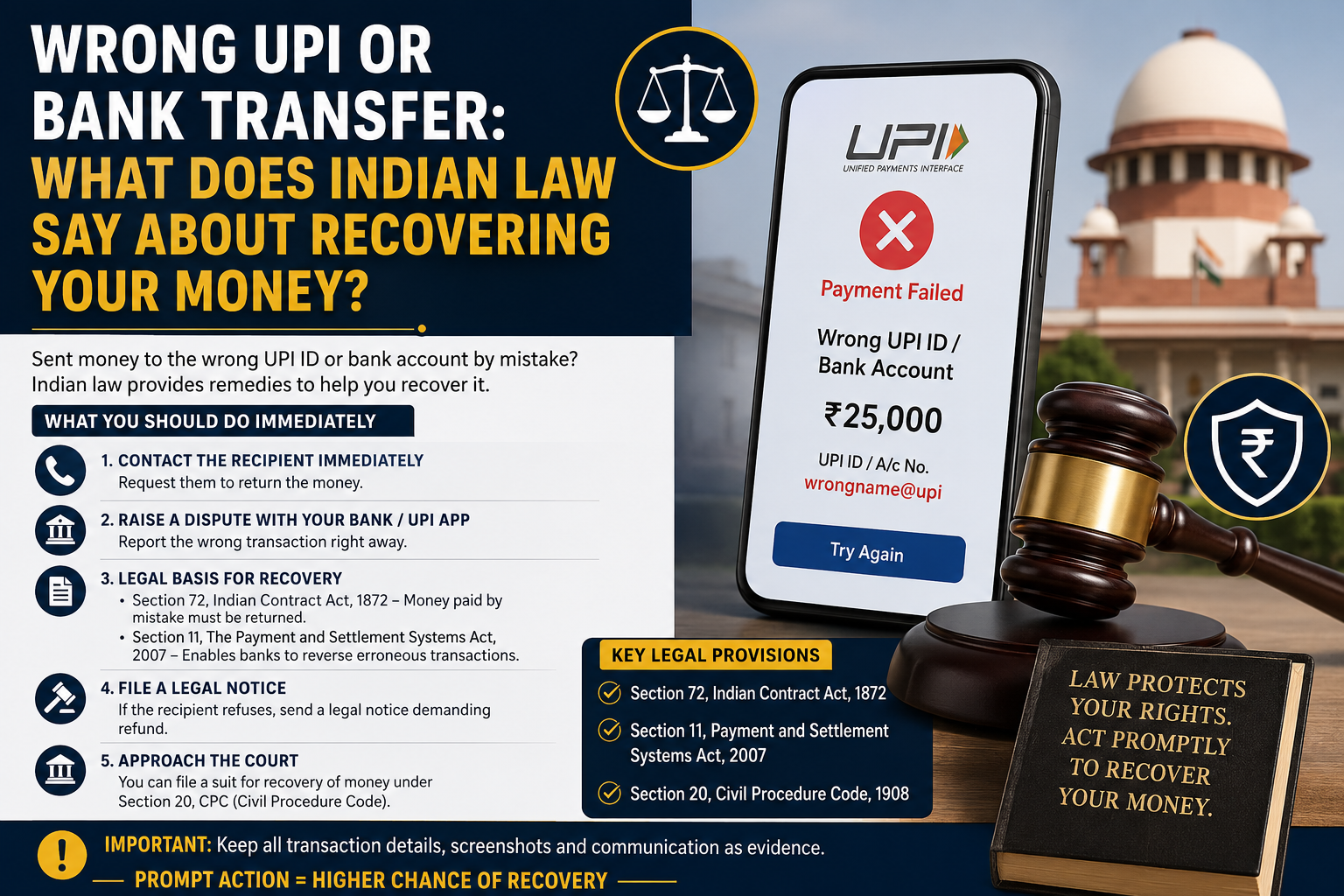
🌟 Introduction
India has witnessed a digital payment revolution over the last decade. With the rapid adoption of Unified Payments Interface (UPI), Internet Banking, NEFT, RTGS, IMPS, mobile wallets, and QR code payments, transferring money has become almost effortless. Whether paying a shopkeeper, sending money to family, purchasing goods online, or making business transactions, digital payments have become an integral part of everyday life.
According to official statistics, billions of UPI transactions are processed every month, making India one of the world's leading digital payment economies. 📱💳
While this technological advancement has made financial transactions faster and more convenient, it has also increased the risk of human errors and accidental transfers. A single incorrect digit in an account number, selecting the wrong beneficiary, typing an incorrect UPI ID, or mistakenly entering the wrong amount can result in money being sent to someone else.
Imagine transferring ₹50,000 instead of ₹5,000, or sending funds to "raj123@upi" instead of "rajesh123@upi." Such mistakes happen more often than people realize and can create panic, uncertainty, and financial hardship.
The immediate questions that arise are:
🤔 Can the money be recovered?
⚖️ Does Indian law protect the sender?
🏦 Is the bank responsible for reversing the transaction?
📱 What if the transfer was made through UPI?
🚔 Can the police help recover the amount?
👨⚖️ What legal remedies are available if the recipient refuses to return the money?
The good news is that Indian law does recognize remedies for mistaken transfers, but successful recovery depends on acting quickly, preserving evidence, and following the appropriate legal and banking procedures.
This article explains the legal framework, practical steps, and rights available to individuals who accidentally transfer money to the wrong account or UPI ID.
📌 Understanding a Wrong UPI or Bank Transfer
A wrong transfer occurs when money reaches an unintended person or account because of an error or mistake during the payment process.
Such mistakes may occur due to:
✅ Entering an incorrect account number.
✅ Selecting the wrong beneficiary from saved contacts.
✅ Typing an incorrect UPI ID.
✅ Entering the wrong IFSC code.
✅ Mistakenly scanning an incorrect QR code.
✅ Entering the wrong amount.
✅ Choosing the wrong mobile number linked to UPI.
Although the transfer may have been accidental, the legal consequences depend on the facts and circumstances of each case.
💳 Difference Between a Wrong Transfer and Fraud
It is important to distinguish between an accidental transfer and a fraudulent transaction.
🔹 Wrong Transfer
The sender voluntarily initiates the payment but makes a mistake in entering the details.
Example:
Rohan intends to send ₹10,000 to his brother but accidentally selects another saved beneficiary with a similar name.
This is a mistaken transfer.
🔹 Fraudulent Transfer
The sender is deceived into making the payment.
Examples include:
🎭 Fake customer care scams.
📞 OTP fraud.
📱 QR code scams.
🛒 Fake online shopping websites.
💼 Investment scams.
👮 Digital arrest fraud.
In such situations, criminal remedies and cybercrime procedures become particularly important.
🏦 Common Types of Mistaken Transfers
1️⃣ Wrong UPI ID
A payment is made to an unintended UPI address because of a typing error or incorrect selection.
Example:
amit123@upi
instead of
amitkumar123@upi
2️⃣ Wrong Account Number
The sender enters an incorrect bank account number while initiating an NEFT or RTGS transfer.
3️⃣ Wrong Beneficiary Selection
Many people save beneficiaries in internet banking.
Selecting the wrong saved name can result in payment to an unintended recipient.
4️⃣ Wrong Mobile Number
Certain payment systems rely on registered mobile numbers.
Entering an incorrect number may redirect funds elsewhere.
5️⃣ Wrong Amount
Instead of transferring ₹1,500, a user accidentally enters ₹15,000.
Recovery procedures may still become necessary.
⚖️ Does Indian Law Allow Recovery of Mistaken Transfers?
Yes.
Indian law does not treat mistakenly transferred money as automatically belonging to the recipient merely because it has reached their account.
The legal system recognizes that money transferred under a genuine mistake may, depending on the circumstances, be recoverable through appropriate legal mechanisms.
However, there is no guarantee of immediate or automatic reversal, especially where the bank has correctly executed the payment instructions provided by the customer.
Instead, recovery generally depends on:
📝 Prompt reporting.
📑 Documentary evidence.
🏦 Banking procedures.
🤝 Cooperation of the recipient.
⚖️ Applicable legal remedies.
👨⚖️ Judicial determination where necessary.
📜 Legal Principles Supporting Recovery
Although every case depends on its facts, Indian law generally recognizes that a person should not unjustly benefit from money received by mistake.
The legal framework seeks to balance:
The rights of the sender.
The obligations of financial institutions.
The protection of the recipient's account.
Principles of fairness and justice.
This means that retaining money known to have been mistakenly received may expose the recipient to legal consequences in appropriate cases.
🏛️ The Role of the Indian Contract Act, 1872
One of the key legal principles relevant to mistaken payments is found under the Indian Contract Act, 1872, which recognizes that money paid by mistake may be recoverable in accordance with law.
The underlying objective is to prevent unjust enrichment, ensuring that one person does not unfairly profit at another's expense merely because of an accidental payment.
This principle has long been recognized by Indian courts and forms an important foundation for recovery claims.
🏦 The Role of Banks in Wrong Transfers
Many customers believe that the bank can simply debit the recipient's account and return the money.
In reality, banks operate within a legal and regulatory framework.
When a customer provides payment instructions and the bank correctly processes them, the bank may not have the authority to unilaterally reverse the transaction without following applicable procedures.
However, banks can often assist by:
📞 Contacting the beneficiary bank.
📧 Recording complaints.
📝 Initiating internal communication.
🤝 Facilitating coordination between parties.
📂 Maintaining transaction records.
Customers should therefore notify the bank immediately after discovering the mistake.
📱 Does UPI Make Recovery Easier?
UPI transactions settle almost instantly.
While this provides unmatched convenience, it also means that money can reach the recipient within seconds.
Consequently:
⏱️ Delays in reporting reduce the chances of early intervention.
If reported promptly:
Banks may begin communication quickly.
Records remain fresh.
The possibility of voluntary return improves.
If the recipient withdraws or spends the money before action is initiated, recovery may become more complicated and require legal proceedings.
🚨 First Things You Should Do Immediately After a Wrong Transfer
1️⃣ Stay Calm
Avoid panic.
Collect all transaction information carefully.
2️⃣ Preserve Evidence
Save:
📷 Screenshots.
📷 UPI reference number.
📷 UTR number.
📷 SMS confirmations.
📷 Email receipts.
📷 Bank statement entries.
3️⃣ Contact Your Bank Immediately
Provide:
Account details.
Transaction ID.
Date and time.
Amount transferred.
Beneficiary details.
Request a complaint number and written acknowledgment.
4️⃣ Raise a Complaint Through the Payment App
If the payment was made using UPI, also use the complaint mechanism available within the application.
Maintain screenshots of complaint submissions.
5️⃣ Inform the Recipient (If Known)
Where appropriate and safe, politely explain the mistake and request repayment.
Many accidental transfers are resolved amicably.
6️⃣ Keep Every Communication in Writing
Maintain copies of:
📁 Emails.
📁 Complaint acknowledgments.
📁 Branch letters.
📁 SMS alerts.
📁 Customer care reference numbers.
Proper documentation can significantly strengthen any later legal claim.
⏳ Why Speed Matters
Time is often the deciding factor in recovery.
The earlier the sender reports the mistake:
✅ The greater the possibility of coordinated action.
✅ The easier it becomes to trace the transaction.
✅ Documentary evidence remains readily available.
✅ The recipient may not yet have withdrawn or utilized the funds.
Waiting several days before reporting can complicate the recovery process and reduce the likelihood of a quick resolution.
⚖️ Your Legal Rights as the Sender
Accidentally sending money to the wrong person can be stressful, but Indian law provides avenues to seek recovery. Although there is no automatic guarantee that the amount will be returned immediately, the sender is not without protection.
If you have mistakenly transferred money through UPI, NEFT, RTGS, IMPS, or internet banking, you generally have the following rights:
✅ To lodge a complaint with your bank without delay.
✅ To request the bank to initiate communication with the beneficiary bank.
✅ To use the grievance redressal mechanism provided by the payment service provider.
✅ To pursue appropriate civil or criminal remedies where the facts justify such action.
✅ To preserve and rely upon documentary evidence to support your claim.
The outcome will depend on the facts of the case, the conduct of the recipient, and the applicable legal framework.
🏦 Is the Bank Legally Responsible?
Many customers assume that if money is sent to the wrong account, the bank must reimburse the loss.
However, the answer depends on who made the mistake.
📌 Situation 1: The Customer Made the Error
For example:
You entered the wrong account number.
You selected the wrong beneficiary.
You typed an incorrect UPI ID.
You mistakenly entered ₹1,00,000 instead of ₹10,000.
If the bank processed the transaction exactly as instructed, it may not automatically be liable because it acted on the customer's directions.
📌 Situation 2: The Bank Made the Error
Suppose you entered all the details correctly, but due to a technical issue or operational mistake within the banking system, the amount was credited to the wrong account.
In such situations, the bank may have a responsibility to investigate the issue and take corrective measures in accordance with applicable law and regulatory requirements.
📱 Role of UPI Service Providers
UPI platforms provide in-app mechanisms through which users can report transaction-related issues.
If you discover that money has been transferred to the wrong UPI ID:
1️⃣ Raise a complaint within the application.
2️⃣ Contact your bank immediately.
3️⃣ Preserve all transaction details and screenshots.
4️⃣ Follow up regularly until the matter is addressed.
Prompt reporting often improves the chances of an effective resolution.
📝 Essential Documents to Preserve
Documentation plays a vital role in any recovery process.
Keep copies of:
📷 UPI transaction ID or UTR number.
📷 Bank statement showing the debit.
📷 SMS or email confirmation.
📷 Screenshots of the payment confirmation.
📷 Complaint reference number.
📷 Emails exchanged with the bank.
📷 Any communication with the recipient.
These records may become valuable if legal proceedings are required.
🚔 When Should You File a Police or Cyber Complaint?
Every mistaken transfer does not require police intervention.
However, filing a complaint may become appropriate where:
🔹 The recipient refuses to return the money despite being informed.
🔹 The transaction resulted from deception or impersonation.
🔹 You were induced to transfer money through false representations.
🔹 The transfer is connected with an online fraud or cyber scam.
🔹 Fake identities or forged documents were used.
In such circumstances, reporting the matter to the appropriate authorities without delay may assist in the investigation.
🌐 Cyber Fraud vs. Accidental Transfer
Understanding the difference is important.
✅ Accidental Transfer
You voluntarily send money but make an honest mistake while entering payment details.
Example:
You intended to pay your landlord but accidentally selected another saved beneficiary.
❌ Cyber Fraud
You are tricked into sending money by:
🎭 Fake customer care executives.
📞 OTP scams.
📱 QR code manipulation.
🛒 Fake e-commerce websites.
💼 Investment frauds.
👮 Digital arrest scams.
These situations may involve additional legal remedies beyond a simple recovery request.
👨⚖️ Civil Remedies for Recovery
If the recipient does not voluntarily return the money and the issue cannot be resolved through banking channels, the sender may consider pursuing civil remedies in accordance with the law.
A court may examine:
📑 Whether the transfer occurred by mistake.
📑 Documentary evidence supporting the claim.
📑 Conduct of both parties.
📑 Communication exchanged after discovery of the error.
📑 Applicable legal principles governing restitution.
Proper evidence is often critical to establishing entitlement to recovery.
⚠️ Can the Recipient Legally Keep the Money?
A common misconception is:
“The money reached my account, so it now belongs to me.”
This is not necessarily correct.
If a person knows that funds have been credited to their account by mistake and deliberately refuses to cooperate in returning them, legal consequences may arise depending on the circumstances and the evidence available.
Indian legal principles generally discourage unjust enrichment at another person's expense.
💡 Good Faith vs. Dishonest Conduct
✔️ Good Faith Example
A person notices an unexpected credit in their account.
They immediately inform the bank and cooperate with the recovery process.
Such conduct reflects honesty and good faith.
❌ Dishonest Example
A person realizes that the money belongs to someone else.
They quickly withdraw the amount, ignore repeated requests, and intentionally refuse to return it.
Depending on the facts, such behaviour may expose the individual to legal action.
🏛️ Can Consumer Protection Laws Help?
If the dispute arises because of a deficiency in banking services, consumer protection remedies may also become relevant.
Examples include:
Failure to follow proper banking procedures.
Technical errors attributable to the bank.
Unreasonable delay in handling a legitimate complaint.
However, where the issue is purely between the sender and the unintended recipient, other legal avenues may be more appropriate.
📖 Illustrative Example
Priya intends to transfer ₹25,000 to her architect through internet banking.
She mistakenly selects another beneficiary with a similar name from her saved list.
Within fifteen minutes, she realizes the error.
She immediately:
✅ Contacts her bank.
✅ Obtains a complaint reference number.
✅ Preserves screenshots and transaction details.
✅ Requests the bank to coordinate with the beneficiary bank.
✅ Follows up through the official grievance process.
Because she acted promptly and maintained proper documentation, she significantly strengthens her position for seeking recovery.
⏱️ Why Delayed Action Can Create Problems
If the sender waits several days before reporting the mistake:
❌ The recipient may withdraw or spend the funds.
❌ Evidence may become more difficult to gather.
❌ Communication between institutions may be delayed.
❌ Recovery could require more extensive legal proceedings.
Prompt action is therefore one of the most important practical steps after discovering an erroneous transfer.
❓ Frequently Asked Questions (FAQs)
Q1. Can I get my money back if I entered the wrong UPI ID?
Recovery may be possible, particularly if the issue is reported quickly and appropriate procedures are followed. The outcome depends on the facts of the case and the cooperation of the parties involved.
Q2. Can the bank simply reverse the transaction?
Not always. Where the bank has correctly executed the customer's payment instructions, it may not have the authority to unilaterally debit another customer's account without following applicable legal and procedural requirements.
Q3. Should I contact the recipient directly?
If the recipient is known and it is safe to do so, a polite request explaining the mistake may resolve the matter without litigation.
Q4. What if the recipient refuses to return the money?
Depending on the circumstances, you may explore appropriate legal remedies, including civil proceedings and, where justified by the facts, criminal or cyber law mechanisms.
Q5. Is there a time limit for reporting the mistake?
Although legal rights may continue to exist, reporting the issue immediately greatly improves the prospects of a timely and effective resolution.
🛡️ Practical Tips to Prevent Wrong Transfers
✔️ Double-check the beneficiary name before confirming payment.
✔️ Verify the account number and IFSC code carefully.
✔️ Review the UPI ID character by character.
✔️ Send a small test amount before transferring large sums where practical.
✔️ Avoid making payments in haste or under pressure.
✔️ Be cautious of payment requests received through unfamiliar messages or calls.
✔️ Save transaction receipts and confirmation messages.
✔️ Regularly review your banking notifications to detect errors quickly.
✅ Conclusion
In an era where digital payments have become an essential part of everyday life, accidental UPI and bank transfers are not uncommon. While such mistakes can be distressing, Indian law provides legal avenues to seek recovery of wrongly transferred funds. The key is to act promptly, notify your bank immediately, preserve all transaction records, and follow the appropriate grievance and legal procedures.
Although recovery is not guaranteed in every case, timely action and proper documentation can significantly improve the chances of getting your money back. Staying vigilant and double-checking payment details before confirming any transaction remains the best way to avoid unnecessary financial loss.
⚠️ Disclaimer
This article is intended for general informational and educational purposes only.

Leave a Comment
Your email address and mobile number will not be published. Required fields are marked *