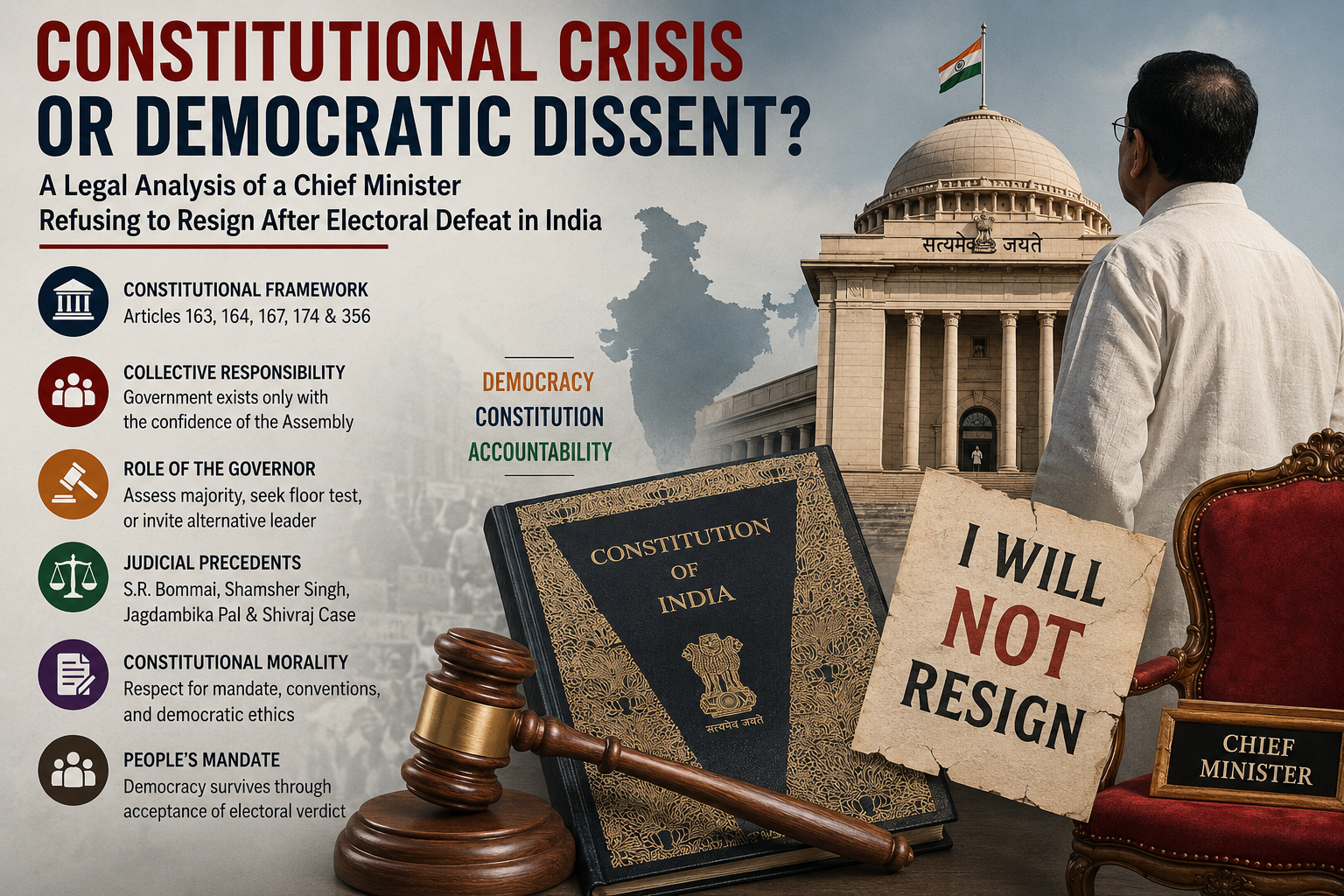
📌 Introduction: The Moment Democracy Faces Its Toughest Test
Elections are often described as the “festival of democracy.” But the true strength of democracy is tested not merely when votes are cast — it is tested when power changes hands peacefully.
India, as the world’s largest constitutional democracy, has historically witnessed intense elections, ideological clashes, and political rivalries. Yet despite these conflicts, constitutional continuity survived because elected governments ultimately accepted democratic outcomes.
However, whenever an incumbent executive allegedly refuses to resign despite losing public mandate, a serious constitutional debate emerges.
The recent political controversy in West Bengal has reignited difficult constitutional questions:
- Can a Chief Minister continue after electoral defeat?
- Is resignation legally mandatory?
- What powers does the Governor possess?
- Can courts intervene?
- Does refusal violate constitutional morality?
- When does political resistance become constitutional impropriety?
This issue is not merely political drama. It concerns the very soul of parliamentary democracy.
This article provides a detailed constitutional and legal analysis of the issue through constitutional provisions, judicial precedents, parliamentary conventions, democratic principles, and comparative constitutional perspectives.
🏛️ I. The Constitutional Position of a Chief Minister
Under the Constitution of India, the Chief Minister is the real executive authority of the State Government.
The relevant constitutional framework includes:
- Article 163
- Article 164
- Article 167
- Article 174
- Article 356
Under Article 164(1), the Governor appoints the Chief Minister.
But this appointment is not personal or absolute.
The constitutional structure clearly implies that the Chief Minister must enjoy the confidence of the Legislative Assembly.
The Governor generally appoints:
- the leader of the majority party,
- coalition leader, or
- a person capable of proving majority support on the floor of the House.
Thus, democratic legitimacy and legislative majority form the constitutional foundation of executive power.
⚖️ II. Parliamentary Democracy: Why Majority Support Is Everything
India follows the Westminster model of parliamentary democracy.
Article 164(2) provides:
“The Council of Ministers shall be collectively responsible to the Legislative Assembly of the State.”
This principle is the backbone of responsible government.
It means:
✅ The government survives only while it enjoys majority support.
✅ Once majority is lost, constitutional legitimacy weakens.
✅ Refusal to resign may amount to constitutional impropriety.
In parliamentary democracy, power does not belong permanently to individuals. It exists only so long as democratic confidence survives.
🔥 III. Is Resignation Legally Mandatory After Electoral Defeat?
This is one of the most important constitutional questions.
Technically, the Constitution does not expressly say:
“A Chief Minister must immediately resign after election defeat.”
However, constitutional governance does not operate only through written text.
It also functions through:
- constitutional conventions,
- democratic ethics,
- parliamentary traditions, and
- constitutional morality.
In parliamentary democracies, conventions carry enormous importance.
Therefore, once it becomes clear that:
- another political formation has secured majority support, and
- the incumbent lacks legislative confidence,
continued occupation of office becomes constitutionally difficult to justify.
🧠 IV. Constitutional Morality: The Invisible Foundation of Democracy
Modern Indian constitutional jurisprudence increasingly emphasizes the doctrine of constitutional morality.
The Supreme Court in important decisions such as:
- Navtej Singh Johar v. Union of India
- Government of NCT of Delhi v. Union of India
observed that constitutional functionaries must act in a manner preserving democratic values and institutional ethics.
Constitutional morality includes:
- respect for democratic mandate,
- institutional restraint,
- accountability,
- peaceful transfer of power,
- constitutional conventions.
Thus, even if temporary continuation is technically possible, prolonged refusal to acknowledge electoral defeat may violate constitutional morality.
👑 V. The Governor’s Constitutional Role During Political Uncertainty
The Governor occupies a sensitive constitutional position during post-election uncertainty.
Under Article 163:
- the Governor ordinarily acts on aid and advice of the Council of Ministers,
- but certain discretionary powers arise during constitutional instability.
After elections, the Governor may:
✅ Assess majority support
✅ Invite majority leader to form government
✅ Request caretaker continuation temporarily
✅ Seek floor test where doubt exists
If an incumbent government refuses to resign despite lacking majority support, constitutional complications intensify.
⚠️ VI. “Pleasure of the Governor” — The Most Misunderstood Constitutional Phrase
Article 164 states ministers hold office “during the pleasure of the Governor.”
But this phrase does not give arbitrary personal power to the Governor.
The Supreme Court in Shamsher Singh v. State of Punjab clarified:
- Governor is a constitutional head,
- not an independent political ruler.
Therefore:
❌ Governor cannot arbitrarily dismiss elected governments.
✅ But Governor may act where constitutional breakdown becomes apparent.
This balance protects both democracy and federalism.
🧾 VII. Caretaker Government: Temporary Continuation vs Constitutional Resistance
After elections, outgoing governments often continue temporarily until the new government is sworn in.
This is called a caretaker government.
A caretaker government generally:
- avoids major policy decisions,
- refrains from large appointments,
- avoids major financial commitments,
- performs routine administration only.
Thus, temporary continuation itself is not unconstitutional.
But refusal to facilitate transfer of power raises serious constitutional concerns.
🏛️ VIII. Floor Test: The Ultimate Constitutional Weapon
Indian constitutional law repeatedly recognizes one principle:
Majority must be tested on the floor of the House.
Important precedents include:
⚖️ 1. S.R. Bommai v. Union of India
This landmark judgment established:
- majority should ordinarily be tested in the Assembly,
- not determined subjectively by Governors.
⚖️ 2. Jagdambika Pal Case
The Court ordered immediate floor test.
⚖️ 3. Shivraj Singh Chouhan v. Speaker Madhya Pradesh Legislative Assembly
The Supreme Court reaffirmed:
Floor test is the constitutionally recognized method for determining majority.
Thus, if a defeated Chief Minister still claims support, the constitutional mechanism is simple:
👉 Prove it on the Assembly floor.
⚖️ IX. Can Courts Intervene in Such Situations?
Yes.
The Supreme Court and High Courts possess powers of judicial review where:
- constitutional machinery is abused,
- democratic mandate is ignored,
- floor test is delayed improperly,
- constitutional authorities act arbitrarily.
Courts may:
- order floor test,
- direct assembly session,
- prevent unconstitutional delay,
- supervise constitutional transition in extraordinary situations.
However, courts usually avoid directly replacing governments. They prefer democratic resolution through constitutional procedure.
🚨 X. Can Refusal to Resign Trigger Constitutional Breakdown?
Potentially, yes.
Article 356 allows President’s Rule where:
“Government of the State cannot be carried on in accordance with the Constitution.”
But Article 356 is extraordinary.
After S.R. Bommai v. Union of India:
- misuse of President’s Rule became judicially reviewable,
- federalism received strong constitutional protection.
Therefore, mere political controversy is insufficient.
But if:
- lawful transfer of power is obstructed,
- Assembly process is frustrated,
- constitutional governance becomes paralyzed,
then constitutional breakdown arguments may arise.
🗳️ XI. Electoral Mandate: The Real Source of Democratic Legitimacy
Democratic legitimacy originates from the people.
When voters decisively reject a government:
- moral legitimacy weakens,
- political authority becomes temporary,
- continuation without majority appears constitutionally fragile.
Law and legitimacy must coexist.
A technically surviving government without democratic confidence creates constitutional discomfort.
🌍 XII. How Other Democracies Handle Electoral Defeat
🇬🇧 United Kingdom
Prime Ministers traditionally resign immediately after electoral defeat.
Constitutional conventions govern peaceful transfer.
🇺🇸 United States
The U.S. presidential system differs because executive authority does not depend on legislative majority.
Yet even there, refusal to accept electoral outcomes created serious institutional tension after the 2020 elections.
🇨🇦 Canada & 🇦🇺 Australia
Both follow Westminster-style conventions similar to India.
Caretaker conventions are respected with constitutional discipline.
⚔️ XIII. Constitutional Morality vs Political Strategy
A difficult question often emerges:
Can allegations of electoral malpractice justify refusal to resign?
A defeated government may allege:
- EVM irregularities,
- violence,
- unconstitutional interference,
- electoral malpractice.
But constitutional remedies already exist:
✅ Election petitions
✅ Judicial review
✅ Statutory challenge mechanisms
Unilateral refusal to vacate office without constitutional support may undermine democratic order itself.
📜 XIV. Election Petitions: The Constitutional Remedy for Disputed Results
Election disputes in India are governed by the Representation of the People Act, 1951.
Election results may be challenged before High Courts.
However:
Until a competent court invalidates results, declared outcomes remain legally operative.
This principle preserves constitutional stability.
⚠️ XV. Governor’s Discretion: Necessary Power or Dangerous Tool?
Indian constitutional history also warns against partisan gubernatorial behavior.
Controversies have involved:
- manipulated invitations,
- selective floor tests,
- politically motivated dismissals.
Therefore gubernatorial discretion must remain:
- neutral,
- transparent,
- constitutionally justified.
The Supreme Court increasingly scrutinizes politically motivated constitutional conduct.
🏛️ XVI. Federalism, Stability & Democratic Survival
Political instability in major states affects:
- governance,
- law and order,
- economic confidence,
- institutional trust.
Thus constitutional functionaries must act with restraint, maturity, and respect for democratic continuity.
📺 XVII. Media Narratives and Constitutional Polarization
Modern constitutional crises no longer unfold only inside legislatures.
They now unfold through:
- television debates,
- social media campaigns,
- digital misinformation,
- political narratives.
That is why constitutional literacy and factual clarity are more important than ever.
⚖️ XVIII. Can the Supreme Court Monitor Such a Crisis?
In extraordinary circumstances, yes.
Under:
- Article 32,
- Article 136,
- Article 142,
the Supreme Court possesses wide constitutional powers.
The Court may:
✅ order immediate floor test
✅ supervise constitutional process
✅ ensure peaceful democratic transition
✅ prevent unconstitutional delay
Yet courts generally avoid becoming political administrators.
🧭 XIX. The Ethical Side of Democratic Transfer of Power
Democracy survives not merely through legal enforcement, but through constitutional culture.
Peaceful transfer of power reflects:
- institutional maturity,
- respect for voters,
- democratic confidence,
- constitutional patriotism.
When incumbents resist democratic transition:
- polarization increases,
- constitutional trust weakens,
- institutions suffer.
🏁 XX. Final Conclusion: Democracy Survives Through Restraint, Not Force
The refusal of a Chief Minister to resign after apparent electoral defeat raises one of the most serious constitutional questions in parliamentary democracy.
Legally:
✅ Temporary caretaker continuation may be permissible.
❌ Long-term continuation without majority support becomes constitutionally indefensible.
India’s constitutional system ultimately depends upon:
- democratic mandate,
- legislative confidence,
- constitutional morality,
- peaceful transition of power.
The Governor, judiciary, Election Commission, and constitutional institutions all possess carefully balanced roles in preserving democratic continuity.
The Constitution was never designed merely to distribute power.
It was designed to ensure responsible use of power.
Democratic defeat is not a constitutional disaster.
Refusal to respect democratic outcomes can become one.
📌 Disclaimer
This article is a constitutional and legal analysis for educational and public discussion purposes only. Political developments may evolve with time, and factual claims should be independently verified through official records, election data, judicial proceedings, and constitutional authorities.