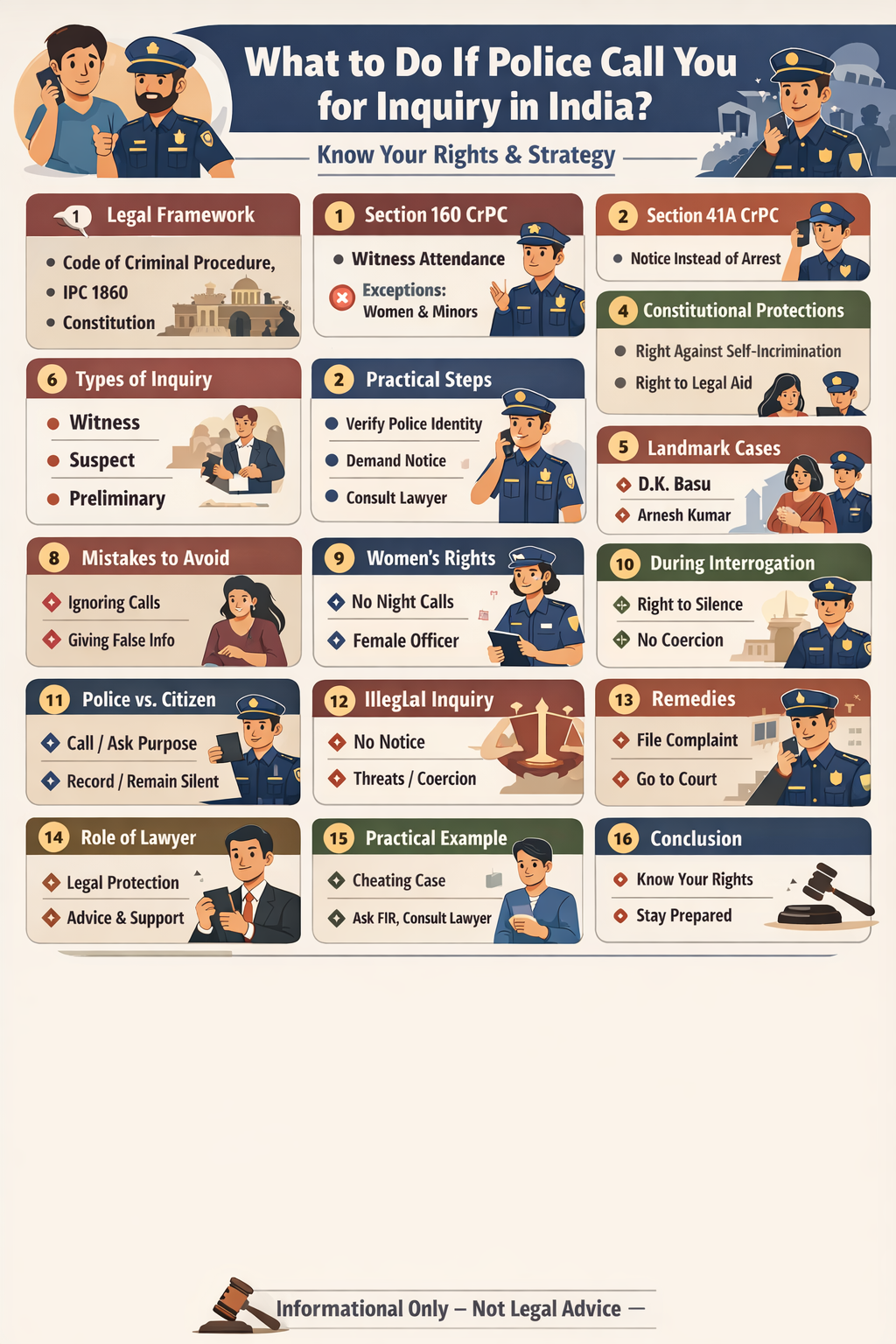
📌 1. Introduction
Receiving a call from the police for inquiry (पूछताछ) is one of the most stressful experiences for any citizen. In India, lack of legal awareness often leads to fear, panic, and sometimes wrongful actions by individuals that worsen their legal position.
However, it is crucial to understand that:
👉 Police inquiry ≠ Arrest
👉 You have strong legal rights under Indian law
This article provides a complete, in-depth legal framework, including:
- Statutory provisions
- Constitutional safeguards
- Landmark judgments
- Practical strategy
⚖️ 2. Legal Framework Governing Police Inquiry
Police powers are not absolute—they are governed by statutory law.
📜 Relevant Law:
- Code of Criminal Procedure, 1973
- Indian Penal Code, 1860
- Constitution of India
🔍 Section 160 CrPC – Attendance of Witness
Police can require attendance of:
- Witnesses
- Persons acquainted with facts
⚠️ Important Protection:
- Women and minors cannot be forced to attend police station
- They must be examined at their residence
🔍 Section 41A CrPC – Notice of Appearance
Instead of arrest, police must issue notice:
👉 This is a safeguard against arbitrary arrest
🧠 3. Constitutional Protections
🛡️ Article 20(3) – Right Against Self-Incrimination
No person shall be compelled to be a witness against himself.
🛡️ Article 21 – Right to Life and Personal Liberty
Includes:
- Right to fair procedure
- Protection from arbitrary police action
🛡️ Article 22 – Protection Against Arrest
- Right to know grounds of arrest
- Right to lawyer
🏛️ 4. Landmark Case Laws (Very Important)
⚖️ D.K. Basu v. State of West Bengal
Key Principles:
- Arrest guidelines mandatory
- Police must follow procedure
- Protection against custodial torture
⚖️ Joginder Kumar v. State of Uttar Pradesh
Held:
👉 Arrest is not mandatory
👉 Must be justified
⚖️ Arnesh Kumar v. State of Bihar
Important:
- Police must issue notice before arrest
- No automatic arrest
⚖️ Nandini Satpathy v. P.L. Dani
Principle:
👉 Right to remain silent during interrogation
🧠 5. Types of Police Inquiry
1. Witness Inquiry
- You are not accused
2. Suspect Inquiry
- You may become accused
3. Preliminary Inquiry
- Before FIR
🚨 6. Step-by-Step Practical Strategy
✔️ Step 1: Stay Calm and Analytical
Fear leads to mistakes
✔️ Step 2: Verify Police Identity
Ask:
- Name
- Rank
- Police station
✔️ Step 3: Ask Legal Basis
- FIR number?
- Section involved?
✔️ Step 4: Demand Written Notice
Under Section 41A CrPC
✔️ Step 5: Consult Lawyer
👉 Never go blindly
✔️ Step 6: Prepare Statement
- Stick to facts
- Avoid assumptions
❌ 7. Common Mistakes to Avoid
- Ignoring police call
- Giving false statement
- Signing blank papers
- Going alone in serious cases
👩⚖️ 8. Special Protection for Women
- Cannot be called at night
- Must be questioned at residence
- Presence of female officer
🔐 9. Rights During Interrogation
- Right to silence
- Right to lawyer
- No torture or coercion
- No illegal detention
📊 10. Police Powers vs Citizen Rights
| Police Power | Citizen Right |
|---|---|
| Call for inquiry | Ask purpose |
| Record statement | Remain silent |
| Issue notice | Demand copy |
⚠️ 11. When Inquiry Becomes Illegal
- No notice
- Forced confession
- Threat or coercion
👉 You can:
- Approach Magistrate
- File complaint
🏛️ 12. Remedies Against Police Misuse
- Complaint to SP
- Writ Petition under Article 226
- Human Rights Commission
💼 13. Role of Lawyer (Critical Insight)
A lawyer ensures:
- No illegal questioning
- Proper documentation
- Protection from arrest
🧾 14. Practical Example
Scenario:
You receive call for cheating case inquiry
Correct Action:
- Ask FIR details
- Consult lawyer
- Appear with preparation
🚀 15. Advanced Legal Strategy (Expert Level)
👉 Always:
- Keep call records
- Take written acknowledgment
- Avoid verbal admissions
📊 16. Conclusion
Police inquiry is a legal process—not a punishment.
Awareness of rights + correct strategy = complete protection
⚠️ Final Disclaimer
This content is for informational purposes only and does not constitute legal advice. For specific cases, consult a qualified legal professional.