Introduction
For many people in Uttar Pradesh, visiting a police station is confusing and stressful. One of the most common questions asked by citizens is:
“Why did the police write my complaint as an application, NCR, or complaint case instead of registering an FIR?”
Some people believe the police are refusing to act. Others assume every complaint must become an FIR immediately. In reality, Indian criminal law works through different legal categories. Every grievance does not automatically become an FIR. The correct procedure depends on the nature of the offence, the facts disclosed, and the powers given to police under law.
This article explains, in clear and practical language, when police may register a complaint instead of an FIR, when FIR is mandatory, what legal remedies are available, and how citizens in Uttar Pradesh should protect their rights.
This content is freshly written in an original style for public education and is intended to be easy to understand.
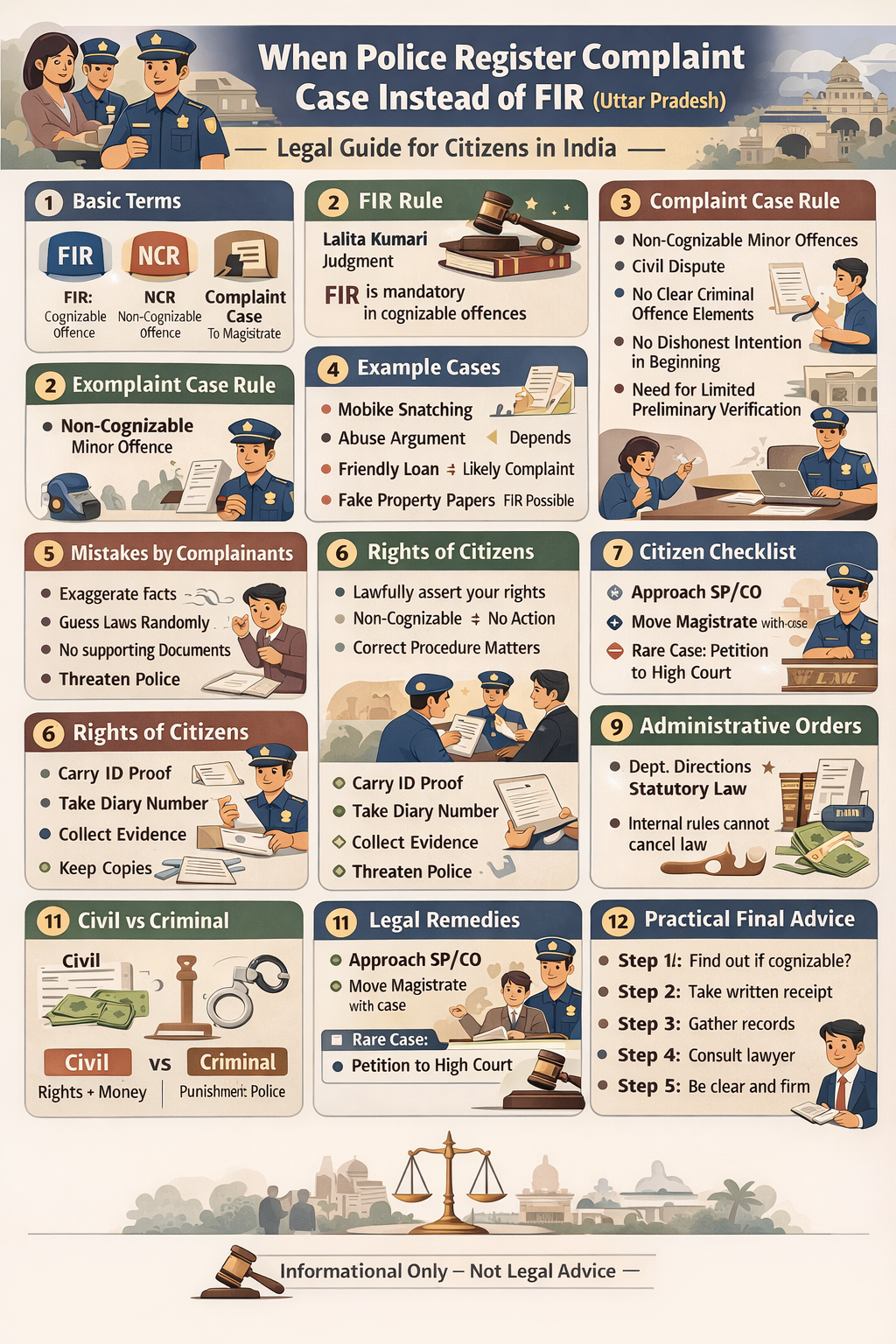
1. Understanding the Basic Difference
Before discussing police procedure, it is important to understand three common terms:
A. FIR (First Information Report)
An FIR is registered when information discloses a cognizable offence. In such cases, police can investigate and may arrest according to law.
Examples often include:
- Serious assault
- Theft
- Robbery
- Cheating in certain situations
- Criminal breach of trust
- Sexual offences
- Kidnapping
B. NCR / Non-Cognizable Report
Where the offence is non-cognizable, police may record the complaint but cannot start a full investigation without permission of the Magistrate.
Examples may include:
- Minor hurt
- Simple abuse in some circumstances
- Defamation
- Public nuisance in certain situations
C. Complaint Case / Private Complaint / Complaint to Magistrate
A person may approach the Magistrate directly when:
- Police fail to register FIR
- Matter requires judicial intervention
- Law permits complaint procedure
- Citizen seeks summons/trial through court route
2. Why Every Complaint Is Not an FIR
Many disputes reach police stations daily, but not all are criminal offences. Some are:
- Civil disputes over property
- Family misunderstandings
- Money recovery disputes without criminal intent
- Business disagreements
- Contract breaches
- Neighborhood quarrels
- Social media arguments
If every disagreement became an FIR, the criminal justice system would collapse under misuse and overload.
That is why police must first see whether the complaint discloses:
- A cognizable offence
- A non-cognizable offence
- A civil dispute
- Need for preliminary verification in limited situations
3. What the Law Says About FIR
The central principle in Indian criminal law is simple:
If information clearly reveals a cognizable offence, police should register FIR.
This principle was strongly discussed in the landmark decision of Lalita Kumari v. Government of Uttar Pradesh.
Core Idea from the Judgment
Where a cognizable offence is disclosed, registration of FIR is generally mandatory. Police cannot routinely avoid registration by delaying or converting every matter into a complaint.
This judgment became extremely important because it protected ordinary citizens from arbitrary refusal.
4. Then Why Do Some Cases Become Complaint Cases?
Even after the above rule, some matters are still processed differently because facts matter.
Situations Where Complaint Route May Be Appropriate
A. Non-Cognizable Offence
If the allegations reveal only a non-cognizable offence, police may record the complaint and advise the complainant about the proper legal route.
B. Purely Civil Dispute
If the matter is essentially:
- property possession dispute
- agreement dispute
- unpaid friendly loan without dishonest intention at the beginning
- partnership disagreement
then criminal law may not be the first remedy.
C. Lack of Essential Ingredients of Offence
Sometimes the complaint uses words like “fraud” or “cheating,” but facts do not legally satisfy the ingredients of the offence.
D. Need for Limited Preliminary Verification
In certain categories recognized by courts, limited preliminary inquiry may be permissible before FIR.
5. What Is a “Parivaad” or Complaint Case?
In common Hindi usage, many people say परिवाद when referring to a complaint case before a Magistrate.
This usually means the citizen moves the court directly, and the Magistrate may:
- record statement
- examine witnesses
- order inquiry
- issue summons
- direct investigation in appropriate cases
This route is especially useful where police are inactive or the case is not being handled fairly.
6. Can Police Directly Refuse FIR?
The short answer: Not in a cognizable case.
If facts clearly show a cognizable offence, police should not reject the complaint casually.
However, they may lawfully say:
- This is non-cognizable
- This is civil in nature
- Please give supporting documents
- Correct jurisdiction lies elsewhere
- The facts do not reveal criminal offence as stated
The legality depends on the real facts—not just labels used by parties.
7. Uttar Pradesh Practice: Why Administrative Orders Are Issued
Police departments sometimes issue internal directions to ensure:
- proper classification of complaints
- reduction of false FIRs
- improved scrutiny
- proper record keeping
- discipline in registration process
- faster disposal of minor matters
These directions may tell officers to examine whether a matter is:
- cognizable
- non-cognizable
- civil
- complaint case suitable
Such directions can help administration, but they cannot override statutory law.
8. Administrative Circular vs Law: Which Prevails?
This is very important.
No departmental circular can cancel the effect of criminal procedure law or Supreme Court rulings.
If the law says FIR must be registered in a cognizable case, then an internal administrative practice cannot become a shield for unlawful refusal.
Citizens should always remember:
Procedure may be guided internally, but legal rights come from law.
9. Examples: FIR or Complaint?
Example 1: Mobile Phone Snatched on Road
Likely criminal offence involving theft/robbery elements. FIR route generally appropriate.
Example 2: Neighbor Abuses You in Argument
Depends on facts. May be non-cognizable or minor offence. Complaint route may arise.
Example 3: Friendly Loan Not Repaid
Usually civil recovery unless dishonest intention existed from the beginning.
Example 4: Forged Property Papers Prepared
May disclose serious cognizable offences. FIR may be appropriate.
Example 5: Husband’s Family Harassing Wife
Depending on facts, criminal law provisions may apply and FIR may be necessary.
10. Difference Between Civil Wrong and Criminal Offence
Many people confuse these two.
Civil Wrong
Focuses on:
- compensation
- recovery
- injunction
- rights enforcement
Criminal Offence
Focuses on:
- punishment
- investigation
- public wrong
- state prosecution
A person cannot convert every civil dispute into criminal pressure tactics.
Courts repeatedly caution against misuse of criminal process in civil matters.
11. Important Judicial Thinking on Misuse of Criminal Law
Courts across India have often observed that criminal law should not be used as a shortcut for:
- debt recovery
- property pressure
- business settlement leverage
- revenge after failed transactions
That does not mean genuine cheating or fraud is ignored. It means intention and ingredients matter.
12. What If Police Say “Give Application First”?
This is common.
Do not panic. Ask politely:
- Diary number / receiving number
- Name of officer receiving it
- Status of complaint
- Whether offence is considered cognizable or non-cognizable
- What next legal step is advised
Always keep copies.
13. Smart Citizen Checklist at Police Station
When submitting complaint:
- Carry ID proof
- Keep two copies
- Attach documents
- Mention dates clearly
- Mention names carefully
- Avoid exaggeration
- Ask receiving stamp/signature
- Keep witnesses details if available
These simple steps greatly improve credibility.
14. What If Police Wrongly Treat Serious Case as Complaint Only?
If a serious cognizable matter is being diluted, use remedies.
Remedy 1: Senior Police Authority
Approach:
- Circle Officer
- Superintendent of Police
- Commissioner (where applicable)
Submit written representation.
Remedy 2: Magistrate
Move the Magistrate under applicable criminal procedure provisions seeking proper action.
Remedy 3: Complaint Case
File private complaint with evidence.
Remedy 4: High Court
In suitable rare cases, constitutional remedies may be invoked.
15. Role of the Magistrate
The Magistrate is an important safeguard in the justice system.
Where police fail or dispute exists, the court can examine whether legal action is required.
That is why complaint route is not a “weaker option.” In many cases, it is a powerful lawful remedy.
16. Why Some Citizens Prefer FIR Even When Complaint Route Exists
People often want FIR because:
- It feels official
- Police investigation begins
- Greater pressure on accused
- Stronger perception of seriousness
But legal strategy should depend on facts, not emotion.
Sometimes a properly prepared complaint case can be more effective than a weak FIR.
17. Common Mistakes by Complainants
Avoid these errors:
1. Exaggerating Facts
False additions can damage the entire case.
2. Wrong Sections Mentioning Randomly
Facts matter more than self-selected legal sections.
3. Threatening Police Staff
Stay respectful and firm.
4. No Documentary Evidence
Attach receipts, chats, photos, agreements, medical papers where relevant.
5. Delay Without Explanation
Late reporting may weaken credibility in some matters.
18. Digital Evidence in Modern Complaints
Today many disputes involve:
- WhatsApp chats
- Audio calls
- Screenshots
- Emails
- Bank transfers
- CCTV footage
- Social media posts
Preserve original evidence carefully.
Do not edit screenshots or manipulate files.
Authenticity matters.
19. Women, Senior Citizens, and Vulnerable Persons
Special sensitivity is expected where complainants are:
- women
- children
- senior citizens
- persons with disability
- victims of harassment
In such matters, procedural fairness and dignity are essential.
20. False Complaints: A Real Concern
It must also be said honestly: false complaints do happen.
Because of this, careful scrutiny by police and courts is important.
A fair system must protect both:
- genuine victims
- falsely accused persons
Justice requires balance.
21. If You Are the Accused in a Complaint Instead of FIR
Do not assume you are guilty.
Take these steps:
- Read allegations carefully
- Preserve documents
- Consult lawyer
- Avoid threatening complainant
- Cooperate legally
- Prepare factual defence
Many cases fail because allegations cannot be proved.
22. Why Legal Advice Matters Early
Early legal advice can help identify:
- whether case is civil or criminal
- whether FIR is proper
- whether complaint case is stronger
- what documents are needed
- how to avoid self-harm through wrong statements
Early mistakes are expensive later.
23. Human Reality: Why Citizens Feel Frustrated
People often say:
“I went for justice but got procedure.”
This feeling is understandable. But procedure exists to ensure fairness. The answer is not blind FIR in every case—the answer is lawful classification and accountable action.
24. Best Draft Format for a Police Complaint
A strong complaint usually contains:
- Name and address
- Date and time of incident
- Place of incident
- Full facts in sequence
- Names of accused (if known)
- Witness names
- Documents attached
- Relief requested
- Signature and contact details
Short, clear, truthful writing works best.
25. Can Mediation Solve Some Matters?
Yes, in many non-serious disputes:
- neighborhood issues
- minor misunderstandings
- payment confusion
- family communication disputes
Early settlement may save years of litigation.
But serious offences should not be casually trivialized.
26. Important Reminder About Terminology Changes
Some criminal procedure laws in India have undergone legislative changes in recent years. Practical implementation may use updated terminology and new statutory references. However, the core citizen principle remains the same:
Know the nature of the offence. Know your remedy. Act with records.
27. Final Practical Roadmap for Uttar Pradesh Citizens
If police do not register FIR:
Step 1
Ask politely: Is it cognizable or non-cognizable?
Step 2
Take written acknowledgment of complaint.
Step 3
Collect all evidence.
Step 4
Approach senior authority if required.
Step 5
Consult a lawyer.
Step 6
Move Magistrate where necessary.
Step 7
Stay factual and patient.
28. Conclusion
The real question is not “Why no FIR?” The real question is:
What does the law require in this case?
Sometimes FIR is mandatory. Sometimes complaint procedure is proper. Sometimes the dispute belongs in civil court. Sometimes judicial intervention is needed.
A legally aware citizen is stronger than a confused citizen.
Understanding the difference between FIR, NCR, and complaint case can save time, reduce frustration, and help achieve lawful justice.
Disclaimer
This article is for public legal awareness and general educational purposes only. It is not a substitute for professional legal advice. Facts of every case are different. For case-specific guidance, consult a qualified legal practitioner.