Introduction
Buying an apartment is not only about receiving keys and shifting into a flat. A real housing project becomes legally complete only when ownership rights, common areas, management systems, records, and statutory compliances are properly transferred. Many apartment owners discover problems only after possession—missing approvals, unpaid dues, incomplete fire systems, no sanctioned maps, no society handover, no maintenance records, or no legal control over common areas.
This is where apartment laws, ownership laws, cooperative laws, and real estate regulations become extremely important.
One of the most common questions asked by flat owners is:
Why is apartment registration necessary?
What documents, NOCs, approvals, and records must a builder hand over to the apartment association or society?
These questions are highly practical because failure of proper handover can lead to years of disputes, unsafe buildings, legal confusion, and financial burden on residents.
This detailed guide explains the legal importance of apartment registration, association handover obligations, key NOCs, essential documents, and practical remedies—especially with reference to Uttar Pradesh and broadly applicable principles in other Indian states.
This article is written in original, human-friendly language for awareness and educational use.
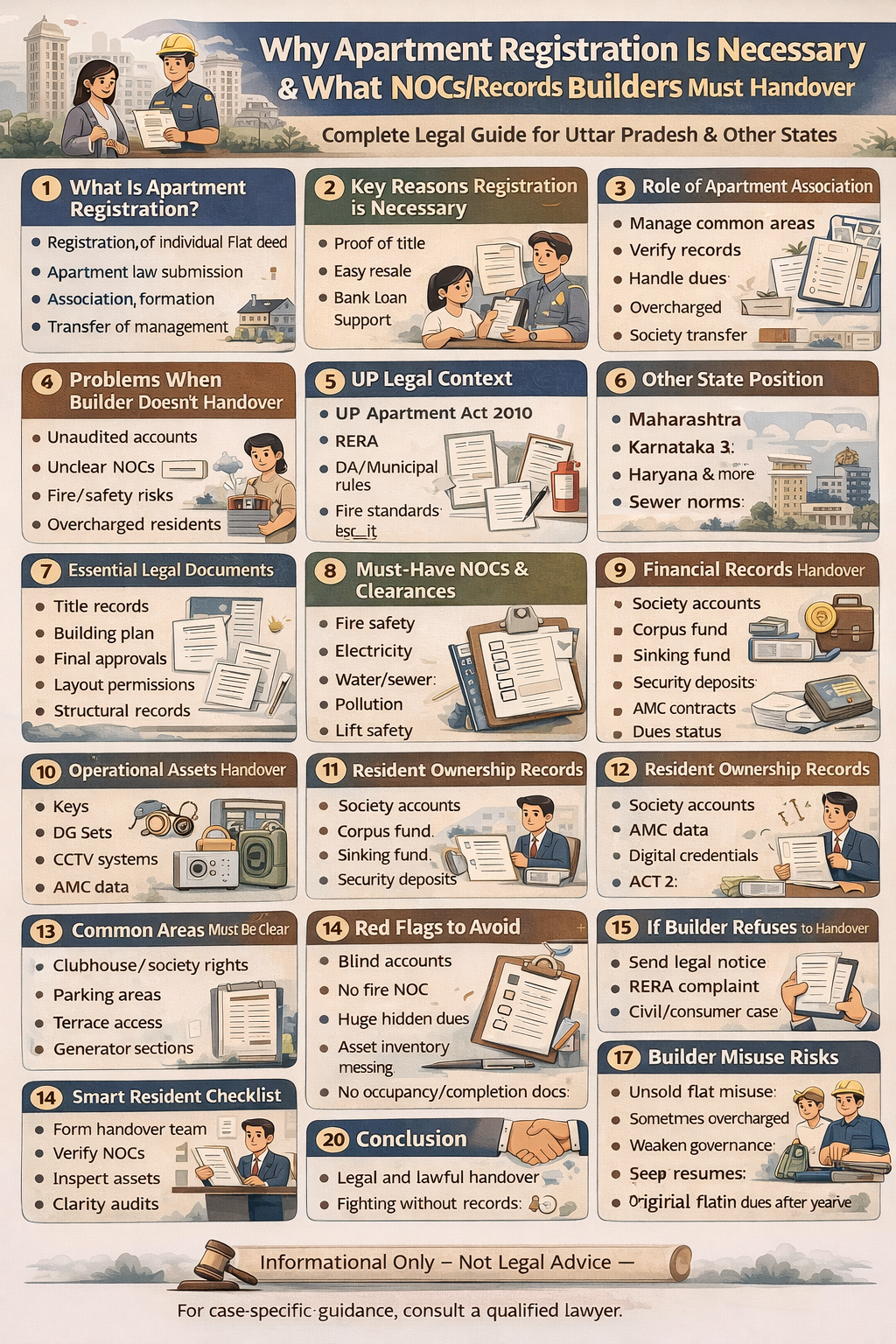
1. What Is Apartment Registration?
The term “apartment registration” may be used in different ways by citizens. It commonly refers to one or more of the following:
A. Registration of Individual Flat Sale Deed
The purchaser gets legal ownership documentation through registered conveyance / sale deed.
B. Declaration / Submission Under Apartment Ownership Law
Project or building may be brought under the applicable apartment ownership framework.
C. Registration of Association / Society / RWA / AOA
Owners collectively form a legal body to manage common areas and resident affairs.
D. Transfer / Handover of Management
Builder hands control of maintenance and common management to residents.
Each stage has separate legal significance.
2. Why Apartment Registration Is Necessary
Apartment registration is not a mere paperwork exercise. It protects ownership, governance, and future rights.
Key Reasons:
- Proof of title
- Legal recognition of ownership
- Easier resale
- Bank loan eligibility
- Mutation / records support
- Protection against competing claims
- Voting rights in association
- Better control over maintenance
- Ability to challenge illegal builder actions
- Smooth inheritance and succession planning
Without proper registration, buyers may face serious future complications.
3. Why Individual Flat Sale Deed Is Important
Many buyers assume booking form + possession letter = ownership. That is incorrect in many cases.
A registered deed is usually crucial because it helps establish:
- Identity of property
- Area details
- Consideration paid
- Rights transferred
- Share in common areas (subject to law/documents)
- Legal evidence of transaction
Oral promises cannot replace registered title documents.
4. Why Residents Need an Apartment Association
In multi-storey projects, individual ownership alone is not enough. Shared spaces require collective governance.
Common areas often include:
- Lifts
- Corridors
- Parking systems
- Clubhouse
- Garden
- Security systems
- Water pumps
- STP
- Fire systems
- Rooftop utilities
- Boundary infrastructure
Someone must legally manage these areas. That is why associations matter.
5. Common Problems When Builder Does Not Handover
Residents across India often face these issues:
- Builder keeps maintenance control for years
- No audited accounts
- No vendor records
- No fire compliance documents
- No sanctioned map copy
- Hidden liabilities
- No list of flat owners
- Unsold units misused
- High maintenance charges
- No reserve fund clarity
- Defect complaints ignored
Delayed handover creates power imbalance.
6. Uttar Pradesh Legal Context
In Uttar Pradesh, apartment ownership and project governance may involve multiple legal frameworks depending on the project structure, including:
- Uttar Pradesh Apartment (Promotion of Construction, Ownership and Maintenance) Act, 2010
- Real Estate (Regulation and Development) Act, 2016
- Local development authority rules
- Fire safety norms
- Municipal building regulations
- Electricity/water/sewer laws
- Contractual documents
Exact obligations depend on project facts, approvals, and structure adopted.
7. Position in Other States
Different states may follow their own apartment ownership statutes, cooperative laws, condominium laws, and municipal frameworks.
Examples:
- Maharashtra apartment/cooperative frameworks
- Karnataka ownership frameworks
- Haryana / Gurugram project rules
- Delhi apartment and municipal regulations
- Noida / Greater Noida authority conditions
- Telangana / Karnataka / Tamil Nadu state-specific systems
The names differ, but the core principle remains the same:
Builder must not permanently retain control after project completion where residents are entitled to self-governance.
8. What Should Be Handovered to the Apartment Association?
This is the most important practical section.
The builder should ordinarily hand over legal, technical, financial, and operational control with records.
Below is a comprehensive checklist.
9. Essential Legal Documents to Be Handovered
A. Title and Land Records
- Ownership documents of land
- Development agreement (if applicable)
- Lease deed (if leasehold land)
- Mutation records where relevant
- Encumbrance-related disclosures if applicable
B. Project Approvals
- Sanctioned building plan
- Revised sanctioned plans
- Completion certificate (where applicable)
- Occupancy certificate / possession permissions (where applicable)
- Layout approval copies
C. Structural / Technical Records
- Structural drawings
- Service drawings
- Plumbing layout
- Electrical layout
- Lift specifications
- Fire system plans
These documents help future maintenance and repairs.
10. Important NOCs Often Required at Handover
The exact list varies by state, project type, and local authority. But commonly relevant NOCs / clearances may include:
1. Fire Department NOC / Fire Compliance
Very important in high-rise projects.
2. Electricity Connection / Energization Approval
For common area supply and lawful connection systems.
3. Water Supply / Sewer Connection Approval
Where applicable.
4. Pollution / Environmental Compliance
For large projects or where required.
5. Lift Safety Approval / Certification
Critical for operational safety.
6. STP / Waste Management Compliance
Where infrastructure exists.
7. Occupancy / Completion Related Approval
One of the most important documents.
8. Local Authority Clearance
As required under municipal or development authority framework.
Not every project requires every item in identical form, but residents should insist on applicable compliances.
11. Financial Records That Must Be Handovered
This is where many disputes arise.
Residents should seek:
- Maintenance account statements
- Corpus fund details
- Sinking fund details
- Vendor payments summary
- Security deposits held
- Electricity common dues status
- Water dues status
- Property tax common area status
- Insurance details
- Outstanding liabilities list
- AMC contracts
- Pending litigation disclosure
Without accounts, residents inherit blind liabilities.
12. Operational Assets to Be Handed Over
Physical and digital assets matter too.
Physical Assets
- Keys
- Access cards
- DG sets
- Pumps
- Fire equipment
- CCTV systems
- Intercom systems
- Office furniture
- Tools / maintenance inventory
Digital Assets
- CCTV login access
- Gate management software credentials
- Maintenance software admin rights
- Email IDs
- Website / domain access (if project-run system exists)
- Vendor contacts database
Modern handover is incomplete without digital control.
13. Resident Data and Ownership Records
Association should receive:
- List of all allottees
- Contact details (subject to privacy compliance)
- Tower/unit inventory
- Unsold inventory details
- Parking allotment records
- Transfer status where available
This helps governance and billing.
14. Common Areas Must Be Clearly Identified
A major source of litigation is confusion over common areas.
Residents should verify:
- Clubhouse ownership/use rights
- Terrace rights
- Basement use
- Parking classification
- Generator areas
- Security cabins
- Garden/open area rights
- Community hall usage
- Commercial area separation
Everything should be documented.
15. Can Builder Keep Maintenance Forever?
Generally, indefinite private control by builder despite matured occupancy and resident readiness often leads to challengeable disputes.
Temporary maintenance during initial stage may be practical. Permanent dominance is another issue.
The correct position depends on:
- Applicable state law
- Buyer agreements
- Occupancy level
- Formation of association
- Regulatory directions
- Court rulings
16. When Should Handover Happen?
There is no single universal date for all projects, but practical triggers often include:
- Sufficient occupancy achieved
- Association formed
- Common services functional
- Necessary approvals obtained
- Accounts ready
- Resident body capable of takeover
Unreasonable delay may create legal grievance.
17. Common Builder Excuses Residents Hear
- “Association not ready yet”
- “Some towers pending”
- “Documents under process”
- “Approvals awaited”
- “You cannot manage this project”
- “Maintenance contract locked for years”
Some reasons may be genuine, others may be delay tactics. Facts matter.
18. Red Flags Before Taking Handover
Residents should be careful if:
- No audited accounts provided
- No fire compliance proof
- Major defects unresolved
- No completion/occupancy documents
- No vendor details
- Huge hidden dues
- Litigation concealed
- Asset inventory missing
- Unsold units unclear
Do not accept blind handover.
19. Smart Resident Checklist Before Accepting Handover
Create a formal committee and verify:
- Legal documents
- Technical systems
- Financial records
- Safety systems
- Vendor contracts
- Pending defects
- Insurance
- Digital access
- Asset inventory
- Minutes of transfer meeting
Use written records only.
20. What If Builder Refuses to Handover?
Possible remedies may include (depending on facts):
- Formal representation to builder
- Legal notice
- Complaint before RERA authority
- Civil proceedings
- Consumer complaint in suitable cases
- Action under apartment ownership law
- Complaint to local authority if compliance missing
Correct remedy depends on evidence and jurisdiction.
21. Role of RERA in Handover Disputes
Even where apartment law applies, RERA may still be relevant in disputes involving:
- Delay
- False promises
- Non-completion of amenities
- Possession issues
- Documentation defaults
- Transfer-related obligations depending on facts
Multi-forum strategy requires professional planning.
22. Special Issue: Unsold Flats and Voting Power
Builders often retain unsold inventory. This may affect governance questions such as maintenance contributions or voting depending on applicable rules and documents.
Residents should understand the project’s legal structure carefully.
23. Defects Liability and Post-Handover Repairs
Handover does not always erase builder responsibility for defects. Depending on law and contract, certain defect liabilities may continue.
Document defects early and communicate formally.
24. Insurance and Safety Compliance
Before handover, residents should verify:
- Building insurance status
- Fire system serviceability
- AMC for lifts
- DG maintenance
- Emergency response systems
- CCTV retention systems
Safety failures become expensive after takeover.
25. Practical Example
Scenario
500-family project occupied for 3 years. Builder still controls maintenance. No audited accounts shared. Fire alarm frequently fails. Residents denied documents.
Smart Resident Action
- Form recognized association
- Demand records in writing
- Seek accounts and approvals
- Conduct technical inspection
- Send legal notice
- Initiate RERA / legal proceedings if needed
26. Mistakes Residents Should Avoid
- Fighting without records
- Verbal allegations only
- No internal unity
- Signing vague handover minutes
- Ignoring accounts
- Ignoring safety compliance
- Delaying action for years
27. Best Draft Demand Letter Topics
Your association letter may request:
- Date for handover meeting
- Full document set
- NOC copies
- Accounts statements
- Vendor list
- Asset inventory
- Pending defects list
- Access credentials
- Common area possession details
Be firm, polite, and specific.
28. Human Reality Behind Handover Disputes
This is not only about paperwork. It affects:
- family safety
- monthly expenses
- property value
- resale marketability
- community harmony
- emergency readiness
Strong governance protects daily life.
29. Final Conclusion
Apartment registration and lawful handover are essential parts of real ownership. A flat buyer does not purchase four walls alone—the buyer also depends on shared systems, lawful governance, safety infrastructure, and transparent records.
Whether in Uttar Pradesh or any other state, residents should insist on:
- proper registration
- valid approvals
- financial transparency
- safety compliances
- clear transfer of management
A project is truly complete only when residents receive not just possession—but control, clarity, and legal security.
Disclaimer
This article is for general educational awareness only and does not constitute legal advice. Exact rights and obligations depend on project documents, state laws, approvals, and facts of each case. For case-specific guidance, consult a qualified legal professional.