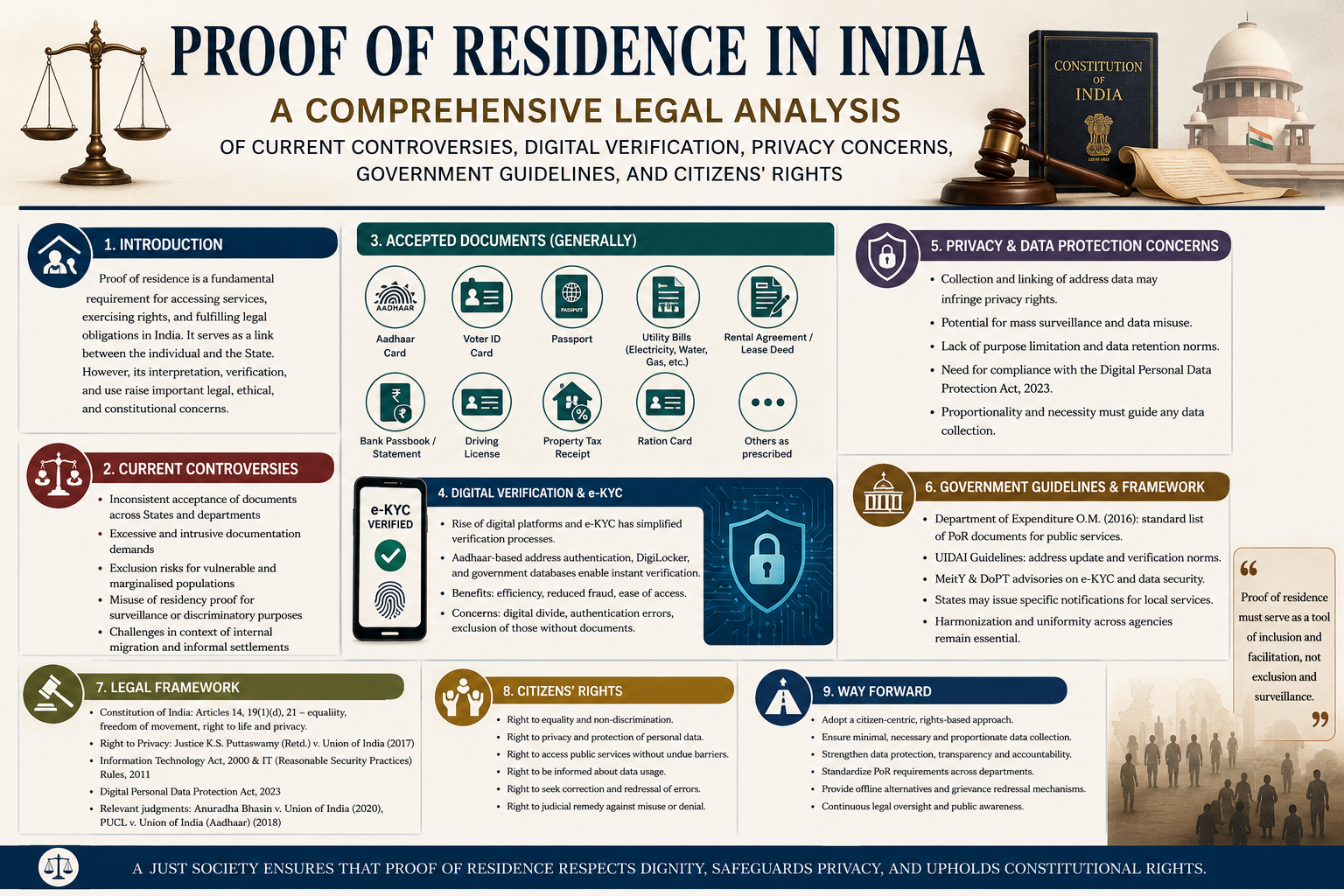
🌍 Introduction: Why Is "Proof of Residence" Suddenly a National Legal Debate?
Imagine visiting a bank to open an account, applying for a passport, purchasing a new SIM card, enrolling in a government welfare scheme, or registering to vote. In each of these situations, one question almost always arises:
“Can you provide proof of your current residence?”
At first glance, this may seem like a routine administrative requirement. However, in recent years—and particularly in 2026—the concept of Proof of Residence has become a subject of significant legal, constitutional, and public policy debate in India.
The increasing use of Digital KYC (Know Your Customer), AI-assisted verification, online government services, and digital identity systems has transformed address verification from a simple paperwork requirement into a complex legal issue involving privacy, surveillance, inclusion, data protection, and access to essential services.
⚖️ A growing question now confronts lawmakers, courts, and citizens alike:
Should proof of residence merely establish where a person currently lives, or has it become an indirect tool for determining access to rights, benefits, and public services?
This debate affects millions of people every day—students living in hostels, migrant workers, tenants, women changing residence after marriage, senior citizens, people living in informal settlements, and even professionals who frequently relocate for work.
📖 What Is Proof of Residence?
Proof of Residence (also called Proof of Address) refers to any officially accepted document that demonstrates where a person is presently residing.
Its primary purpose is administrative verification, not proof of nationality or citizenship.
Unlike Proof of Identity, which establishes who you are, Proof of Residence establishes where you currently live.
This distinction is legally significant because different rights and services depend on different forms of proof.
For example:
- 🏦 Banks require address verification for KYC compliance.
- 📱 Telecom companies verify addresses before issuing SIM cards.
- 🛂 Passport authorities conduct police verification at the applicant's residential address.
- 🗳️ Election authorities determine the constituency based on residence.
- 🏛️ Local government bodies use residential information for welfare schemes, taxation, and civic services.
Thus, proof of residence is more than just an address—it has become a gateway to numerous legal and administrative rights.
⚠️ Why Has Proof of Residence Become Controversial in 2026?
The debate surrounding Proof of Residence has intensified due to several emerging issues.
📱 1. Expansion of Digital Verification
Banks, fintech companies, telecom providers, and government departments increasingly rely on digital verification systems instead of traditional physical checks.
Supporters argue that this improves efficiency and reduces fraud.
Critics worry about errors, exclusion, and over-reliance on technology.
🔐 2. Privacy and Data Protection Concerns
Every time a citizen submits address proof, sensitive personal information may be shared with multiple public and private entities.
This raises important questions:
- Who stores this information?
- How long is it retained?
- Can it be shared with third parties?
- What safeguards exist against misuse or data breaches?
The debate has become even more significant in the era of digital governance and expanding data collection.
🏠 3. Challenges Faced by Tenants and Migrant Workers
Millions of Indians live in rented accommodation or migrate for education and employment.
Many of them struggle to provide acceptable residence documents because:
- rental agreements may not be registered,
- utility bills remain in the landlord's name,
- official records are not updated promptly.
As a result, they may face delays in obtaining banking services, passports, or government benefits.
This has led to calls for more inclusive and flexible proof-of-residence policies.
🎓 4. Students and Young Professionals
Students residing in hostels or paying-guest accommodations often encounter difficulties in proving their current residence.
Similarly, young professionals who relocate frequently for work may have different addresses on Aadhaar, bank accounts, passports, and employment records.
These inconsistencies often create administrative hurdles despite there being no question about their identity or citizenship.
⚖️ 5. Residence vs. Citizenship: A Growing Public Misunderstanding
One of the most important legal debates is the widespread confusion between:
- 🏠 Proof of Residence
- 🆔 Proof of Identity
- 🇮🇳 Proof of Citizenship
- 📜 Domicile
These concepts serve different legal purposes, yet they are often misunderstood by the public.
For instance, a person may legally reside in a State without being domiciled there, and proof of residence does not automatically establish citizenship.
Understanding these distinctions is essential for protecting both administrative efficiency and constitutional rights.
🎯 Purpose of This Article
This article aims to provide a comprehensive legal analysis of Proof of Residence in India by examining:
- ⚖️ The legal meaning and importance of proof of residence.
- 📜 Constitutional principles governing residence-related requirements.
- 🏛️ Relevant statutory provisions and government guidelines.
- 📄 Accepted proof-of-residence documents.
- 📱 Digital verification systems and e-KYC.
- 🔐 Privacy concerns and data protection challenges.
- 📰 Current legal controversies and public debates in 2026.
- 👥 The impact on citizens' rights, especially vulnerable groups.
- 💡 Practical guidance and suggested legal reforms.
Rather than treating Proof of Residence as a mere administrative formality, this article explores how it intersects with constitutional values such as equality, dignity, privacy, due process, and access to public services.
As India continues its transition toward digital governance, the debate is no longer simply about producing an address document—it is about ensuring that technological progress remains consistent with the rule of law and the protection of fundamental rights.
In the following sections, we will examine the constitutional framework, legal provisions, accepted documents, current controversies, and the future of residence verification in India.
⚖️ Does the Indian Constitution Define "Proof of Residence"?
One of the most common misconceptions among citizens is that the Constitution of India defines or prescribes a "Proof of Residence" document.
The answer is No.
The Constitution does not prescribe any specific document such as an Aadhaar Card, Passport, Electricity Bill, or Rent Agreement as an official proof of residence.
Instead, the Constitution recognizes several rights and principles that indirectly make residential verification legally significant.
Therefore, the legal concept of Proof of Residence has evolved through parliamentary laws, government rules, administrative guidelines, and judicial interpretation rather than through a single constitutional provision.
📖 Constitutional Framework Governing Residence
Although the Constitution does not define Proof of Residence, several constitutional provisions influence its legal importance.
🏛️ Article 14 – Equality Before Law
Article 14 guarantees equality before law and equal protection of laws.
This means that every authority verifying a person's residential address must follow a fair, reasonable, and non-arbitrary procedure.
Residence verification cannot become a tool for discrimination against:
- 👨🎓 Students
- 👷 Migrant workers
- 🏠 Tenants
- 👵 Senior citizens
- 👩 Women changing residence after marriage
- 🏕️ Homeless persons
Every citizen and resident deserves equal treatment while complying with address verification requirements.
🏛️ Article 19 – Freedom of Movement and Residence
Article 19(1)(d) guarantees the freedom to move freely throughout India.
Article 19(1)(e) gives every citizen the right to reside and settle in any part of India.
These constitutional freedoms are directly connected with Proof of Residence because:
- citizens frequently change cities for employment,
- students relocate for higher education,
- professionals move for transfers,
- families migrate due to economic opportunities.
If administrative procedures become excessively rigid, these constitutional freedoms may effectively become difficult to exercise.
🏛️ Article 21 – Right to Life and Personal Liberty
Over the years, the Supreme Court has interpreted Article 21 broadly.
It now includes:
- dignity,
- privacy,
- procedural fairness,
- access to essential services.
Today, address verification affects access to:
- 🏦 Banking
- 📱 Mobile connectivity
- 🏥 Healthcare
- 🎓 Education
- 💰 Welfare benefits
- 🛂 Passport services
Consequently, arbitrary denial of services merely because of procedural issues relating to residence documents may raise concerns under Article 21.
🔐 Right to Privacy
The landmark judgment of the Supreme Court in K. S. Puttaswamy (Retd.) v. Union of India (2017) recognized privacy as a fundamental right under Article 21.
This judgment has transformed the debate on Proof of Residence.
Today, citizens frequently submit residential information to:
- Banks
- Telecom companies
- Insurance companies
- Educational institutions
- Digital payment platforms
- Government departments
This raises important legal questions:
- 🔒 Who stores this data?
- 🔒 How long is it retained?
- 🔒 Who can access it?
- 🔒 Can it be shared with third parties?
- 🔒 What safeguards protect citizens from misuse?
Therefore, Proof of Residence is no longer merely an address verification issue—it has become a privacy issue.
📚 Major Laws Governing Proof of Residence
Unlike citizenship, India has no single comprehensive law dedicated exclusively to Proof of Residence.
Instead, different statutes regulate residential verification for different purposes.
📜 1. Aadhaar Act
The Aadhaar Act, 2016 allows residents to obtain an Aadhaar number based on residency requirements.
However:
✔ Aadhaar helps establish identity and address.
❌ It does not by itself determine citizenship.
This distinction has become increasingly important in recent public debates.
📜 2. Passports Act, 1967
The Passports Act requires applicants to furnish their residential address for passport issuance and police verification.
The address is necessary to verify where the applicant resides.
However, the address mentioned in the passport is not conclusive proof of ownership, domicile, or citizenship.
📜 3. Representation of the People Act, 1950
For voter registration, residence plays a crucial role.
A person must ordinarily reside in the constituency where they seek enrollment as an elector.
This law recognizes the importance of residence while ensuring that electoral rolls accurately reflect local populations.
📜 4. Banking Regulations and RBI KYC Directions
Banks are legally required to verify customers under Know Your Customer (KYC) norms.
Proof of Residence is therefore necessary for:
- opening bank accounts,
- obtaining loans,
- financial transactions,
- preventing money laundering.
Banks may accept multiple officially valid documents depending on regulatory guidelines.
📜 5. Prevention of Money Laundering Framework
Address verification is also an important component of India's anti-money laundering regime.
Financial institutions must establish both:
- identity,
- current residential address.
This reduces financial fraud and strengthens regulatory compliance.
🏢 Government Guidelines
Different government agencies prescribe different documents depending on the purpose.
For example:
🏦 Banks may accept one set of documents.
📱 Telecom companies may require another.
🛂 Passport authorities follow separate verification procedures.
🏛️ State governments may prescribe additional requirements for welfare schemes.
Thus, there is no universal Proof of Residence document accepted for every legal purpose.
Instead, the required document depends upon the authority concerned and the applicable legal framework.
⚠️ Why Does This Create Confusion?
Many citizens assume:
“If one department accepted my Aadhaar, every other department must also accept it.”
Legally, this assumption is incorrect.
Different authorities have different statutory obligations.
For example:
- A bank may require updated KYC.
- Passport authorities conduct police verification.
- Election authorities verify ordinary residence.
- Universities may ask for hostel or rental certificates.
- State welfare departments may require domicile-related documentation.
Thus, one document may be sufficient in one situation but insufficient in another.
⚖️ Why Proof of Residence Matters in Everyday Life
Today, Proof of Residence is required for:
🏦 Opening bank accounts
📱 Purchasing SIM cards
🛂 Applying for passports
🚗 Obtaining driving licences
🗳️ Voter registration
🏥 Health insurance
🎓 College admissions
🏠 Rental verification
💰 Government welfare schemes
📜 Property registration
🏢 GST and business registrations
Because residential verification has become a gateway to so many essential services, it directly affects citizens' ability to participate fully in economic and social life.
💭 The Core Debate
The central legal debate in 2026 is not whether residence should be verified, but how verification should be carried out.
Supporters of stricter verification argue that it:
- ✅ prevents fraud,
- ✅ improves national security,
- ✅ strengthens financial compliance,
- ✅ reduces fake identities.
Critics argue that excessive documentation can:
- ❌ exclude genuine residents,
- ❌ burden migrants and tenants,
- ❌ increase bureaucratic hurdles,
- ❌ threaten privacy through excessive data collection.
Finding the right balance between efficient governance and protection of constitutional rights remains one of the biggest legal challenges in India's evolving digital governance framework.
After understanding the constitutional and legal framework, the next important question is:
"Which documents are legally accepted as Proof of Residence in India?"
Surprisingly, there is no single document that is universally accepted as proof of residence for every legal purpose.
Different authorities prescribe different requirements depending upon the applicable law, the nature of the transaction, and the level of verification required.
For example:
- 🏦 A bank may accept one document under KYC norms.
- 🛂 Passport authorities may require police verification in addition to address proof.
- 🗳️ Election authorities verify "ordinary residence" rather than ownership of a house.
- 🏛️ State governments may prescribe separate documents for welfare schemes.
This often leads to confusion among citizens.
📑 Commonly Accepted Proof of Residence Documents
Although the exact requirements vary, the following documents are widely accepted across government departments and regulated institutions.
1️⃣ Aadhaar Card 🪪
The Aadhaar Card is one of the most commonly used address documents in India.
✅ Accepted for
- Banking KYC
- Government schemes
- PAN linkage
- LPG connections
- Many educational institutions
- Insurance services
⚖️ Legal Position
Aadhaar establishes identity and contains an address.
However:
- It is not proof of citizenship.
- It is only as accurate as the address last updated by the holder.
- If the address is outdated, authorities may request additional documents.
Current Debate 🔥
Many people relocate for employment but never update their Aadhaar address.
This creates practical problems during verification.
Should an outdated Aadhaar still be accepted?
This remains an important administrative challenge.
2️⃣ Passport 🛂
A passport contains the holder's residential address.
It is generally accepted by many institutions.
Accepted for
- Banking
- Visa applications
- International identification
- KYC compliance
Current Debate
Recent discussions have highlighted an important distinction.
A passport may contain a residential address.
However:
- it does not prove ownership,
- it does not establish domicile,
- it is not conclusive proof of citizenship.
Its primary purpose remains international travel.
3️⃣ Voter ID 🗳️
The Electoral Photo Identity Card reflects the voter's constituency.
Since voter registration depends on ordinary residence, it often serves as a useful residence document.
However, if a person changes residence without updating electoral records, discrepancies may arise.
4️⃣ Driving Licence 🚗
Driving licences issued by transport authorities generally contain residential addresses.
Many financial institutions accept them for KYC purposes.
The challenge again arises when the licence contains an outdated address.
5️⃣ Electricity Bill 💡
Utility bills remain among the strongest supporting documents for address verification.
Common examples include:
- Electricity bills
- Water bills
- Piped gas bills
Debate
Utility bills are often unavailable to:
- tenants,
- hostel residents,
- paying guests.
As a result, genuine residents may face difficulties despite actually living at the address.
6️⃣ Registered Rent Agreement 🏠
A registered rent agreement is increasingly accepted by banks and government agencies.
It is especially useful for:
- migrant workers,
- students,
- professionals living on rent.
Current Issue
Many rental arrangements remain informal.
Unregistered agreements often create legal uncertainty.
Several experts argue that India requires a more standardized rental documentation system.
7️⃣ Bank Passbook 📘
Some authorities continue to accept bank passbooks displaying the current residential address.
However, digital banking has reduced reliance on physical passbooks.
8️⃣ Employer Certificate 🏢
Certain government departments and employers issue residential certificates to employees living in official accommodation.
These may be accepted depending on the purpose.
9️⃣ Registered Sale Deed or Property Documents 🏡
Where a person owns residential property, ownership documents may support address verification.
However:
Owning property and residing there are two different concepts.
Therefore, authorities may still require evidence of actual residence.
🔟 Government-Issued Residence Certificate 📜
Several State Governments issue residence certificates for specific administrative purposes.
These certificates often help in:
- educational admissions,
- state welfare schemes,
- local recruitment,
- reservation benefits (where applicable).
However, their acceptance outside the issuing State may vary.
📊 Can One Document Be Used Everywhere?
No.
This is one of the biggest misconceptions among citizens.
Different authorities operate under different legal frameworks.
Purpose| Possible Accepted Documents
🏦 Bank Account| Aadhaar, Passport, Driving Licence, Utility Bill
📱 SIM Card| Aadhaar, Passport, Official KYC Documents
🛂 Passport| Address proof + Police Verification
🗳️ Voter Registration| Ordinary Residence Verification
🚗 Driving Licence| Address proof prescribed by transport authorities
🏥 Government Schemes| Depends on scheme-specific rules
The document required always depends upon the governing law and administrative guidelines.
⚠️ Common Mistakes Citizens Make
Many people unknowingly create legal complications.
Some common mistakes include:
❌ Not updating Aadhaar after shifting residence.
❌ Using expired utility bills.
❌ Submitting fake rental agreements.
❌ Providing inconsistent addresses across different documents.
❌ Assuming that one document is legally valid for every purpose.
These mistakes can delay applications and may even lead to legal consequences if false information is intentionally provided.
🔍 The Growing Challenge of Frequent Relocation
India's urban workforce is increasingly mobile.
Every year, millions of:
- 👨🎓 Students,
- 👨💼 IT professionals,
- 👩⚕️ Healthcare workers,
- 👷 Construction labourers,
- 🚚 Transport workers,
change cities for education or employment.
Updating every official document after each move is often time-consuming and expensive.
As a result, people frequently possess:
- Aadhaar with one address,
- Passport with another,
- Bank records with a third,
- Employer records with a fourth.
This mismatch is becoming one of the biggest administrative challenges in India's digital governance system.
⚖️ Debate: Should India Introduce a Single National Residence Verification System?
Many legal experts now support the idea of a unified digital residence verification framework.
✅ Arguments in Favour
- Simplifies documentation.
- Reduces repetitive verification.
- Improves administrative efficiency.
- Prevents identity fraud.
- Makes government services faster.
❌ Arguments Against
- Creates risks of mass surveillance.
- Concentrates excessive personal data in one system.
- Increases cybersecurity concerns.
- May expose citizens to identity theft if databases are compromised.
- Raises serious privacy questions after the recognition of privacy as a fundamental right.
The challenge for policymakers is to strike a balance between efficient governance and constitutional safeguards, ensuring that digital innovation does not come at the cost of individual freedoms.
India is rapidly moving towards Digital Governance. Today, a person's residential address is no longer verified only through physical documents or door-to-door inspections. Instead, banks, financial institutions, telecom companies, fintech platforms, insurance providers, and government departments increasingly rely on Digital Verification Systems.
While this transformation has made public services faster and more accessible, it has also triggered an important legal debate:
“Can technology verify a person's residence without compromising privacy and constitutional rights?”
This question lies at the heart of India's ongoing debate on Proof of Residence.
🌐 The Shift from Paper Documents to Digital Verification
Until a decade ago, address verification mainly depended upon:
📄 Electricity Bills
📄 Water Bills
📄 Rent Agreements
📄 Property Documents
📄 Physical Police Verification
Today, technology has changed this landscape.
Verification now frequently takes place through:
- 📱 e-KYC
- 🏦 CKYC
- ☁️ DigiLocker
- 📍 GPS-enabled verification
- 🤖 AI-assisted document verification
- 📸 Facial recognition (for certain services)
- 💻 Online customer onboarding
The objective is simple:
✔ Faster verification
✔ Reduced paperwork
✔ Better fraud detection
✔ Increased financial inclusion
However, this technological shift has also introduced new legal and constitutional challenges.
🏦 What Is e-KYC?
Electronic Know Your Customer (e-KYC) is a digital process through which regulated institutions verify the identity and address of customers electronically.
Instead of submitting multiple physical documents, eligible individuals can complete verification digitally, subject to applicable legal and regulatory requirements.
Benefits of e-KYC
✅ Faster account opening
✅ Less paperwork
✅ Lower administrative costs
✅ Improved customer convenience
✅ Reduced chances of forged documents
For millions of citizens, e-KYC has significantly simplified access to banking and financial services.
📂 Central KYC (CKYC)
To reduce repetitive documentation, India introduced the Central KYC Registry (CKYC).
The idea is simple.
Instead of completing KYC separately for every bank or financial institution, a citizen's verified KYC information can be maintained centrally, subject to applicable regulations.
Advantages
📌 Avoids repeated document submission.
📌 Improves efficiency.
📌 Reduces duplication.
📌 Simplifies financial transactions.
Yet many institutions still require fresh address proof because customers often change residences.
☁️ DigiLocker – Digital Documents for Digital India
Another important development is DigiLocker.
It enables citizens to securely store and access government-issued digital documents.
Instead of carrying physical copies, users may share verified digital documents with authorised agencies.
Advantages
📲 Paperless governance
🔐 Secure document storage
⚡ Instant access
🌱 Environment-friendly administration
However, digital storage also raises concerns regarding:
- cyber security,
- unauthorized access,
- identity theft,
- misuse of personal information.
🤖 AI-Based Address Verification
Artificial Intelligence is increasingly being used for document verification.
AI systems may assist in:
📸 Checking document authenticity
📄 Detecting forged documents
📍 Identifying inconsistencies in addresses
⚠️ Flagging suspicious transactions
These technologies improve efficiency but they also raise significant legal questions.
Should AI Decide?
Most legal experts agree that:
AI may assist officials,
but
AI should not replace human decision-making, especially where legal rights are involved.
Human oversight remains essential to ensure fairness and accountability.
🔐 Privacy Concerns – The Biggest Legal Debate
Every time a citizen shares proof of residence, personal information is disclosed.
This may include:
🏠 Home address
📞 Contact details
🏦 Financial information
📄 Identity records
📍 Location history (in certain digital services)
When multiple organisations collect and store such data, concerns naturally arise.
Important questions include:
- Who controls this information?
- How long is it retained?
- Can it be shared with third parties?
- What happens if the database is hacked?
- Can citizens demand deletion or correction of their information?
These concerns have become central to the debate on digital governance.
⚖️ Privacy as a Fundamental Right
The Supreme Court's landmark decision in K. S. Puttaswamy (Retd.) v. Union of India (2017) recognised privacy as a fundamental right under Article 21 of the Constitution.
The judgment established that any collection or use of personal data by the State must satisfy principles such as:
- 📌 legality,
- 📌 legitimate purpose,
- 📌 necessity,
- 📌 proportionality,
- 📌 procedural safeguards.
These principles are equally relevant when authorities seek proof of residence in digital form.
🛡️ The Digital Personal Data Protection Framework
India's data protection framework seeks to balance technological innovation with individual privacy.
Key objectives include:
- protecting personal data,
- ensuring lawful processing,
- enhancing transparency,
- promoting accountability,
- providing mechanisms for grievance redressal.
For citizens, this means organisations collecting address information are expected to handle it responsibly and in accordance with applicable legal requirements.
⚠️ Current Legal Issues in 2026
Several practical issues continue to dominate public discussion.
🏠 Address Mismatch
Many citizens have:
- Aadhaar with one address,
- Passport with another,
- Bank account with a third,
- Employment records with a fourth.
Should every mismatch automatically result in rejection?
Most experts argue that minor inconsistencies should not deprive genuine residents of essential services.
👨🎓 Students and Paying Guests
Students often live in hostels or rented accommodation without utility bills in their names.
Obtaining proof of residence becomes difficult despite genuine residence.
👷 Migrant Workers
Millions of workers migrate seasonally.
Frequent relocation makes continuous updating of official records practically difficult.
This often creates barriers in accessing banking, welfare schemes, and other services.
🏠 Tenants
Many landlords hesitate to execute registered rent agreements.
Consequently, tenants may struggle to produce acceptable address proof even though they lawfully reside at the premises.
🚨 Fake Residence Documents
Advances in technology have also enabled sophisticated document forgery.
Authorities therefore face the challenge of strengthening verification without imposing unnecessary burdens on genuine citizens.
💭 The Central Debate
The future of Proof of Residence is no longer about whether verification should occur.
The real debate is:
How can India create a residence verification system that is efficient, secure, inclusive, and respectful of constitutional rights?
An ideal framework should:
✅ reduce fraud,
✅ simplify compliance,
✅ protect privacy,
✅ accommodate mobile populations,
✅ avoid discrimination,
✅ ensure due process,
and
✅ preserve public trust in digital governance.
The answers to these questions will shape not only residence verification but also the future relationship between citizens and the digital State.
🏛️ Current Legal Controversies
Until a few years ago, Proof of Residence was largely viewed as a routine administrative requirement. Today, however, it has evolved into a subject involving constitutional rights, digital governance, financial regulation, privacy, inclusion, and administrative fairness.
In 2026, the debate is no longer limited to “Which document should be accepted?”
Instead, the larger constitutional question is:
"Can the State require extensive residential verification while still respecting citizens' fundamental rights?"
This debate has become increasingly relevant as India embraces digital governance and AI-assisted public services.
📰 Controversy 1: Aadhaar Address vs. Actual Residence 🪪🏠
One of the most common practical issues in India is the mismatch between a person's Aadhaar address and their current place of residence.
For example:
- 👨🎓 A student from Bihar studies in Delhi.
- 👩💼 An IT professional from Lucknow works in Bengaluru.
- 👷 A migrant labourer shifts between different cities every few months.
Their Aadhaar may continue to show the permanent address, while they legally reside elsewhere.
⚖️ The Debate
Government's View
✔ Address records should remain updated.
✔ Accurate records improve service delivery.
✔ Updated addresses reduce fraud and administrative errors.
Critics' View
❌ Frequent address updates are difficult for millions of mobile citizens.
❌ Genuine applicants should not be denied essential services merely because their official documents have not yet been updated.
The challenge lies in balancing administrative efficiency with practical realities.
📰 Controversy 2: Digital KYC and Repeated Address Verification 📱🏦
Many citizens wonder:
“Why do I need to submit my address proof repeatedly when another government department has already verified it?”
This question has become one of the most debated issues in banking and financial regulation.
Arguments Supporting Multiple Verifications
✅ Different institutions have different legal obligations.
✅ Updated information helps prevent fraud.
✅ Financial crimes often involve fake addresses.
Arguments Against
❌ Repeated documentation increases inconvenience.
❌ Citizens spend considerable time uploading the same documents.
❌ Multiple databases increase the risk of personal data exposure.
Experts therefore advocate greater interoperability between government databases while preserving privacy safeguards.
📰 Controversy 3: Privacy vs. Surveillance 🔐
Digital verification has significantly increased the collection of personal information.
Every address submitted may reveal:
🏠 Residence
📍 Location
📞 Contact details
📄 Identity information
This has generated an important constitutional debate.
One View
The State requires reliable address information to:
- prevent fraud,
- ensure national security,
- deliver welfare schemes,
- regulate financial transactions.
Opposing View
Privacy advocates argue that:
- unnecessary collection of address data should be avoided,
- citizens should know how their data is used,
- authorities must collect only the information genuinely required for a lawful purpose.
The debate is therefore not about whether verification should occur, but how much personal information should be collected and retained.
📰 Controversy 4: Difficulties Faced by Tenants and Migrant Workers 🏘️
Millions of Indians live away from their permanent homes.
These include:
- 👷 Construction workers
- 👨🎓 Students
- 👨💼 Corporate employees
- 👩⚕️ Healthcare professionals
- 🚚 Transport workers
Many face recurring difficulties because:
- utility bills remain in the landlord's name,
- rental agreements are unregistered,
- frequent relocation delays address updates.
As a result, access to banking, passports, insurance, and government services may become more complicated.
Several legal scholars argue that residence verification systems should be more flexible to reflect India's increasingly mobile population.
📰 Controversy 5: Fake Residence Certificates 🚨
While genuine citizens often struggle with documentation, authorities also face the challenge of forged residence proofs.
False address documents have been used in cases involving:
- financial fraud,
- identity theft,
- illegal property transactions,
- fake educational admissions.
Therefore, stronger verification mechanisms remain necessary.
The legal challenge is ensuring that anti-fraud measures do not become disproportionately burdensome for honest citizens.
🏛️ Judicial Perspective
Indian courts have consistently emphasised that administrative convenience cannot override constitutional guarantees.
Several judicial principles are particularly relevant:
⚖️ Rule of Law
Every verification process must have a legal basis.
Authorities cannot impose arbitrary documentation requirements.
⚖️ Natural Justice
Where adverse decisions affect an individual, fairness requires:
- notice,
- opportunity to respond,
- reasoned decision-making.
⚖️ Proportionality
Verification requirements should be proportionate to the objective.
For example, requiring excessive documentation for low-risk transactions may be considered unreasonable.
⚖️ Protection of Privacy
Following the Supreme Court's decision any collection of personal data should satisfy tests of legality, necessity, and proportionality.
These principles continue to shape India's digital governance framework.
👥 Citizens' Rights During Residence Verification
Every individual is entitled to fair treatment during verification procedures.
Citizens have the right to:
✅ Be informed about the documents required.
✅ Receive equal treatment without discrimination.
✅ Seek correction of inaccurate records.
✅ Expect authorities to protect personal information.
✅ Challenge arbitrary administrative decisions through appropriate legal remedies.
At the same time, citizens also have responsibilities.
They should:
- keep official records updated where reasonably possible,
- provide truthful information,
- avoid submitting forged or misleading documents.
💭 The Central Constitutional Question
The debate surrounding Proof of Residence ultimately raises a broader constitutional issue:
Should technological efficiency be prioritised over individual rights, or can India build a system that protects both?
Supporters of stronger verification argue that:
- it strengthens governance,
- reduces fraud,
- improves public service delivery.
Critics emphasise that:
- digital systems must remain inclusive,
- privacy must be respected,
- genuine residents should not be excluded because of procedural or technological barriers.
The future of residence verification therefore lies not in choosing one side over the other, but in designing a framework that combines security, efficiency, fairness, transparency, and constitutional accountability.
As India continues to digitise governance, Proof of Residence will remain more than an administrative requirement—it will be a continuing test of how effectively the legal system balances public interest with individual rights.
⚖️ Landmark Judicial Principles Relevant to Proof of Residence
Although the Supreme Court has not delivered a single landmark judgment exclusively on "Proof of Residence," several constitutional decisions have laid down principles that directly influence address verification, digital governance, and citizens' rights.
🏛️ 1. Right to Privacy and Residential Information 🔐
The Supreme Court in K. S. Puttaswamy (Retd.) v. Union of India (2017) recognised the Right to Privacy as a fundamental right under Article 21.
Its relevance to Proof of Residence
Every time a citizen submits:
- 🏠 Home address
- 📄 Utility bills
- 🪪 Aadhaar
- 📱 Digital KYC records
personal information is collected.
The Court held that any collection of such information must satisfy:
- ✅ Legality
- ✅ Legitimate State Purpose
- ✅ Necessity
- ✅ Proportionality
- ✅ Procedural Safeguards
This judgment remains the constitutional foundation for digital address verification in India.
🏛️ 2. Equality Before Law
Article 14 requires every verification process to remain:
- Fair
- Reasonable
- Non-arbitrary
Authorities cannot discriminate merely because someone:
- lives in rented accommodation,
- frequently changes residence,
- lives in a hostel,
- is a migrant worker.
Equal treatment remains a constitutional requirement.
🏛️ 3. Procedural Fairness
Indian administrative law consistently requires authorities to:
- provide clear procedures,
- avoid arbitrary rejection,
- give reasonable opportunity to rectify deficiencies,
- act transparently.
These principles are particularly important when residence documents are questioned.
🇮🇳 What Can India Learn?
Legal experts suggest several reforms.
📌 1. Uniform National Guidelines
Different authorities often demand different documents.
A harmonised framework could improve consistency while preserving flexibility where necessary.
📌 2. Easier Address Updates
Citizens who move frequently should have access to faster, simpler mechanisms for updating residential information across government databases.
📌 3. Privacy by Design
Digital verification systems should minimise unnecessary collection and retention of address data.
📌 4. Better Public Awareness
Many people still confuse:
- Proof of Residence
- Proof of Address
- Domicile
- Citizenship
Government awareness campaigns can reduce confusion and improve compliance.
📌 5. Stronger Cybersecurity
As more address information is stored digitally, robust cybersecurity measures become essential to prevent identity theft and data breaches.
❓ Frequently Asked Questions (FAQs)
Q1. Is Proof of Residence the same as Proof of Citizenship?
No. Proof of Residence establishes where a person lives, while Proof of Citizenship establishes legal membership of the Republic of India.
Q2. Is Aadhaar sufficient as Proof of Residence?
It is widely accepted for many purposes, but some authorities may require additional documents depending on the applicable law and the nature of the transaction.
Q3. Can a tenant provide Proof of Residence?
Yes. Depending on the authority, documents such as a registered rent agreement or other acceptable records may be used.
Q4. Why do different authorities ask for different address documents?
Because they operate under different statutory and regulatory frameworks with different verification requirements.
Q5. Does an outdated address automatically invalidate my documents?
Not necessarily. However, an outdated address may create practical difficulties, and updating official records is generally advisable.
Q6. Is digital address verification legally valid?
Yes, provided it complies with applicable laws, regulatory requirements, and constitutional safeguards relating to privacy and fairness.
💡 Key Takeaways
✔ Proof of Residence is not the same as Proof of Citizenship.
✔ There is no single universally accepted residence document for every legal purpose.
✔ Digital verification has improved efficiency but has also raised significant privacy concerns.
✔ The Constitution protects equality, fairness, and privacy during administrative verification.
✔ India's future legal framework should balance technological innovation with constitutional rights.
📝 Conclusion
Proof of Residence is a vital document for accessing banking, government services, education, and other essential facilities. As digital verification expands, India must ensure that residence verification remains secure, transparent, privacy-conscious, and citizen-friendly. A balanced legal framework can protect both administrative efficiency and constitutional rights, ensuring that genuine residents are not unfairly excluded. ⚖️🏠
⚠️ Disclaimer
Disclaimer: This article is intended solely for informational and educational purposes.

Leave a Comment
Your email address and mobile number will not be published. Required fields are marked *